

Most professionals don't stall because they lack ambition. They stall because ambition without structure is just wishful thinking. If you've ever felt like your career is moving, but not necessarily toward anything, you already understand the cost of drifting. To build an intentional career growth plan is to stop reacting to whatever opportunity appears next and start making deliberate choices that compound over time. This guide gives you a framework that blends goal setting across time horizons, daily behavioral shifts, and built-in accountability so your plan actually survives contact with real life.
Table of Contents
- Key takeaways
- Building your intentional career growth plan: self-assessment and goal setting
- Converting goals into daily behavioral actions
- Building accountability and support systems
- Maintaining your plan through regular reviews
- My honest take on why most career plans don't work
- Take your career growth further with Percelx
- FAQ
Key takeaways
| Point | Details |
|---|---|
| Start with honest self-assessment | Map your current skills, gaps, and motivations before setting a single goal. |
| Use a three-horizon goal structure | Short, mid, and long-term goals should link together so each horizon builds toward the next. |
| Replace outcome goals with behavioral ones | Daily micro-actions anchored to existing routines produce more consistent progress than big aspirational targets. |
| Build accountability into the system | Peer partners, mentors, and regular check-ins transform intentions into measurable outcomes. |
| Treat your plan as a living document | Quarterly reviews keep your plan relevant as your priorities and the market evolve. |
Building your intentional career growth plan: self-assessment and goal setting
Before you write a single goal, you need an honest picture of where you actually stand. Not where you hope to be or where you think you should be. Where you are right now.
Start by auditing three areas: your skills, your strengths, and your gaps. Skills are the technical and interpersonal capabilities you've built. Strengths are the areas where you perform at your best with the least friction. Gaps are the distance between where you are and where the role or career you want requires you to be. Write all three down. This exercise alone separates professionals who grow intentionally from those who simply accumulate experience.
Structuring goals across three time horizons
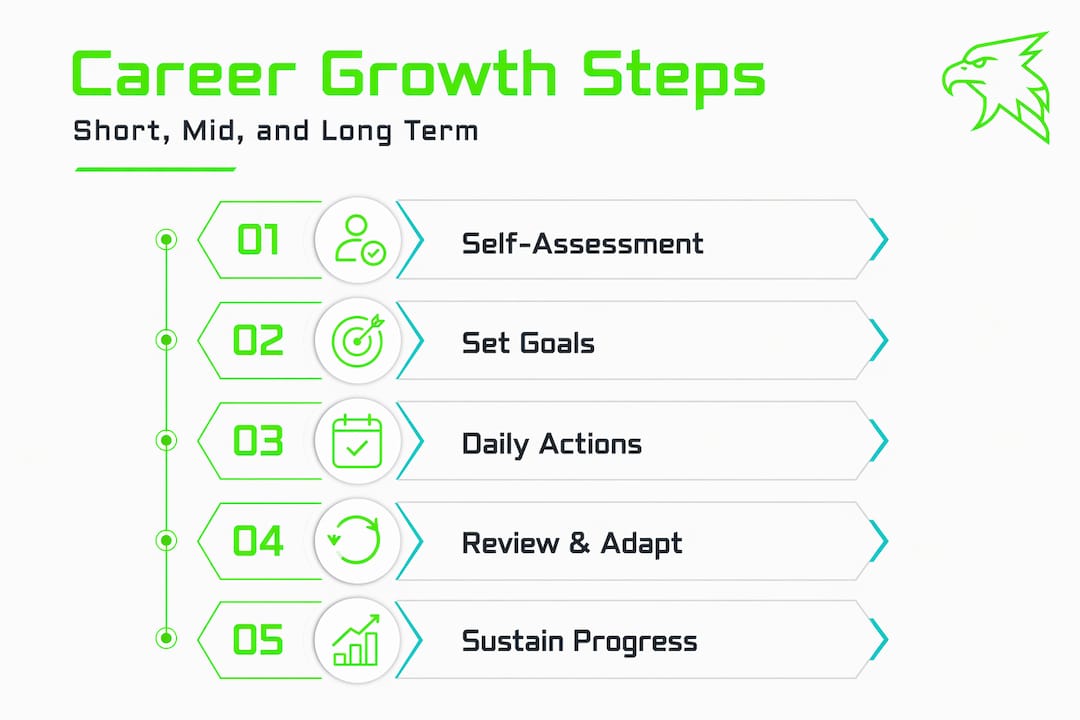
Once you have your baseline, structure your goals using a time-horizon framework. Professional development guidance recommends linking each horizon strategically so your short-term goals are specific and skill-driven while your long-term goals remain directional.
Here's how the three horizons break down:
| Horizon | Timeframe | Purpose | Example goal |
|---|---|---|---|
| Short-term | 0 to 12 months | Build specific skills and take visible action | Complete a data analysis certification |
| Mid-term | 1 to 3 years | Gain experience in target roles or domains | Lead a cross-functional project team |
| Long-term | 3 to 10 years | Define your professional identity and impact | Become a director of product strategy |
The key is that each horizon feeds the next. Your short-term goal of earning a certification directly enables your mid-term goal of leading a project team, which positions you for the long-term director role. When your goals don't connect this way, you end up with a list of aspirations rather than a career development strategy.
Pro Tip: Align at least one goal in each horizon to something you genuinely care about, not just something that looks good on a resume. Purpose-anchored goals are more durable under pressure.
Starting with purpose anchors your goals to an internal reference point that sustains motivation when external rewards slow down. This is especially true for recent graduates who may feel pressure to follow paths that look impressive but don't actually fit their values or working style.
Converting goals into daily behavioral actions
Here's where most career plans collapse. People set clear goals, feel motivated for two weeks, and then slip back into old patterns because nothing in their daily routine actually changed. The fix is shifting from outcome goals to behavioral goals.

An outcome goal sounds like this: "Get promoted to senior manager by next year." A behavioral goal sounds like this: "Every Monday morning after my team standup, I will spend 20 minutes reviewing one leadership case study." The first tells you what you want. The second tells you exactly what you will do and when.
Implementation intentions structured as specific if-then plans double or triple goal follow-through compared to vague aspirations. The "if-then" format works because it removes the decision-making friction in the moment. You're not deciding whether to do the behavior. You've already decided. The trigger (Monday standup ending) automatically cues the action (case study review).
The three-priority rule for 90-day cycles
Here's a discipline that separates people who grow from people who spin. Limiting your focus to three development areas per 90-day cycle keeps your plan executable and trackable. When you try to work on six things simultaneously, you make shallow progress on all of them and deep progress on none.
Follow this sequence to build your 90-day behavioral plan:
- Choose your three priorities. Pick the development areas that will have the biggest impact on your next career horizon. Not the most comfortable ones. The most necessary ones.
- Design one behavioral goal per priority. Each behavioral goal should follow the if-then format and attach to an existing daily or weekly routine so it requires minimal willpower to start.
- Define a micro-action for each goal. A micro-action is the smallest possible version of the behavior. If your goal is to build your professional network, the micro-action might be sending one personalized LinkedIn message per week to someone in your target industry.
- Set a weekly tracking checkpoint. Every Friday, spend five minutes reviewing whether you completed each behavior. No judgment. Just data.
- Adjust at the 30-day mark. If a behavior isn't sticking, change the trigger or reduce the action size. Don't abandon the goal. Redesign the behavior.
Harvard Business School research identifies daily progress on meaningful work as the single most important factor in sustaining motivation over time. Micro-actions make that daily progress possible even on your busiest days.
Pro Tip: If you're struggling to start a new behavior, attach it to something you already do automatically, like your morning coffee, your commute, or the first five minutes after lunch. Existing routines are the most reliable triggers.
Building accountability and support systems
Accountability is not about pressure. It's about creating conditions where follow-through becomes the path of least resistance. Without it, even the best-designed plan fades under the weight of competing priorities.
Here are the four layers of accountability that actually work:
- Self-tracking. Keep a simple weekly log of your behavioral goals. A spreadsheet, a notebook, or a habit-tracking app all work. The act of recording progress makes it visible, and visibility creates commitment. Progress tracking through consistent, small shifts aligned to your strengths is what separates intentional growth from accidental improvement.
- Peer accountability partners. Find one person at a similar career stage who is also working toward a growth goal. Meet every two weeks for 30 minutes. Share what you committed to, what you completed, and what got in the way. This format works because it's reciprocal. You're not just being held accountable. You're holding someone else accountable too.
- Mentors and managers. Real-time feedback and structured mentoring make career development feel authentic rather than performative. Share your growth goals with a manager or mentor and ask for specific feedback on your progress every quarter. Most managers appreciate the initiative. It makes their job easier.
- Professional communities. Volunteering and professional groups expose you to opportunities, perspectives, and connections that your immediate workplace cannot provide. Join one professional association or online community relevant to your target field and engage consistently.
The goal is not to have all four layers operating perfectly from day one. Start with self-tracking. Add a peer partner within the first month. Bring in a mentor or manager conversation within the first quarter. Layer accountability gradually so it becomes part of your professional identity rather than an added obligation.
Maintaining your plan through regular reviews
A career growth plan that you write once and never revisit is not a plan. It's a wish list with a date on it. The difference between a plan that drives real progress and one that collects dust is a scheduled review process.
Quarterly reviews are the minimum. Career growth planning strategy recommends 30-minute self-check-ins every 90 days built around three focused questions.
Use this review sequence to keep your plan alive:
- Assess what's working. Which behavioral goals did you complete consistently? What progress did you make toward your short-term horizon? Celebrate specifics, not just effort.
- Identify what to stop or change. Which behaviors didn't stick? Were the triggers wrong, the actions too large, or the priority not genuinely important to you? Honest answers here prevent you from repeating the same ineffective patterns next quarter.
- Check goal relevance. Have your circumstances, interests, or the market shifted enough to warrant adjusting a mid or long-term goal? Flexibility is not failure. It's maturity.
- Set your next 90-day priorities. Based on your review, choose your next three development areas and design the behavioral goals that will drive them.
"Intentional doesn't mean complicated. It means directed effort and small consistent shifts aligned to your strengths and interests."
Avoiding rigid plans is as important as making them. Professionals who treat their personal growth roadmap as fixed often find themselves grinding toward goals that no longer fit their life. Clear expectations and regular revisiting of your development goals create real career empowerment. The plan should serve you, not the other way around.
My honest take on why most career plans don't work
I've seen a pattern repeat itself constantly. Someone creates a detailed, color-coded career plan in January. By March, it's buried under a folder they never open. The problem isn't discipline. The problem is that the plan was built around outcomes with no behavioral architecture underneath it.
What I've learned is that the plans that actually produce transformation are almost always the boring-looking ones. A single behavioral goal, attached to a Tuesday morning routine, tracked in a plain notebook. That beats a 10-page vision document every time. The identity shift happens through repetition, not through planning sophistication.
I've also found that the people who grow fastest are not the ones with the most ambitious goals. They're the ones who get feedback early and often, adjust without ego, and treat their plan as a conversation rather than a contract. Mentorship matters enormously here. Not because mentors have all the answers, but because an outside perspective reveals blind spots you cannot see from inside your own experience.
If your plan feels overwhelming right now, that's a signal to shrink it, not abandon it. Start with one behavioral goal this week. Build from there. Growth compounds. Give it time.
— Percell
Take your career growth further with Percelx
If you're ready to move beyond guesswork and build a career development strategy grounded in real behavioral data, Percelx was designed for exactly this.

Percelx uses a 360° behavioral assessment approach to reveal the hidden patterns shaping your decisions, leadership, and performance. Instead of generic advice, you get a personalized transformation plan built around your specific gaps and strengths, delivered instantly. Whether you're mapping your own growth or supporting a team's development, Percelx gives you the structure and insight to turn intentions into measurable results. For organizations building mentorship programs and structured career tracks, the enterprise team platform extends these capabilities across your entire workforce. Rated 4.9 stars by professionals who've made the shift from reactive to intentional.
FAQ
What does it mean to build an intentional career growth plan?
Building an intentional career growth plan means defining clear goals across short, mid, and long-term horizons and backing them with specific daily behaviors rather than vague aspirations. It's a structured, living document you review and adjust regularly.
How often should I review my career growth plan?
Quarterly reviews are the recommended minimum. A 30-minute check-in every 90 days helps you assess what's working, adjust what isn't, and set your next cycle of priorities before momentum fades.
How many development goals should I focus on at once?
Focus on no more than three development areas per 90-day cycle. Limiting your priorities keeps your plan executable and prevents the shallow progress that comes from spreading effort too thin.
Do I need a mentor to build a career plan?
A mentor is not required to start, but structured mentoring and real-time feedback significantly accelerate growth by surfacing blind spots you can't identify on your own. Even one quarterly conversation with a more experienced professional adds measurable value.
What's the difference between a career goal and a behavioral goal?
A career goal describes an outcome you want, like earning a promotion. A behavioral goal describes the specific action you will take and when, like reviewing one leadership article every Monday after your team meeting. Behavioral goals are what actually change your daily patterns.