

A mental training routine for athletes is a structured, periodized system for developing the psychological skills that determine performance when physical preparation alone isn't enough. Research confirms that psychological interventions produce meaningful positive effects across skills training, mindfulness, and imagery. Yet most athletes still treat the mind as an afterthought.
Your mental training routine should address these core areas:
- Goal setting: SMART goals tied to process, performance, and outcome
- Self-talk: Replacing negative internal cues with deliberate, positive affirmations
- Emotional regulation: Breathing protocols and mindfulness to manage pressure responses
- Visualization: Mental rehearsal that engages all senses and mirrors real competition
- Focus training: Pre-performance routines that anchor concentration before and during competition
- Resilience building: Deliberate exposure to discomfort to develop mental toughness over time
Managing your internal critic sits at the center of all of it. The Mayo Clinic Health System notes that high-performing athletes learn to interpret competitive discomfort as useful feedback rather than a signal of failure. That reframe alone changes how you perform under pressure.
Table of Contents
- What every effective mental conditioning program includes
- How to periodize and integrate mental training with physical conditioning
- How Percelx personalizes mental training for behavioral transformation
- Practical strategies for sustaining your mental training long-term
- Customizing mental training for your sport and experience level
- Percelx gives you a personalized path to peak mental performance
- Key Takeaways
What every effective mental conditioning program includes
Mental conditioning for athletes mirrors physical training in one critical way: it requires structure, not spontaneity. The Ohio Center for Sport Psychology and the NSCA both emphasize that mental skills must be trained with the same intensity and frequency as physical strength work.
The core components of a strong program:
- SMART goal setting: Goals should be specific, measurable, attainable, realistic, and time-bound. Process goals ("execute my breathing protocol before each serve") outperform pure outcome goals ("win the match") for daily training focus.
- Self-talk management: Identify your default negative cues, then build a short list of replacement phrases. Motivational phrases like "this is mine" or "push through" work best during high-intensity intervals.
- Emotional regulation: Diaphragmatic breathing (inhale 4 counts, exhale 6) activates the parasympathetic nervous system and reduces pre-competition anxiety fast.
- Visualization using the PETTLEP model: Effective imagery reproduces the physical environment, sensory cues, and even error correction of real performance. Generic "happy place" visualization doesn't transfer to competition.
- Focus training: Pre-performance routines give you a repeatable sequence to anchor attention. A three-step reset (breath, self-talk phrase, refocus on a controllable goal) keeps you present after mistakes.
These aren't separate practices. The strongest athletes weave them together into a daily rhythm that reinforces each skill.
How to periodize and integrate mental training with physical conditioning
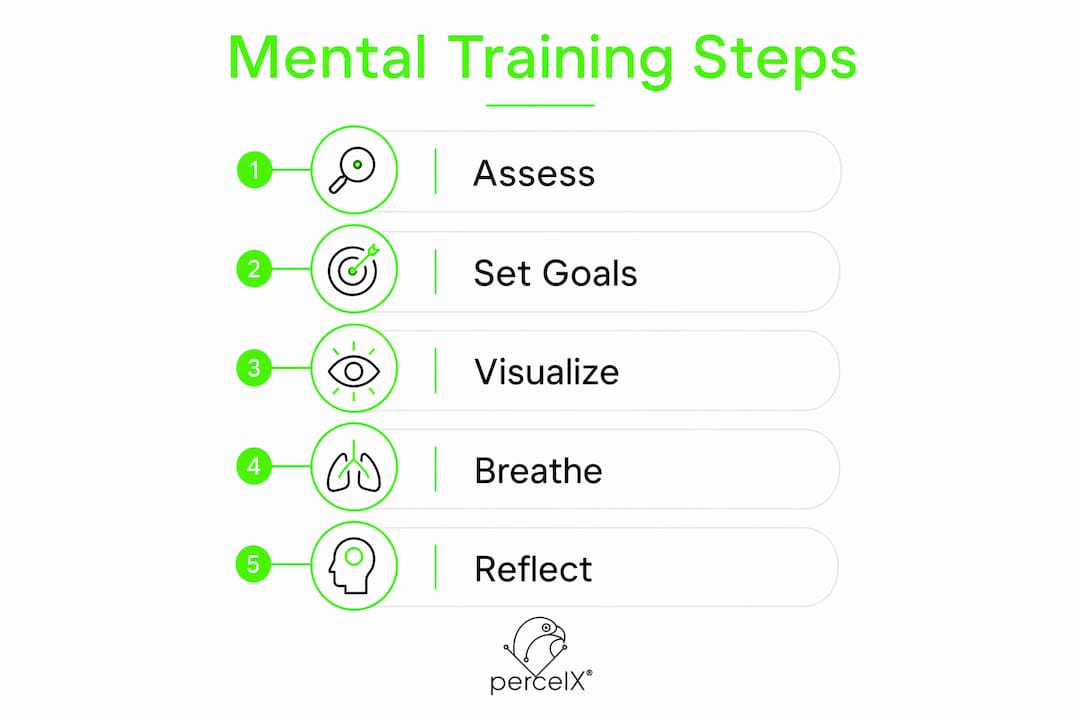
Mental toughness builds like a muscle through deliberate, consistent practice — not willpower or motivation alone. Periodizing your mental work alongside your physical training cycles prevents burnout and accelerates development.
A practical integration framework:
- Warm-ups: 3 minutes of controlled breathing and positive affirmations before physical work begins
- Interval training: Use self-talk cues during the hardest segments, not just before them
- Post-workout stretching: 8 minutes of visualization while your body recovers
- Rest days: Deeper mental skills work, journaling, and goal review
Tracking matters as much as the practice itself. A training journal that captures your mental state, self-talk quality, and imagery vividness alongside physical stats gives you real data on what's working. Without consistent tracking, mental training programs lose their effectiveness.
Pro Tip: Focus on one mental skill for a full three months before adding another. Mastering goal setting before layering in visualization builds far more capacity than dabbling in five skills at once.
For mental toughness in athletics, the periodization principle is the same as physical training: progressive overload. Start with five minutes of daily mental practice, then increase duration and complexity as the habit solidifies.
How Percelx personalizes mental training for behavioral transformation
Generic mental training programs give every athlete the same toolkit. Percelx takes a different approach: its 360° behavioral intelligence platform reveals the hidden behavioral patterns shaping your decisions, reactions, and leadership under pressure, then delivers a customized transformation plan instantly.
| Mental Training Element | Generic Program | Percelx-Customized Plan |
|---|---|---|
| Goal setting | Standard SMART template | Aligned to your behavioral profile and leadership gaps |
| Self-talk | General positive phrases | Cues matched to your specific internal critic patterns |
| Emotional regulation | Universal breathing protocols | Techniques calibrated to your stress response profile |
| Visualization | Basic imagery scripts | Scenarios built around your sport and behavioral tendencies |
| Progress tracking | Self-reported journaling | Assessment-driven feedback with measurable benchmarks |
Percelx carries a 4.9-star customer satisfaction rating, built on the premise that transformation requires personalization. The platform's assessments identify foundational gaps in mental performance and leadership alignment, then provide ongoing support to ensure results compound over time. For athletes and professionals who need more than a generic playbook, that specificity is the difference between incremental gains and real behavioral change.
The mental skills every elite athlete needs are well-documented. What separates performers at the highest level is how those skills are calibrated to their individual behavioral patterns.
Practical strategies for sustaining your mental training long-term
Consistency is where most mental training routines break down. The habit formation principles that work for physical training apply directly here: start small, attach mental exercises to existing routines, and measure progress objectively.
Key strategies for long-term momentum:
- Anchor mental exercises to physical cues: Breathing protocols during warm-up, visualization during stretching. No separate time block required.
- Monitor self-talk quality weekly: Write down three negative thoughts that surfaced during training, then reframe each one. Over time, this becomes automatic.
- Use stress inoculation deliberately: Seek out one small discomfort each week — a harder interval, a colder shower, a high-pressure drill. Each exposure builds tolerance.
- Evaluate after competition: Identify what went well, what needs adjustment, and one specific focus for the next week. Avoid rumination; use structured reflection instead.
Pro Tip: Avoid common mental performance mistakes like skipping mental training on rest days. Those sessions, even just five minutes of breathing and journaling, often produce the most durable gains.
Emotional regulation progress shows up in how quickly you reset after a mistake, not just in how calm you feel before competition. Track your reset speed as a concrete metric.
Customizing mental training for your sport and experience level
A marathon runner's mental training routine looks nothing like a basketball player's. The psychological demands of endurance sports center on sustaining focus and managing discomfort over long durations. Team sports require rapid attention-switching, emotional regulation after mistakes, and leadership under social pressure.

For endurance athletes, visualization should rehearse the middle miles, not just the finish line. That's where the internal critic gets loudest. Breathing protocols and positive cue words ("strong," "smooth," "this is mine") anchor focus when fatigue peaks.
For team sport athletes, pre-performance routines need to account for external variables: crowd noise, officiating calls, teammate errors. A three-step reset routine (breath, phrase, refocus) gives you a portable tool that works regardless of what's happening around you.
Beginner athletes benefit most from starting with goal setting and breathing regulation before adding visualization or advanced self-talk work. The focus improvement techniques that work for elite performers require a foundation of basic mental habits first.
Elite athletes often need to audit existing mental patterns more than learn new ones. Behavioral assessment at this level reveals which automatic responses are limiting performance, and that's where customized programs produce the sharpest gains.
Percelx gives you a personalized path to peak mental performance
Most athletes spend years building physical capacity and weeks, at best, on mental conditioning. Percelx closes that gap with a behavioral intelligence assessment that maps your psychological patterns, identifies the gaps holding you back, and delivers a customized mental training plan built specifically for your sport, your role, and your development stage.

The platform's 360° assessment goes beyond generic questionnaires. It surfaces the behavioral tendencies that drive your decision-making under pressure, your leadership patterns in team environments, and the specific internal critic scripts that surface when performance is on the line. With a 4.9-star satisfaction rating and instant personalized feedback, Percelx is built for athletes and professionals who want measurable results, not generic advice. Start your behavioral assessment at percelx.org and get your customized plan today.
Key Takeaways
A structured, periodized mental training routine built around your behavioral profile produces more durable performance gains than any generic psychological skills program.
| Point | Details |
|---|---|
| Mental training requires periodization | Structure mental skills work in cycles mirroring physical training for progressive, lasting development. |
| One skill at a time builds more capacity | Focusing on a single mental skill for three months outperforms scattering effort across multiple techniques simultaneously. |
| Visualization needs the PETTLEP model | Effective imagery reproduces physical environment and sensory cues, not just positive mental pictures. |
| Customization drives real transformation | Generic programs miss the behavioral patterns unique to each athlete; personalized plans produce measurable results. |
| Percelx delivers instant personalized plans | Percelx's 360° behavioral assessment identifies your specific gaps and builds a customized mental training routine immediately. |