

Most organizations can tell you how many employees completed a training program. Far fewer can tell you whether those employees actually changed how they work. That gap between completion and transformation is where real professional growth lives, and it is also where most measurement efforts fall apart. To genuinely measure professional behavior transformation progress, you need defined behaviors, consistent baselines, and a layered approach to data collection that goes well beyond sign-in sheets. This guide gives you exactly that, in a form you can put to work immediately.
Table of Contents
- Key takeaways
- Measuring professional behavior transformation progress: the foundation
- Selecting the right metrics for behavior change
- Implementing the measurement process
- Common pitfalls that distort your results
- Interpreting data and driving continuous improvement
- My take on measuring behavior change in the real world
- How Percelx accelerates behavior transformation measurement
- FAQ
Key takeaways
| Point | Details |
|---|---|
| Define behaviors precisely | Identify 2–4 specific, observable actions before any transformation effort begins. |
| Establish a baseline first | Capture self-assessments and manager observations at enrollment to enable credible before-and-after comparisons. |
| Use a three-layer KPI model | Track leading, adoption, and impact indicators on separate cadences for a complete picture. |
| Measure at multiple checkpoints | Collect data at 30, 60, 90, and 180 days post-training to confirm lasting change, not just early enthusiasm. |
| Pair numbers with narrative | Combine quantitative scores with manager feedback and sentiment surveys to give leaders context for decisions. |
Measuring professional behavior transformation progress: the foundation
Before you can track change, you need to know exactly what you are tracking. This sounds obvious, yet most programs fail to enforce consistent behavior definitions and matched observations over time, which makes their data unreliable from the start.
The industry standard for evaluating on-the-job behavior change is Kirkpatrick Level 3 evaluation. It requires you to define 2–4 observable behaviors per transformation goal, written as specific, repeatable actions that both a participant and a manager can rate independently. "Demonstrates empathy" is not a measurable behavior. "Asks at least two clarifying questions before responding in a client conversation" is.
Once your behaviors are defined, you need a baseline. Collect it at enrollment, before any training or coaching begins, using three sources:
- Self-assessments: Participants rate their own current frequency of each target behavior on a consistent scale.
- Manager observations: Direct managers complete the same rating against the same behavior definitions.
- Structured checklists: Short, scenario-based prompts that surface actual performance rather than perceived performance.
Keeping behavior definitions fixed across every measurement point is non-negotiable. If you reword a behavior description between baseline and follow-up, you are no longer measuring the same construct. You are creating noise, not data.
Pro Tip: Write each target behavior as an action verb plus a context. "Gives direct feedback to a direct report within 48 hours of a performance event" is the format to aim for. It is observable, time-bound, and rateable by someone who was not in the room.
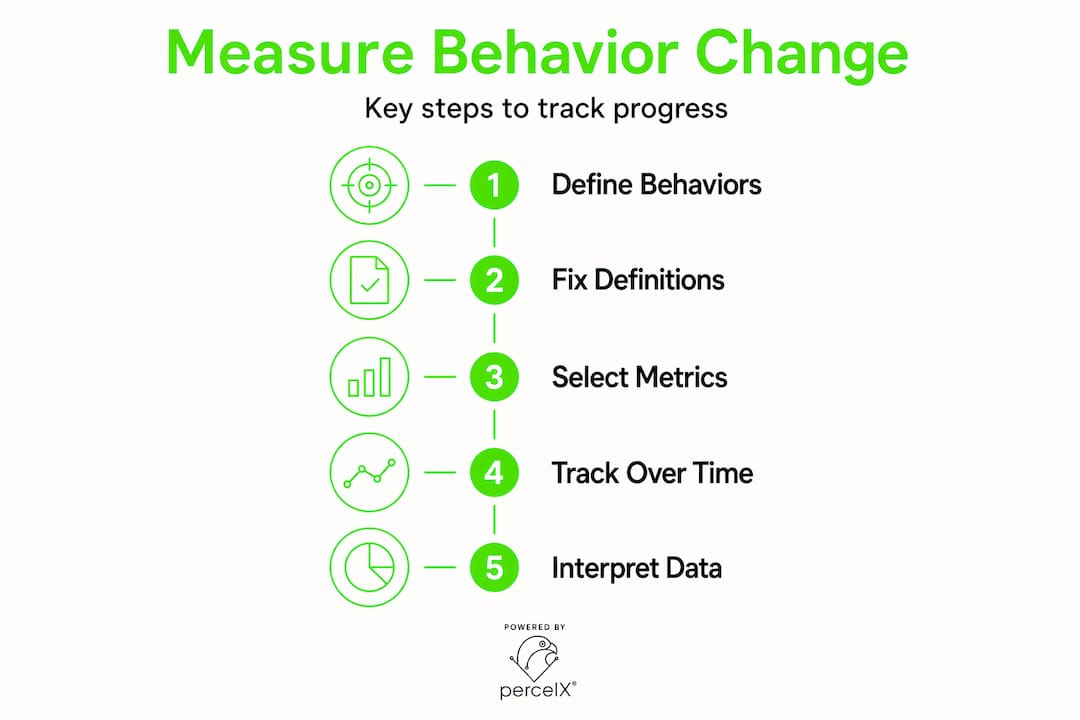
You can also build this behavior-definition work into a broader career growth framework that ties individual transformation goals to longer-term professional development.
Selecting the right metrics for behavior change
Not all metrics tell the same story. A three-layer KPI framework with 2–3 metrics per layer gives you early signals, adoption evidence, and business impact proof in one measurement architecture.
Here is how each layer works in practice:
| Layer | Metric type | Examples | Cadence |
|---|---|---|---|
| Leading indicators | Readiness and exposure signals | Training completion rate, assessment participation, pre-work scores | Weekly |
| Adoption indicators | On-the-job behavior application | Process compliance rate, observed behavior frequency, peer feedback scores | Biweekly or monthly |
| Impact indicators | Business outcomes linked to changed behavior | Productivity gains, quality pass rate, client satisfaction scores | Monthly |
The mistake most teams make is stopping at the leading layer. Training completion alone is a weak signal. A green light on completion can mask a complete lack of application in the actual workplace. Adoption indicators are where behavior transformation becomes visible, and impact indicators are where it becomes defensible to leadership.
When selecting your 2–3 metrics per layer, prioritize actions that have a direct decision impact. If a sales manager is working on more consultative questioning, the adoption metric is not "attended workshop on consultative selling." It is "observed use of needs-discovery questions in three or more client calls per week."
Pro Tip: Do not rely only on numbers. Include 2–3 qualitative data points per dashboard cycle, such as manager feedback summaries or brief participant sentiment surveys, so the numbers have context and your stakeholders can act on them, not just read them.
Behavioral measurement is the critical indicator that transformations are genuinely taking hold in the workplace, not just in training rooms. Without confirmed behavior change, even strong engagement scores do not translate into improved outcomes.
Implementing the measurement process
Knowing what to measure is half the battle. Here is how to build a process that collects reliable data over time without burning out your team or your managers.
-
Assign persistent participant IDs at enrollment. Linking data across instruments using a consistent identifier lets you connect baseline scores, follow-up observations, and business metrics to the same individual. Without this, Level 3 behavior change evidence stays anecdotal.
-
Schedule matched observation windows at 30, 60, and 90 days. Both the participant and the manager complete the same behavior rating form at each checkpoint. This matched self-and-manager approach prevents your data from reflecting two different realities.
-
Add a six-month check. Temporary enthusiasm fades over time. Lasting behavior change is best confirmed around six months post-training, when the novelty has worn off and the habit either holds or slips.
-
Use multiple data instruments. Combine observation rubrics, structured manager check-ins, system logs where available, and brief participant surveys. More accurate measurement comes from pairing self-assessment with external observation and operational metrics.
-
Activate managers as measurement multipliers. Weekly manager coaching combined with clear role expectations accelerates time to proficiency. Tracking the percentage of teams where managers are actively discussing target behaviors gives you a leading indicator for adoption success.
The biggest implementation risk is measuring only at training completion. Behavior lives in application, not in the training room. If your only data point is a post-course survey, you are measuring reaction, not transformation.
Pro Tip: Create a shared observation rubric that both managers and participants use. When both parties rate behavior using identical criteria, you can quickly spot perception gaps, which are often where the most productive coaching conversations begin.

Common pitfalls that distort your results
Even well-intentioned measurement programs produce misleading data. Watch for these specific patterns.
-
Conflating attendance with adoption. Completion rates and attendance data reflect exposure, not application. Separating these metrics from adoption and proficiency measures prevents overestimating progress.
-
Missing the baseline. Without a pre-intervention benchmark, you cannot make a credible before-and-after comparison. Any improvement you report becomes a claim rather than a measurement.
-
Over-relying on self-report. Self-assessments are valuable, but they are subject to social desirability bias. Pairing them with manager observation scores and peer feedback produces far more reliable evidence.
-
Drifting behavior definitions. If the team rewords a behavior description between month one and month three, the two measurements are no longer comparable. Lock your definitions before you start and do not touch them.
-
Measuring too rarely or too often. Monthly check-ins for adoption indicators work well. Daily pulse surveys generate noise. Weekly adoption tracking usually captures enough signal without creating survey fatigue.
"Without consistent behavior definitions and matched observations over time, behavior change programs end up measuring noise, not growth."
This is the pattern Percelx sees repeatedly: organizations that invest in transformation programs but fail to build the measurement infrastructure that would prove the programs are working.
Interpreting data and driving continuous improvement
Data collected without a plan for interpretation is just storage. Here is how to turn your behavior transformation metrics into decisions.
Start by combining quantitative trends with qualitative context. A drop in observed behavior frequency at the 60-day mark means very little on its own. Add manager feedback noting a recent team restructuring, and the pattern becomes explainable and correctable. Including 2–3 qualitative insights alongside numbers in your dashboards transforms reporting into a decision-making tool.
Tie behavior changes directly to business KPIs. Projects that hit adoption thresholds show a 3.33x higher success rate on intended business outcomes than those that do not. That figure is worth putting in front of your leadership team alongside your behavior adoption scores. It makes the investment in measurement itself defensible.
Use your data to identify friction points. If adoption rates plateau between the 30 and 60-day marks for one team but not another, find out what is different. Common culprits include manager reinforcement gaps, unclear role expectations, or a mismatch between the target behavior and actual workflow. Assign a clear owner to each friction point with a specific resolution action and a follow-up date.
Pro Tip: Present behavior transformation data to senior leadership in a one-page narrative format that leads with the business impact metric, follows with adoption evidence, and closes with the coaching action required. Leaders act faster on a story than on a spreadsheet.
Tracking tools like behavioral intelligence platforms can automate the aggregation of these data points, flag outliers, and surface patterns across cohorts, which is especially valuable when you are managing transformation programs at scale.
My take on measuring behavior change in the real world
I have seen transformation initiatives built on impressive intentions and weak measurement collapse quietly, usually around the three-month mark when initial enthusiasm fades and nobody is looking at the data closely enough.
The hardest lesson I have internalized is that precision in behavior definition is not a bureaucratic exercise. It is the entire foundation. When you define a behavior loosely, you give everyone permission to interpret progress loosely, and that is where self-deception enters the picture.
Leadership engagement is the other multiplier that people consistently undervalue. When senior leaders ask specifically about behavior adoption metrics in governance meetings, the whole organization treats measurement differently. It stops being an L&D compliance task and becomes a shared accountability system.
The pattern I warn people about most is confusing participation with change. High attendance numbers feel good. High survey satisfaction scores feel good. Neither tells you whether anyone actually changed how they work. Real transformation evidence looks quieter: a manager noting that a direct report now handles conflict differently, a sales log showing consistent use of discovery questions, a quality audit flagging fewer errors. That is the signal worth building your measurement program to capture.
My honest advice: build measurement into your transformation governance from day one, not as an afterthought. Schedule the 90-day observation before the program launches. Assign the participant IDs before enrollment opens. Set the cadence before the first session runs. Retrofitting measurement onto a program already in motion almost never works.
— Percell
How Percelx accelerates behavior transformation measurement
You have built the measurement framework. Now the question is whether you have the right tools to run it at scale.

Percelx is built specifically for this challenge. The Percelx 360 Enterprise platform gives teams structured behavioral assessments, matched participant and manager observation data, and dashboards that surface adoption and impact trends in real time. For organizations that want to embed behavioral measurement directly into existing systems, the Percelx Behavioral Intelligence API provides the infrastructure to customize data collection, link participant identifiers across instruments, and integrate behavior metrics with your existing business KPIs. If you are starting from a baseline, Percelx also offers a free assessment to identify the hidden behavioral patterns shaping your team's performance right now. The platform carries a 4.9-star satisfaction rating because it does not just measure transformation. It accelerates it.
FAQ
What does measuring professional behavior transformation progress actually mean?
It means tracking observable, on-the-job changes in how an individual works, decides, or leads, using matched self-assessments and manager observations across multiple time points rather than relying on training completion or satisfaction scores.
How many behaviors should you target per transformation initiative?
The Kirkpatrick Level 3 model recommends defining 2–4 specific, observable behaviors per initiative. Fewer than two limits your data; more than four spreads attention too thin to drive meaningful coaching conversations.
When should behavior change be measured after training?
Measure at enrollment for a baseline, then at 30, 60, and 90 days post-training for adoption evidence, and again at six months to confirm that changes are lasting rather than a product of initial motivation.
Why is training completion a poor indicator of behavior transformation?
Completion confirms that someone attended a program, not that they applied anything from it. Behavior adoption, measured through manager observations and process compliance data, is the only reliable indicator that transformation is actually occurring.
How do you connect behavior change data to business outcomes?
Tie adoption indicator scores directly to the business KPIs most influenced by the target behaviors, such as linking improved feedback behavior to team retention rates or consultative questioning to revenue per client. Organizations that hit adoption thresholds are 3.33x more likely to achieve their target business outcomes.