

Measuring team transformation over time is the practice of capturing longitudinal behavioral, performance, and maturity data to determine whether a team is genuinely changing or simply appearing to change. Most leaders confuse activity with progress. They run workshops, deploy new tools, and conduct engagement surveys, then wonder why results stay flat. The discipline of tracking team development requires more than periodic check-ins. It demands baselines, consistent reassessment intervals, and a combination of behavioral and technical metrics that together reveal the full picture of team evolution.
How to measure team transformation over time: the baseline imperative
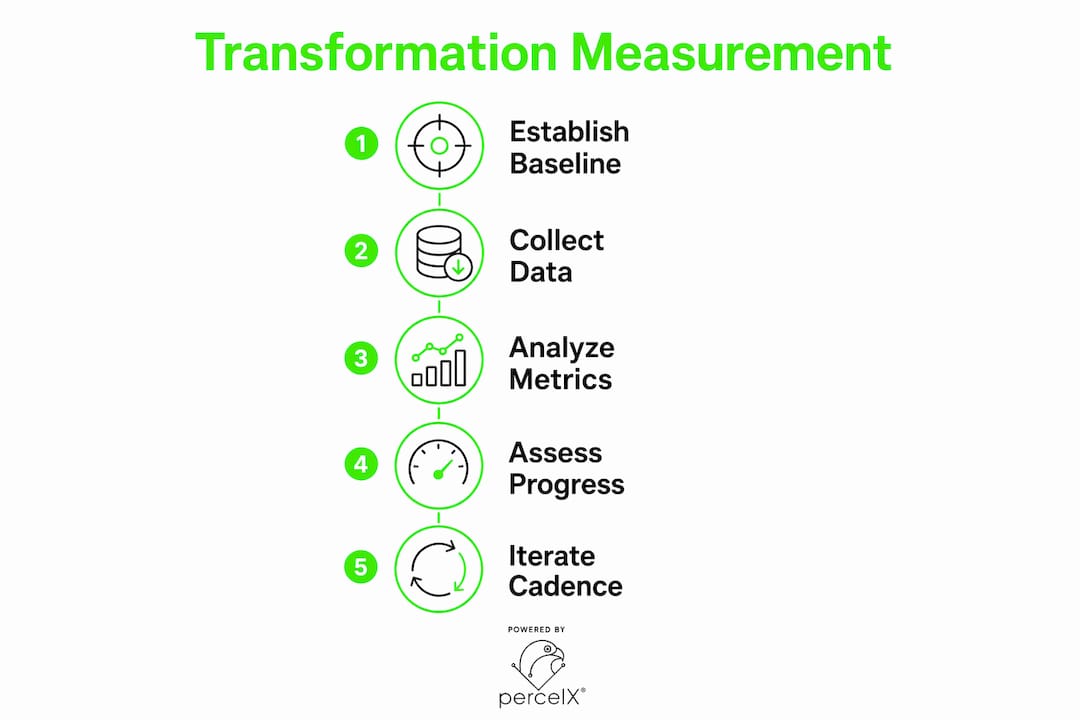
The single most important step in any measurement program is establishing a baseline before transformation work begins. Without a documented starting point, every subsequent score is meaningless. You cannot assess team growth if you have no record of where the team started.
The SAFe Team and Technical Agility (TTA) Maturity Model recommends completing a baseline assessment before the first improvement Program Increment (PI), then reassessing at the team level every 2 to 3 months and at the Agile Release Train (ART) level every PI or semi-annually. This cadence is deliberate. It gives teams enough time to implement changes before being measured again, which prevents the assessment fatigue that distorts data.
Your baseline should cover three dimensions:
- Behavioral alignment: How well do team members' behaviors support the desired transformation direction?
- Technical maturity: Where does the team sit on practices like test automation, continuous integration, and deployment frequency?
- Delivery performance: What are the current velocity, cycle time, and predictability scores?
These three dimensions anchor your improvement roadmap. Every subsequent assessment measures movement against this foundation, not against an abstract ideal.
Pro Tip: Use the Open AI Transformation Maturity Model as a reference for evidence-based scoring. Each score requires documented proof, such as process notes, tool usage logs, or delivery results, so you avoid perception-only ratings that inflate apparent progress.
What metrics and tools give you objective transformation data?
Self-reported maturity scores tell you how a team perceives its progress. Objective metrics tell you what actually happened. The strongest measurement programs combine both, because neither source alone is sufficient to evaluate team progress with confidence.

On the technical side, velocity, PI predictability, and flow metrics like cycle time and deployment frequency serve as indicators of process stability and delivery maturity. These numbers are harder to game than survey responses. A team that claims to practice continuous integration but deploys once a month has a measurable gap between perception and reality.
On the behavioral side, traditional engagement surveys primarily capture feelings and miss the behavioral change readiness that determines whether transformation actually sticks. The PACA (People and Culture Assessment) framework measures 380 behavior patterns linked to execution capability, revealing organizational readiness rather than just morale. This distinction matters enormously. A team can report high satisfaction while still resisting the behavioral shifts that transformation requires.
| Metric type | Examples | What it reveals |
|---|---|---|
| Technical delivery | Velocity, cycle time, deployment frequency | Process maturity and delivery consistency |
| Behavioral readiness | PACA, 360° behavioral assessments | Actual change behavior and alignment |
| Platform adoption | Monthly active users (MAU), adoption rate | Enablement team impact and utilization |
| Team health | PI predictability, flow efficiency | Stability and sustainable pace |
For platform and enablement teams, DORA metrics alone are insufficient. Tracking monthly active users and adoption rates alongside traditional delivery metrics reveals whether the platform is actually being used, which is the real measure of its contribution to transformation.
Pro Tip: Pair your maturity model scores with a behavioral intelligence platform like Percelx to capture the people-side data that technical metrics miss. Behavioral patterns predict future performance far better than current output numbers alone.
How to maintain a consistent measurement cadence
Consistent cadence separates meaningful trend data from noise. A single data point tells you where a team stands today. A series of data points collected at regular intervals tells you whether the team is accelerating, plateauing, or regressing.
Salesforce recommends analyzing KPIs as week-over-week or month-over-month trends rather than relying on isolated snapshots. The same principle applies directly to team transformation metrics. Here is a practical approach to building that cadence:
- Standardize your metric definitions. Decide exactly how velocity, cycle time, and behavioral scores are calculated before you start. Changing definitions mid-program corrupts your trend line.
- Automate data collection where possible. Manual data entry introduces inconsistency. Tools like Jira, Azure DevOps, and behavioral intelligence APIs can feed dashboards automatically, removing human error from the equation.
- Build a centralized dashboard. A single view of all transformation metrics, updated in real time, gives leaders and teams immediate visibility into progress without requiring manual reporting cycles.
- Interpret slope, not just score. A team at maturity level 2 that is trending upward is in a better position than a team at level 3 that has been flat for two PIs. The direction of change matters as much as the current position.
- Connect findings to improvement backlogs. Every assessment cycle should produce a prioritized list of improvement actions. Measurement without a response mechanism is just data collection. It produces no transformation.
Standardizing metric calculation and automating data capture significantly improves the reliability and interpretability of transformation data over time. This is not optional infrastructure. It is the foundation of credible measurement.
Common mistakes that undermine transformation measurement
The most damaging mistake leaders make is treating employee satisfaction scores as indicators of transformation readiness. Satisfaction measures how people feel about their current situation. Readiness measures whether they have the behavioral capacity and alignment to change. These are different constructs, and conflating them produces false confidence.
BCG research highlights that emotions shift quickly during transformation, and continuous behavioral measurement prevents leaders from making decisions based on outdated assumptions about team confidence and capacity. Relying on instinct to gauge where your team stands is a measurement failure, not a leadership strength.
Other common pitfalls include:
- Scoring without evidence. The Open AI Transformation Maturity Model mandates documented proof for every score. Without evidence, ratings reflect perception rather than reality, and longitudinal comparison becomes meaningless.
- Assessing too frequently. Quarterly assessments at the team level are appropriate. Weekly maturity scoring creates fatigue and produces unreliable data as teams begin to game responses.
- Disconnecting measurement from action. If assessment results do not feed directly into improvement planning, teams quickly learn that assessments have no consequences. Participation drops, and data quality deteriorates.
- Ignoring indirect-impact teams. Platform engineering and enablement teams contribute to transformation without always showing up in delivery metrics. Measuring only output teams creates a blind spot in your overall transformation picture.
Most transformations fail because leaders misunderstand how people experience change. Measurement must include human experience, such as adoption rates and behavioral shifts, not just delivery outputs. Harvard Business Review
Adapting measurement frameworks to different team types
No single measurement framework fits every team context. A software team adopting AI tools, an agile team maturing its delivery practices, and a platform team supporting internal developers each require a different combination of metrics and assessment approaches.
The table below maps team types to their most relevant measurement approaches:
| Team type | Primary metrics | Behavioral indicators | Cadence |
|---|---|---|---|
| Software teams (AI adoption) | Deployment frequency, AI tool utilization, cycle time | Behavioral readiness scores, adoption patterns | Monthly reviews, quarterly deep assessments |
| Agile delivery teams | Velocity, PI predictability, flow efficiency | Team alignment, collaboration behaviors | Every 2 to 3 months per SAFe TTA guidance |
| Platform/enablement teams | MAU, adoption rate, cost efficiency | Internal customer satisfaction, usage trends | Daily to quarterly per metric type |
| Business unit teams | OKR attainment, process cycle time | Change readiness, leadership alignment | Quarterly assessments, monthly pulse checks |
For platform teams specifically, adoption and utilization metrics correlated with downstream team delivery better reveal platform contributions than DORA metrics alone. A platform that no one uses cannot drive transformation regardless of how well it scores on deployment frequency.
Behavioral intelligence platforms become especially valuable when tracking people-side change across diverse team types. The Percelx for Teams approach applies 360° behavioral assessments that surface hidden patterns affecting decision-making and leadership alignment, giving you a consistent measurement layer across all team contexts. This consistency is what allows you to compare progress across teams and identify where transformation momentum is building versus where it is stalling.
Key takeaways
Effective transformation measurement requires baselines, evidence-based scoring, and consistent cadence connected directly to improvement action.
| Point | Details |
|---|---|
| Establish a baseline first | Document starting-point scores before transformation work begins to anchor all future comparisons. |
| Combine objective and behavioral metrics | Pair delivery data like velocity and cycle time with behavioral assessments to capture the full picture. |
| Analyze trends, not snapshots | Week-over-week and month-over-month trend lines reveal direction of change more reliably than single scores. |
| Score with documented evidence | Require proof for every maturity rating to prevent perception-based inflation that corrupts longitudinal data. |
| Connect results to improvement action | Every assessment cycle must produce prioritized improvements or measurement loses its organizational value. |
Why measurement only works when leaders stay in the loop
Here is what I have seen consistently across transformation programs: the measurement infrastructure gets built, the dashboards go live, and then leadership stops looking at them after the first two cycles. That is where most programs quietly fail.
The France Travail case study is instructive. Their 296% increase in features delivered came from sustained measurement and leadership commitment across multiple PIs, not from a single assessment sprint. The measurement itself did not produce the result. Leadership's consistent engagement with what the measurement revealed, and their willingness to act on it, produced the result.
I have also seen the opposite pattern. Teams score themselves generously on maturity models because no one requires evidence for the ratings. Scores climb while delivery performance stays flat. The disconnect is obvious in retrospect, but it goes unnoticed when leaders treat assessment as a compliance exercise rather than a learning tool.
The AgilityHealth Agility Health Review integrates quantitative assessment with qualitative team reflection for exactly this reason. Numbers without conversation miss the context that explains why a score moved. Conversation without numbers misses the accountability that keeps improvement honest.
My honest recommendation: treat every assessment cycle as a structured conversation between the team and its leadership, with data as the shared language. The goal is not a higher score. The goal is a team that performs differently than it did three months ago, with the evidence to prove it.
— Percell
How Percelx helps you track team transformation with confidence
Percelx is built for exactly the measurement challenge this article describes. The Percelx Behavioral Intelligence and Performance Transformation Platform captures continuous behavioral and performance data, supports evidence-backed maturity scoring, and surfaces the hidden behavioral patterns that traditional metrics miss. With a 4.9-star satisfaction rating, Percelx delivers personalized transformation plans grounded in 360° assessment data, so your improvement roadmap reflects what your team actually needs rather than what a generic survey suggests. For teams building measurement into their development workflows, the Percelx Developer Platform provides behavioral intelligence APIs that integrate directly with your existing tools and dashboards, giving you a consistent, automated data layer for tracking transformation progress at scale.
FAQ
What does it mean to measure team transformation over time?
Measuring team transformation over time means capturing baseline data before change begins, then reassessing at fixed intervals using behavioral, maturity, and delivery metrics to track directional progress. The goal is longitudinal evidence of genuine change, not a single score.
How often should you reassess team transformation progress?
The SAFe TTA model recommends reassessing at the team level every 2 to 3 months and at the program level every PI or semi-annually. More frequent assessments risk fatigue and produce unreliable data.
Why are engagement surveys insufficient for tracking team transformation?
Engagement surveys measure how people feel, not whether they have the behavioral capacity to change. The PACA framework measures 380 behavior patterns linked to execution capability, revealing readiness that morale scores consistently miss.
What is the biggest mistake in measuring team maturity scores?
Scoring maturity without documented evidence is the most damaging mistake. The Open AI Transformation Maturity Model requires proof for every rating because perception-based scores inflate apparent progress while actual performance stays flat.
How do you measure transformation for platform or enablement teams?
Platform teams require metrics beyond DORA, including monthly active users, adoption rates, and cost efficiency indicators. Correlating utilization data with downstream team delivery outcomes reveals the platform's true contribution to transformation.