

Most professionals know they need to grow. Far fewer know how to measure it. Choosing the right professional growth assessment best practices is harder than it sounds. You are not just picking a tool. You are deciding what data to trust, what feedback to act on, and what framework will actually move the needle on your career or your team. This article breaks down the criteria, methods, and implementation strategies that separate assessments that create real momentum from those that collect dust after the first review cycle.
Table of Contents
- Key takeaways
- 1. Professional growth assessment best practices start with clear criteria
- 2. The top professional growth assessment methods explained
- 3. Comparing assessment methods against key criteria
- 4. How to establish criteria and communicate them upfront
- 5. Building continuous feedback loops into your process
- 6. Training evaluators to reduce bias
- 7. Using assessment results to build personalized development plans
- 8. Leveraging technology to standardize and scale assessments
- 9. Reviewing and refreshing your assessment framework regularly
- My take on what most organizations get wrong
- Take your assessment practice further with Percelx
- FAQ
Key takeaways
| Point | Details |
|---|---|
| Assessment is the foundation | Professional development plans require assessment as the first step to map capabilities and set a meaningful trajectory. |
| Multi-source feedback reduces bias | Combining self, peer, and manager input produces more accurate and fair evaluations than single-source methods. |
| Continuous beats annual | Real-time feedback cycles drive more development than once-a-year reviews tied to compensation decisions. |
| Clarity in competency frameworks matters | Semantic precision at the facet level is a prerequisite for valid and reliable assessment results. |
| Refresh your framework regularly | Evaluation standards should be reviewed and updated periodically to stay defensible and aligned with current goals. |
1. Professional growth assessment best practices start with clear criteria
Before you evaluate a single employee or choose a single tool, you need to know what you are actually measuring. Vague criteria produce vague results. The most effective assessment frameworks are built on a short list of non-negotiable qualities.
Validity and reliability come first. A valid assessment measures what it claims to measure. A reliable one produces consistent results across different raters and time periods. If your competency framework uses terms like "leadership presence" or "strategic thinking" without defining them precisely, you are inviting inconsistency. Research on the ATHENA framework confirms that conceptual distinctiveness at the facet level is a prerequisite for valid assessment interpretation.
Alignment with organizational goals is the second filter. Skills assessment tools that measure competencies disconnected from your actual business priorities waste everyone's time. Your framework should reflect the behaviors and outcomes your organization rewards and needs.
Other criteria worth building into your evaluation checklist:
- Scalability: Can the method work for a team of five and a team of five hundred?
- Frequency fit: Does the cadence match your culture? Continuous feedback models work differently than annual cycles.
- Bias mitigation: Does the method use diverse data sources to reduce the influence of any single evaluator's blind spots?
- Development orientation: Is the output focused on growth or judgment? The best assessments produce plans, not verdicts.
- Integration with career growth metrics: Can results connect directly to promotion readiness, skill gap analysis, or succession planning?
Pro Tip: Before selecting any assessment tool, write down the three to five specific behaviors or outcomes you need to measure. If a tool cannot map directly to those, move on.
2. The top professional growth assessment methods explained
Understanding your options is half the battle. Each method has a different design logic, and each fits a different context. Here is a practical breakdown.
360-degree feedback is the most widely recognized approach in professional development frameworks. It collects input from managers, peers, direct reports, and sometimes clients. The result is a richer picture than any single evaluator can provide. 360-degree feedback works best in leadership roles and customer-facing positions where perception from multiple directions matters. The downside is that it requires a psychologically safe culture to function honestly.

Competency frameworks with behavioral anchors give evaluators specific, observable behaviors to rate instead of abstract traits. This reduces subjectivity and makes feedback more specific. When combined with a well-defined skills catalog, they become one of the most reliable performance evaluation techniques available.
OKR-based appraisals tie assessment directly to measurable outcomes. Instead of rating how someone "communicates," you measure whether they hit the goals they committed to. This approach works well for roles with clear deliverables and less well for positions where the work is relational or hard to quantify.
Continuous feedback and coaching models replace or supplement the annual review with regular check-ins, real-time recognition, and documented conversations. Modern appraisal methods prioritize this kind of ongoing dialogue over snapshot evaluations. The momentum this creates is real. People improve faster when feedback is timely.
Self-assessments promote reflection and personal ownership of growth. They are most powerful when paired with external validation. Used alone, they carry significant bias risk.
Project-based evaluations assess performance through actual work outputs. They are ideal for technical roles, creative fields, and consulting contexts where the quality of deliverables tells the story more clearly than any rating scale. For professionals in consulting or advisory roles, this method often surfaces insights that structured surveys miss entirely.
Pro Tip: Do not default to one method. The most effective employee development strategies layer two or three approaches. For example, pair a competency framework with quarterly self-assessments and a mid-year 360 review.
3. Comparing assessment methods against key criteria
Not every method performs equally across every dimension. This comparison helps you match the right approach to your specific context.
| Method | Bias risk | Feedback quality | Scalability | Development focus | Best for |
|---|---|---|---|---|---|
| 360-degree feedback | Low (multi-source) | High | Moderate | High | Leaders, managers |
| Competency frameworks | Moderate | High | High | High | Most roles |
| OKR-based appraisals | Low | Moderate | High | Moderate | Output-driven roles |
| Continuous feedback | Low | Very high | Moderate | Very high | Fast-growth teams |
| Self-assessment | High | Moderate | Very high | High | Reflection and planning |
| Project-based evaluation | Low | High | Low | High | Technical, creative roles |
The pattern here is clear. Methods that draw on multiple data points consistently produce lower bias risk and stronger development outcomes. Methods that rely on a single evaluator or a single moment in time carry the most risk of distortion.
Scalability is where many organizations stumble. A method that works beautifully in a 20-person team may collapse under its own weight at 200 people without the right technology infrastructure to support it.
4. How to establish criteria and communicate them upfront
The single most common failure in professional growth assessment is starting the process without telling people what success looks like. Clear criteria and transparent communication increase engagement and make the resulting development plans far more motivating.
Before launching any assessment cycle, publish the competency definitions, rating scales, and the purpose of the evaluation. People perform differently when they understand what is being measured and why. This is not about gaming the system. It is about alignment.
Build in a kickoff conversation where managers and employees discuss the criteria together. This creates shared ownership and surfaces any misalignment before it becomes a dispute about scores.
5. Building continuous feedback loops into your process
Annual reviews made sense when work moved slowly. Today, a year is too long to wait for course correction. The most effective feedback mechanisms for growth are embedded in the workflow, not bolted on at the end of a performance cycle.
Practical ways to build continuity:
- Weekly or biweekly one-on-ones with documented notes
- Pulse surveys that track sentiment and development progress in real time
- Recognition tools that capture positive behavioral examples as they happen
- Quarterly development conversations that revisit goals and adjust priorities
The key is documentation. Verbal feedback disappears. Written records create a narrative of growth that both managers and employees can reference when it matters most.
6. Training evaluators to reduce bias
Even the best assessment design fails when the people running it are not calibrated. Evaluator bias is one of the most persistent problems in performance evaluation techniques, and most organizations underinvest in addressing it.
Training should cover the most common distortions: recency bias (overweighting recent events), halo effect (letting one strong trait color all ratings), and affinity bias (rating people more favorably when they remind you of yourself). These are not character flaws. They are cognitive defaults that structured training can interrupt.
Calibration sessions, where evaluators discuss ratings together before finalizing them, are one of the most effective tools for aligning judgment across a team. They also surface inconsistencies that would otherwise go unnoticed.
7. Using assessment results to build personalized development plans
Assessment data without a follow-through plan is just paperwork. The real value of any professional growth assessment is what happens after the scores are recorded. Assessment serves as the foundational step in a five-part development system that includes goals, resources, strategy, and evaluation.
Each person's development plan should be specific to their gap profile, not a generic list of recommended courses. If someone scores low on cross-functional communication but high on technical execution, their plan should reflect that. Generic plans produce generic results.
For organizations operating at scale, this is where technology becomes essential. Platforms that can analyze assessment data and surface personalized recommendations remove the bottleneck of manual plan creation and make individualized growth realistic at volume.
8. Leveraging technology to standardize and scale assessments
Technology does not replace good assessment design. It amplifies it. When your process is sound, the right platform makes it faster, more consistent, and easier to analyze across large populations.
Look for tools that support:
- Configurable competency frameworks that match your specific role requirements
- Multi-rater data collection with anonymization controls
- Analytics dashboards that surface skill gaps at the individual, team, and organizational level
- Integration with learning management systems so development plans connect directly to resources
For organizations exploring strategic growth consulting, aligning your technology choices with your broader transformation goals from the start saves significant rework later.
9. Reviewing and refreshing your assessment framework regularly
Assessment frameworks are not permanent. The skills that matter in your organization today may not be the same ones that matter in three years. The Joint Committee on Standards for Educational Evaluation updates evaluation standards every five years to maintain quality and defensibility. Your internal frameworks should follow a similar rhythm.
Schedule a formal review of your competency definitions, rating scales, and feedback processes at least every two years. Involve both HR professionals and frontline managers in that review. The people closest to the work often spot outdated criteria faster than anyone else.
Pro Tip: When refreshing your framework, do not just add new competencies. Remove ones that no longer reflect your strategic priorities. A shorter, sharper framework is almost always more effective than a comprehensive one that nobody can remember.
My take on what most organizations get wrong
I have seen organizations invest heavily in assessment tools while skipping the foundational work that makes those tools meaningful. The technology looks impressive. The rollout feels thorough. But when you look at the competency definitions driving the ratings, they are vague, overlapping, and unmeasurable. The result is data that feels authoritative but cannot actually predict performance or guide development.
The other mistake I see constantly is treating self-assessment as a reliable standalone input. People are genuinely poor judges of their own blind spots. That is not an insult. It is how cognition works. Self-assessment is most valuable as a starting point for conversation, not as evidence. When organizations weight it too heavily without external validation, they end up with development plans built on incomplete pictures.
What actually works is simpler than most platforms suggest. Define your competencies precisely. Collect input from multiple directions. Give feedback close to the moment it is relevant. And then connect the data to a real plan with real accountability. That sequence, done consistently, produces more growth than any single sophisticated tool ever will.
The hardest part is not the assessment itself. It is building the organizational discipline to act on what you learn. That is where most growth efforts stall. Not at the data collection stage, but at the follow-through.
— Percell
Take your assessment practice further with Percelx
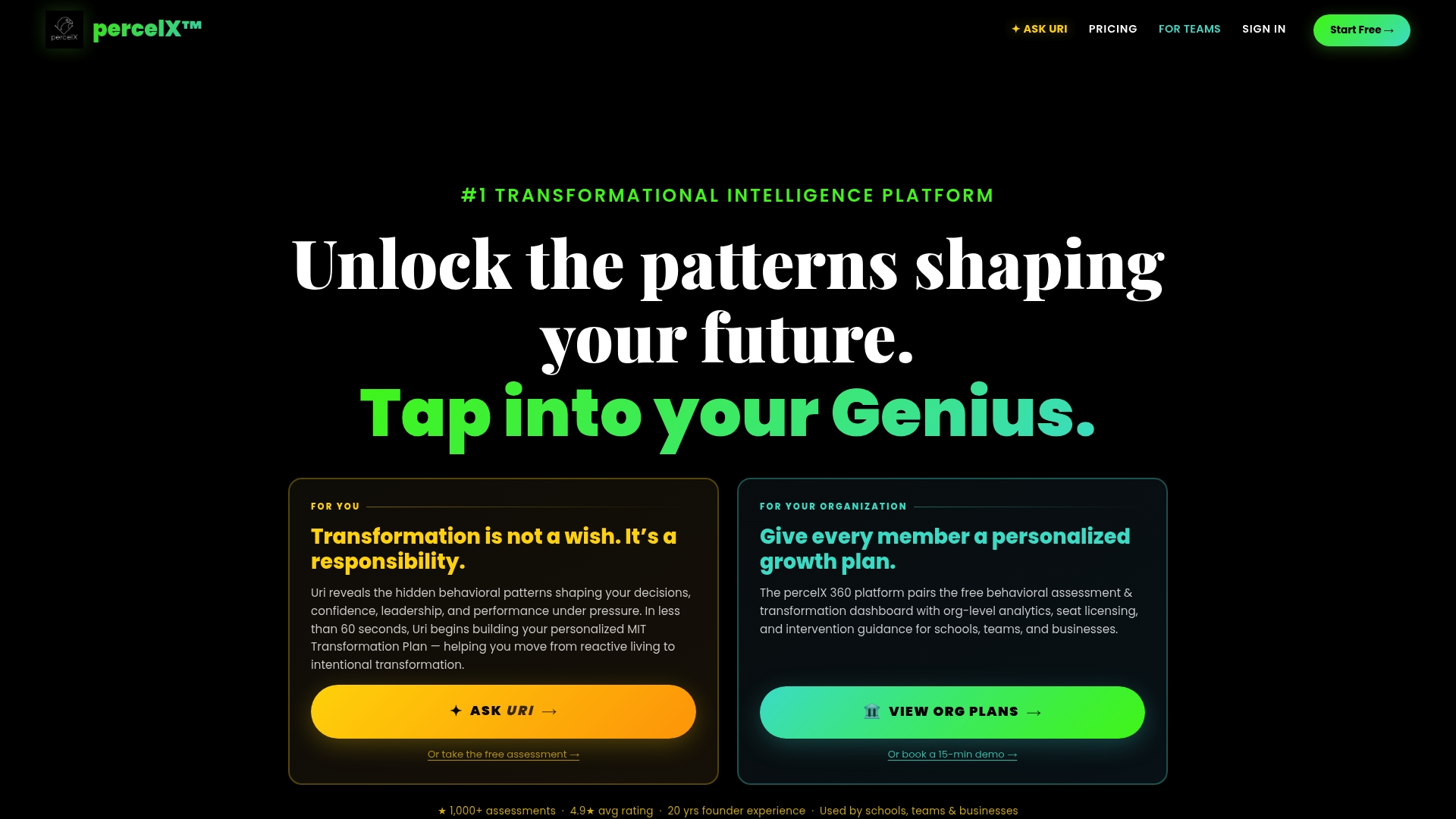
If you are ready to move beyond generic evaluations and into assessments that actually reveal what drives performance, Percelx was built for exactly that. The Percelx behavioral intelligence platform goes beyond surface-level ratings to surface the hidden behavioral patterns shaping decision-making, leadership, and team dynamics. It delivers personalized transformation plans instantly, turning raw assessment data into a clear path forward.
For teams and organizations, Percelx 360 Enterprise scales that same depth across entire departments, giving leaders the data they need to build high-performance cultures grounded in real behavioral insight. With a 4.9-star satisfaction rating and ongoing support built in, Percelx turns assessment into transformation, not just documentation.
FAQ
What are the best practices for professional growth assessments?
Effective professional growth assessments use clear competency definitions, multiple data sources, and regular feedback cycles. Best practices also include training evaluators to reduce bias and connecting results directly to personalized development plans.
How often should professional growth assessments be conducted?
Most organizations benefit from continuous or quarterly feedback loops rather than annual reviews alone. Frequent check-ins allow for timely course corrections and keep development momentum active throughout the year.
What is 360-degree feedback and when should you use it?
360-degree feedback collects input from managers, peers, direct reports, and sometimes clients to create a multidimensional picture of performance. It works best for leadership and customer-facing roles where perception from multiple directions directly affects outcomes.
How do you reduce bias in performance evaluations?
Using multi-source feedback and running evaluator calibration sessions are the two most effective ways to reduce bias. Training evaluators to recognize recency bias, halo effect, and affinity bias also significantly improves rating accuracy.
How do you turn assessment results into a development plan?
Start by identifying the specific gaps the assessment reveals, then build a plan with targeted resources and measurable milestones tied to those gaps. Generic plans rarely produce results. The more precisely the plan maps to the individual's actual gap profile, the more likely they are to follow through.