

Focus is the athlete's ability to direct and sustain attention on relevant cues while filtering out distractions, and it is the single most trainable mental skill that separates consistent performers from inconsistent ones. The role of focus in athletic outcomes is not a soft concept. Sports science research confirms it as a measurable predictor of accuracy, endurance, and decision-making across disciplines. Whether you compete in football, basketball, cricket, or endurance sports, your attention management shapes your results as directly as your physical conditioning does. Understanding how focus works, and how to train it, gives you a concrete edge that most athletes never fully develop.
How does focus directly affect athletic performance metrics?
Focus is a direct driver of measurable performance gains, not just a mental nicety. An 8-week mindfulness training program with 88 youth football athletes aged 12–18 produced a 7.4% improvement in passing accuracy and a 7.8% gain in body endurance. Those numbers show that mental training produces physical results at the same rate as many conditioning programs.
Visual attention training produces equally specific gains. Optimizing fixation behaviors led to a 5% improvement in 3-point shooting accuracy among semi-professional basketball players. The training targeted fixation durations of 600ms or longer, which means the benefit came from how athletes looked at the target, not just how hard they concentrated.

Cricket research reveals something even more striking. Focus level mediated the relationship between abdominal strength, anaerobic endurance, and bowling accuracy, explaining over 95% of the variance in accuracy outcomes. Focus was the strongest predictor (β = .647) of accuracy. That means two athletes with identical physical conditioning will produce different accuracy results based on their attentional control alone.
The performance impact of concentration shows up across three key categories:
- Accuracy: Visual fixation and attentional control directly improve precision in skill-based tasks like shooting, passing, and throwing.
- Endurance: Mental focus training extends physical output by reducing perceived effort and maintaining motor efficiency under fatigue.
- Decision-making: Structured psychological skills training sharpens tactical choices and stress responses during competition.
| Performance Area | Focus Mechanism | Measured Outcome |
|---|---|---|
| Passing accuracy | Mindfulness training | 7.4% improvement in youth football |
| 3-point shooting | Visual fixation protocol (600ms+) | 5% accuracy gain in basketball |
| Bowling accuracy | Attentional control as mediator | Over 95% of variance explained |
| Endurance tasks | External focus strategy | Extended time to failure, lower RPE |
What is the difference between internal and external focus?
The distinction between internal and external focus is one of the most important concepts in sports psychology, and most athletes get it wrong. Internal focus means directing attention to your own body movements, such as monitoring your arm swing, foot placement, or breathing. External focus means directing attention outward toward the effect of your movement, such as the ball's trajectory, a target on the wall, or the feel of the court under your feet.
Internal focus increases self-consciousness and disrupts fluid movement by pulling automatic motor programs into conscious control. The result is slower, less efficient execution and higher perceived effort. Athletes who over-monitor their mechanics during competition often describe this as "paralysis by analysis," and the research confirms it is a real performance cost.
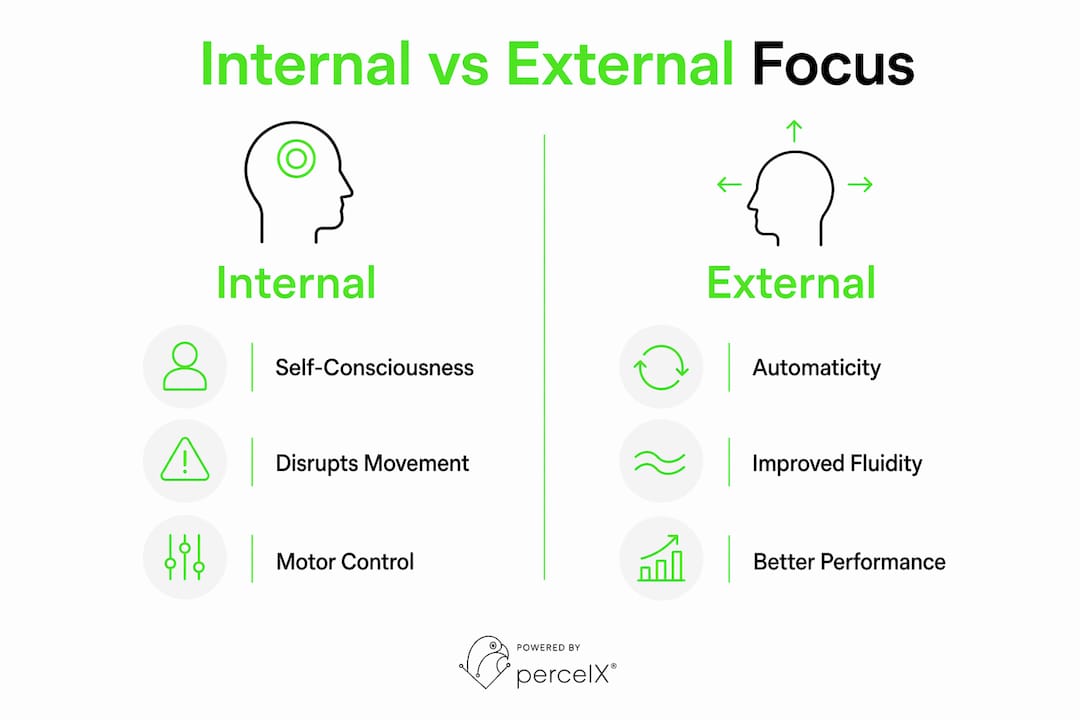
External focus, by contrast, promotes automated motor control. When your attention is on the outcome rather than the process, your nervous system runs movement patterns more efficiently. External focus subjects reported less fatigue and less unpleasantness on fatiguing tasks compared to internal focus subjects, with improved wall-sit duration and lower ratings of perceived exertion. That is a direct endurance benefit from a simple attentional shift.
The practical implications for your training are clear:
- During skill execution: Direct attention to the target or the movement's effect, not your limbs.
- During endurance work: Focus on an external cue like a point on the wall or the rhythm of your movement's impact, not on how your muscles feel.
- Under pressure: External focus reduces the emotional weight of fatigue and pain, helping you stay in the task longer.
Pro Tip: Before your next training session, pick one external cue to focus on during your hardest drill. Notice whether your effort feels different compared to when you monitor your own mechanics.
How can athletes train their focus skills?
Focus is trainable through specific, structured methods, and the mental skills every elite athlete needs include attentional control as a core component. The four most validated approaches are mindfulness periodization, visual attention training, Quiet Eye protocols, and Psychological Skills Interventions.
1. Mindfulness periodization
Mindfulness for athletes is not one format fits all. Longer mindfulness courses build cognitive resilience and long-term focus endurance. Shorter daily sessions boost immediate task precision before competition. Matching the format to your goal produces better results than generic meditation practice.
2. Quiet Eye training
Quiet Eye refers to a prolonged, stable fixation on the target of at least 600ms before executing a skill. Quiet Eye duration improvements signal stable attentional control and predict superior accuracy in precision sports like free throws, penalty kicks, and golf putting. You can train this by using video feedback to measure your pre-shot fixation and deliberately extending it during practice.
3. Visual fixation protocols
Visual fixation patterns are personalized information search strategies. Optimizing them improves rapid decision-making and skill execution. Work with a coach or use eye-tracking tools to identify where your gaze goes under pressure and whether it matches high-performance fixation patterns.
4. Psychological Skills Interventions
Structured psychological skills training over eight weeks improves tactical decision-making, mental toughness, and stress handling in football players. The core components are goal setting, attentional control practice, imagery, and self-talk. These are not abstract exercises. They are repeatable mental drills that build the same way physical drills do.
Pro Tip: Treat your focus training like a physical workout. Schedule it, track it, and progress it. A 10-minute attentional control session before practice produces more consistent gains than occasional meditation.
Coaches should integrate attentional control and imagery into regular physical training rather than treating them as optional extras. When mental and physical training align, the transfer to competition is faster and more durable.
What psychological and neurological mechanisms explain focus gains?
The performance benefits of focus training have a clear neurological foundation. Neural efficiency improvements from focus training appear as increased alpha EEG oscillations in the brain, which indicate sustained top-down attentional control. This enhanced control supports accuracy maintenance even under competitive stress. The brain, in effect, gets better at filtering irrelevant information and prioritizing task-relevant cues.
Attentional filtering is the process by which the brain selects what to process and what to ignore. Athletes with stronger attentional control process movement-relevant information faster and more accurately. This directly improves motor programming, which is the brain's ability to plan and execute movement sequences efficiently. The result is cleaner technique under pressure, not just better concentration.
"Encouraging an external focus can attenuate the negative effects of pain and physiological fatigue, helping athletes maintain performance under stress. When attention shifts outward, the brain's self-monitoring load decreases, freeing cognitive resources for task execution and emotional regulation."
Mental toughness and decision-making also improve through the same attentional pathways. Psychological skills training builds the mental architecture that allows athletes to stay process-focused when outcomes are uncertain. This is not willpower. It is a trained cognitive pattern that responds to the same principles as physical conditioning: specificity, progressive overload, and recovery.
The connection between behavioral patterns and athletic performance runs deeper than most athletes realize. Habitual attentional patterns, including where you look, what you think about under pressure, and how you respond to fatigue, are behavioral defaults that can be identified, measured, and changed.
Key Takeaways
Mental focus is the most measurable and trainable cognitive skill in athletics, and shifting from internal to external attention produces immediate, documented gains in accuracy, endurance, and decision-making.
| Point | Details |
|---|---|
| Focus drives measurable results | Mindfulness training produced 7.4% passing accuracy and 7.8% endurance gains in youth football. |
| External focus outperforms internal | Directing attention outward reduces perceived fatigue and extends time to failure on endurance tasks. |
| Quiet Eye is trainable | Fixation durations of 600ms or longer predict superior accuracy and can be developed through visual protocols. |
| Psychological skills training works | Eight-week structured programs improve tactical decision-making and mental toughness in competitive athletes. |
| Neural efficiency is the mechanism | Focus training increases alpha EEG oscillations, improving attentional filtering and motor programming under pressure. |
Why I think most athletes underinvest in focus training
Most athletes treat mental training as something you do when physical training is not enough. That is the wrong order. Focus is not a supplement to physical preparation. It is the system that determines how much of your physical capacity actually shows up in competition.
The research on external focus changed how I think about coaching cues entirely. Telling an athlete to "feel their hip rotation" produces worse results than telling them to "drive the ball through the target." The movement is the same. The attentional direction is different. The outcome is measurably better with external cues. Most coaching still defaults to internal cues because they feel more instructional, but they actively interfere with automatic motor execution.
The other thing most athletes miss is that focus training has a periodization logic, just like strength training. Long mindfulness programs build cognitive resilience over months. Short pre-session protocols sharpen immediate precision. Using only one format for both goals is like doing only heavy lifting and expecting it to also build your aerobic base.
The athletes who close the gap between their training performance and their competition performance are almost always the ones who have built consistent attentional control habits. Physical talent sets the ceiling. Focus determines how close you get to it.
— Percell
How Percelx supports athletes in building mental performance
Athletes who want to close the gap between physical potential and actual results need more than general advice. They need a personalized picture of the behavioral patterns that shape their attention, decision-making, and performance under pressure.

Percelx uses a 360° behavioral assessment to reveal the hidden attentional and decision-making patterns that affect how you perform when it matters most. The Percelx platform delivers a customized performance plan instantly, mapping your behavioral gaps and giving you a clear path to build the mental skills that drive real results. With a 4.9-star satisfaction rating, Percelx combines data-driven behavioral insight with ongoing support so your focus training produces measurable, lasting gains.
FAQ
What is the role of focus in athletic outcomes?
Focus is the ability to direct and sustain attention on relevant performance cues while filtering distractions. Research confirms it directly improves accuracy, endurance, and decision-making across sports.
How does external focus improve sports performance?
External focus directs attention toward the effect of movement rather than the movement itself. This promotes automatic motor control, reduces perceived fatigue, and extends endurance compared to internal focus strategies.
Can focus be trained like a physical skill?
Yes. Mindfulness periodization, Quiet Eye protocols, and Psychological Skills Interventions all produce measurable focus improvements. An 8-week program improved youth football passing accuracy by 7.4%.
What is Quiet Eye and why does it matter?
Quiet Eye is a stable visual fixation on the target lasting at least 600ms before skill execution. It predicts superior accuracy in precision sports and can be developed through specific visual attention training.
How does mindfulness training affect athletic performance?
Mindfulness training builds cognitive resilience over longer programs and sharpens immediate task precision in shorter sessions. The format should match the performance goal for best results.