

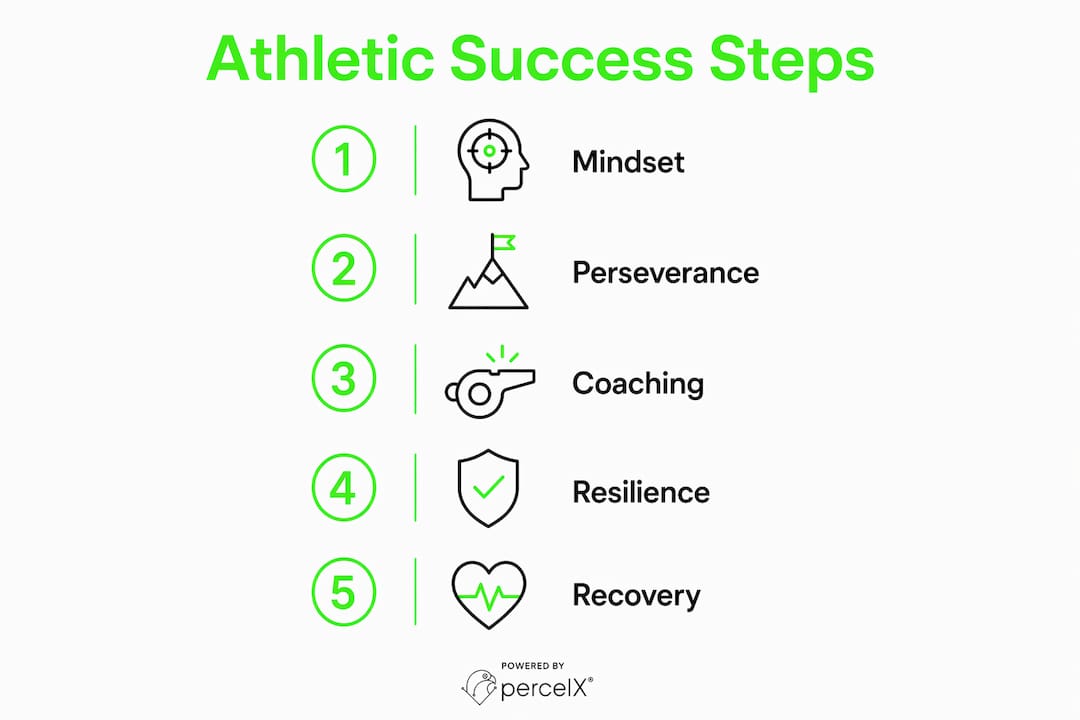
Mindset is defined as the athlete's core belief about whether ability is fixed or can grow through effort, and this belief is the primary psychological factor organizing performance under pressure. The psychology of athletic success now has a clear research consensus: mental constructs like perseverance, self-efficacy, and emotional regulation sit between mindset and measurable results. A 2026 Frontiers in Psychology study of 254 Chinese university athletes confirmed that growth mindset works through perseverance, not through any direct physical enhancement. Understanding why mindset determines athletic success means understanding these behavioral pathways, because that is where training and coaching can actually intervene.
Why mindset determines athletic success through effort and perseverance
Mindset does not make your muscles stronger or your reaction time faster. What it does is change how you behave when training gets hard, when a race goes badly, or when a competitor pulls ahead. That behavioral shift is the entire mechanism, and it is more powerful than most athletes realize.
The 2026 Frontiers study found that growth mindset's effect on performance in an 800-meter run was fully mediated by perseverance of effort, with a standardized coefficient of β=0.23. This means the mindset itself produced no direct performance gain. Every benefit flowed through the athlete's sustained effort habits. That distinction matters enormously for how you train your mental game in sports.
Grit, the psychological construct popularized in sports psychology frameworks, contains two distinct dimensions worth separating:
- Perseverance of effort: Staying consistent with practice and pushing through obstacles, even when progress stalls
- Consistency of interest: Maintaining long-term passion for the same goal without shifting focus
Research shows perseverance of effort is the dimension that actually mediates the mindset-to-performance link. Consistency of interest matters for career longevity, but it does not carry the same direct performance weight in competitive settings. If you want to apply the psychology of athletic success to your training, focus your mental work on building effort habits, not just sustaining enthusiasm.
Mindset also organizes behavior under challenge rather than directly enhancing physical capability. Athletes with a growth orientation interpret setbacks as information rather than evidence of inadequacy. That reframing keeps effort levels high when a fixed-mindset athlete would disengage.

Pro Tip: Log your effort consistency each week, not just your performance outcomes. Tracking whether you showed up and pushed hard, regardless of results, reinforces the behavioral patterns that mindset theory predicts will compound into real gains.
How does coaching environment shape mindset and self-efficacy?
Even the strongest personal mindset can be undermined by the wrong coaching environment. This is one of the most underappreciated truths in the mental game in sports, and recent research makes it impossible to ignore.
A 2026 BMC Psychology study of 369 Turkish athletes used structural equation modeling to show that supportive coaching behaviors increase athletes' perceived performance by building psychological safety, self-efficacy, and resilience. The reverse was equally clear: controlling coaching reduced those same psychological resources and produced negative indirect effects on performance perception.
The table below contrasts the two coaching styles and their psychological effects:
| Coaching style | Psychological effect | Performance outcome |
|---|---|---|
| Autonomy-supportive | Builds self-efficacy, psychological safety, resilience | Higher perceived and actual performance |
| Controlling | Reduces self-efficacy, undermines psychological safety | Lower performance perception, increased anxiety |
Self-efficacy, defined as an athlete's belief in their capacity to execute a specific task, is the key mediator here. A coach who gives athletes choices, explains the rationale behind training decisions, and acknowledges their feelings actively builds that belief. A coach who relies on punishment, rigid control, and conditional approval erodes it, regardless of how talented or mentally tough the athlete is.
Sport psychologist Marc Cormier from the University of Kentucky has noted that pressure is a subjective appraisal, meaning the same competitive situation can produce confidence in one athlete and anxiety in another depending on how they interpret it. Coaches who create psychologically safe environments give athletes the space to develop more constructive appraisals over time.
For athletes, this means your environment is part of your mental training. Seek out coaches who explain their decisions, invite your input, and treat mistakes as learning data. For coaches, the role of confidence in performance is not built through praise alone. It is built through consistent autonomy support that lets athletes develop genuine competence beliefs.
Pro Tip: After each training session, ask yourself one question: Did my coach's feedback today increase or decrease my belief in my own ability? If the answer is consistently "decrease," that is a structural problem worth addressing, not a personal weakness to push through.
How do mental toughness and emotional regulation build performance resilience?
Mental toughness is defined in sports psychology as the psychological edge that allows an athlete to cope better than opponents with the demands of training and competition. It is not a fixed personality trait. It is a trainable cluster of skills that includes emotional regulation, attentional control, and resilience under pressure.
A 2025 Frontiers study found that mental toughness improves performance self-efficacy through two sequential mediators: emotional regulation and psychological resilience. The pathway runs in that order. Mental toughness first improves how well you manage your emotional state under stress. That emotional control then builds resilience, which finally raises your confidence in your ability to perform. Autonomy-supportive coaching strengthened all three stages of this pathway.
Here is how to build each stage deliberately:
- Train emotional regulation first. Use pre-competition routines, controlled breathing protocols, and post-competition reflection to develop consistent emotional control. Athletes who regulate emotions well do not eliminate nerves. They convert arousal into focus.
- Build resilience through deliberate exposure. Put yourself in high-pressure practice scenarios regularly. Simulated pressure builds the psychological resilience that transfers to competition. Avoiding pressure in training guarantees it will destabilize you in competition.
- Let resilience compound into self-efficacy. Each time you manage a high-pressure moment well, you create evidence that you can do it again. Self-efficacy is built from mastery experiences, not from affirmations. Collect those experiences intentionally.
Mindset practice should focus on internal regulation pathways like emotional control and resilience, not only positive thinking. Positive thinking without the behavioral infrastructure of emotional regulation is just optimism. It does not hold up when competition pressure arrives.
How does cognitive flexibility support recovery and sustained performance?
Cognitive flexibility is defined as the mental ability to shift attention, reframe situations, and adapt thinking patterns in response to changing demands. In athletic contexts, it is the psychological skill that determines how quickly you recover from a poor performance, a bad call, or a mid-competition setback.
A 2026 Frontiers study demonstrated that cognitive flexibility supports recovery through self-regulation, with perceived control moderating how effective that recovery process becomes. Athletes who believe they have some control over their situation use cognitive flexibility more effectively. Those who feel helpless get less benefit from the same mental skills.
| Psychological mechanism | Function in recovery | Moderating factor |
|---|---|---|
| Cognitive flexibility | Enables attentional shifting and reframing after setbacks | Perceived control amplifies the effect |
| Self-regulation | Restores focus and behavioral alignment post-disruption | Emotional regulation capacity |
| Perceived control | Determines how fully cognitive flexibility translates to recovery | Coaching environment and mindset beliefs |
Mindset interventions restore self-regulation function best after poor performances rather than by arguing against negative beliefs directly. That is a critical distinction. Telling an athlete "think positive" after a bad game does not work. Teaching them to shift attention, re-engage their routine, and restore behavioral control does. Recovery is an active, resource-dependent process, and cognitive flexibility is the primary tool.
To build cognitive flexibility, practice attentional shifting drills during training. Deliberately interrupt your focus, then practice returning to your performance cues. Develop a reset routine, a short physical or mental sequence you use after errors, that signals your brain to shift attention forward rather than ruminate backward.
How can athletes actively build a success-oriented mindset?
Mindset and sports achievement are not separate from physical training. They are part of the same development system, and the athletes who treat them that way gain a measurable edge. Here is how to build that system deliberately:
- Anchor mindset work to effort habits. Behavioral mindset interventions work best when linked to effort-tracking and habit reinforcement rather than motivational messaging alone. Log your training consistency, not just your times or scores.
- Audit your coaching environment. Even mentally strong athletes can underperform when coaching undermines psychological safety. If your environment is controlling, your mindset work will fight an uphill battle. Address the environment, not just the internal state.
- Practice emotional regulation as a skill. Build pre-competition routines, use controlled breathing, and debrief your emotional responses after competition. Treat emotional control the same way you treat technical skills: with deliberate, structured practice.
- Develop a cognitive reset routine. After errors or setbacks, use a physical cue (a breath, a word, a gesture) to shift attention forward. This trains the attentional flexibility that supports psychological recovery and keeps performance momentum intact.
- Seek performance anxiety resources proactively. Pressure management is a learnable skill, not a personality trait. Athletes who address anxiety early develop stronger appraisal patterns that hold up under competition stress.
Pro Tip: Combine mindset training with behavioral tracking for measurable gains. Record your effort consistency, emotional regulation attempts, and reset routine use each week. Patterns in that data will show you exactly where your mental game needs the most development.
Key takeaways
Mindset determines athletic success by shaping perseverance, emotional regulation, and self-efficacy, all of which require deliberate training, a supportive coaching environment, and consistent behavioral reinforcement to produce real performance gains.
| Point | Details |
|---|---|
| Mindset works through perseverance | Growth mindset improves performance only when it drives sustained effort habits, not through direct physical change. |
| Coaching environment is non-negotiable | Autonomy-supportive coaching builds self-efficacy and resilience; controlling coaching undermines both, regardless of athlete mindset strength. |
| Mental toughness is a trainable skill | Emotional regulation and resilience are the sequential mediators between mental toughness and performance self-efficacy. |
| Cognitive flexibility drives recovery | Athletes recover faster from setbacks when they can shift attention and restore self-regulation, especially when they feel a sense of control. |
| Behavioral tracking amplifies mindset gains | Linking mindset beliefs to measurable effort habits produces compounding performance improvements over time. |
What working with behavioral patterns has taught me about mindset
Most athletes I work with arrive believing mindset is about attitude. They think if they just believe hard enough, results will follow. That framing is not wrong, but it is dangerously incomplete.
What the research confirms, and what I see consistently in practice, is that mindset is a behavioral system. It only produces results when it is connected to specific habits, a supportive environment, and trained psychological skills like emotional regulation and cognitive flexibility. The belief alone is inert. It needs behavioral infrastructure to activate.
The most overlooked factor is the coaching environment. I have seen athletes with exceptional mental toughness plateau or regress because their coaching setup was controlling and psychologically unsafe. Mindset is not a shield against a toxic environment. It is a resource that gets depleted by one.
My honest recommendation: treat your mindset like you treat your physical conditioning. Assess it, track it, and build it through structured practice. Do not wait for a crisis to start. The athletes who develop these skills proactively are the ones who perform when it counts most. Mindset is not a fixed trait you either have or do not. It is a dynamic, context-dependent skill you build deliberately, one behavioral pattern at a time.
— Percell
How Percelx helps athletes build a performance mindset

Percelx is built for athletes and coaches who want to move beyond motivation and into measurable transformation. The Percelx behavioral intelligence platform reveals the hidden behavioral patterns shaping your effort, resilience, and decision-making under pressure. Through a 360° assessment approach, Percelx delivers personalized transformation plans that connect mindset beliefs to the specific effort habits and emotional regulation skills that drive real performance gains. Whether you are an individual athlete tracking your own development or a coach building an autonomy-supportive team environment, Percelx gives you the data and structure to make mindset work visible and measurable. Explore the Percelx team performance tools and start building the behavioral foundation your athletic success depends on.
FAQ
Why does mindset matter more than talent in sports?
Mindset determines how consistently an athlete applies their talent through sustained effort and resilience. Research shows growth mindset improves performance through perseverance of effort, meaning athletes with strong mindsets outwork and outlast those who rely on natural ability alone.
How does coaching style affect an athlete's mindset?
Autonomy-supportive coaching builds self-efficacy, psychological safety, and resilience, all of which amplify positive mindset effects. Controlling coaching undermines these same resources, reducing performance perception even in mentally tough athletes.
Can mindset influence how athletes recover from poor performances?
Cognitive flexibility and self-regulation are the primary recovery mechanisms, and both are trainable mindset skills. A 2026 Frontiers study found that athletes with higher cognitive flexibility recovered faster through self-regulation, especially when they maintained a sense of perceived control.
What is the difference between mental toughness and growth mindset?
Growth mindset is the belief that ability develops through effort. Mental toughness is the trained capacity to manage emotions, maintain focus, and perform under pressure. Both contribute to athletic success, but through different psychological pathways: mindset through perseverance, and mental toughness through emotional regulation and resilience.
How long does it take to develop a performance mindset?
Mindset development is an ongoing process tied to behavioral habit formation, not a one-time shift. Athletes who consistently track effort habits, practice emotional regulation, and work within supportive coaching environments typically see measurable behavioral changes within weeks, with compounding performance gains over months.