

Most team leaders who struggle to transform underperforming team dynamics never see the real problem clearly. They blame individuals, run workshops, reshuffle responsibilities, and wait. Nothing sticks. The truth is that poor team performance is rarely a people problem at its root. It is almost always a systems problem, a leadership behavior problem, or both. This guide gives you a diagnosis-first framework grounded in organizational behavior research to identify what is actually broken, change the right things in the right order, and build the kind of team you can count on.
Table of Contents
- Key takeaways
- How to transform underperforming team dynamics
- The leadership behavior shift that changes everything
- Designing roles and collaboration for clarity
- Executing and sustaining your improvement plan
- My honest take on what actually moves the needle
- See your team's hidden patterns with Percelx
- FAQ
Key takeaways
| Point | Details |
|---|---|
| Diagnose before you act | Start with a 14-day root cause audit before making any structural or personnel changes. |
| Leadership behavior is the lever | How you handle decisions, conflict, and failure shapes your team's behavioral norms every day. |
| Psychological safety drives output | Teams with high psychological safety outperform peers by 27% in productivity and innovation. |
| Structure reduces friction | Clear roles and decision frameworks like RACI eliminate the ambiguity that stalls execution. |
| Give change 90 days, then assess | A bounded timeline prevents endless cycles and forces honest evaluation of what is working. |
How to transform underperforming team dynamics
The industry term for this process is a Team Performance Improvement Plan, or TPIP. It is a structured, time-boxed intervention designed to treat underperformance as a system-level issue first, before examining individual contributors. Most leaders skip straight to fixing people. That is why most interventions fail.
Structured TPIPs begin with a mandatory 14-day diagnosis phase. The goal is not to gather opinions. It is to map the dominant root cause across four categories:
- Manager effectiveness: Are leadership behaviors creating confusion, fear, or passivity?
- Goal misalignment: Do team members understand what success looks like and why it matters?
- Resourcing gaps: Is the team under-staffed, under-tooled, or asked to do work without adequate support?
- Structural bottlenecks: Are approval chains, unclear ownership, or siloed information slowing everything down?
Once you identify the category, you go deeper using what is known as the Waterline Model. Think of your team like a ship. What you see above the waterline are process issues: missed deadlines, poor meeting quality, low output. But the damage is always below. The Waterline Model breaks that submerged layer into four diagnostic levels: structure, dynamics, interpersonal, and individual. The critical rule is to always diagnose from the surface downward. Many leaders jump straight to "interpersonal tension" when the real issue is structural ambiguity.
To gather useful diagnostic data, use a combination of one-on-one conversations, output review, and behavioral observation. Look for patterns across multiple data sources, not single incidents. Misdiagnosis is the most common failure mode in team interventions because leaders treat symptoms as causes.
Pro Tip: During your 14-day diagnosis, keep a simple log of recurring themes across your 1:1 conversations. If three or more people mention the same friction point independently, you have found a real signal.
| Diagnostic layer | What it looks like | Where to look |
|---|---|---|
| Structure | Unclear roles, redundant approvals | Org charts, decision logs |
| Dynamics | Conflict avoidance, groupthink | Meeting observations, retrospectives |
| Interpersonal | Trust deficits, cliques | 1:1 conversations, peer feedback |
| Individual | Skill gaps, low motivation | Performance data, direct observation |
The leadership behavior shift that changes everything
Here is what most management training misses: your team does not respond to what you say. They respond to what you do, especially in high-stakes moments. How you react when someone raises a problem, how you handle a failed project, who gets credit and who gets questioned publicly. These behaviors are the actual operating system of your team's culture.

Dynamics problems in teams consistently trace back to leader behavior signals rather than process gaps. You can rewrite a process document and nothing will change. But if you change how you run your Monday meeting, things shift fast.
Three specific leader behaviors to audit first:
- Decision-making norms: Do you make unilateral decisions and announce them, or do you involve the right people before deciding? Second-guessing your team in public kills initiative.
- Conflict response: When two team members disagree, do you smooth it over quickly or create space for honest resolution? Avoidance teaches the team that conflict is dangerous.
- Failure response: When something goes wrong, do you get curious or assign blame? Psychological safety requires repeated signals of curiosity and learning, not blame, when mistakes arise.
Building psychological safety is not a culture initiative. It is a daily behavioral practice. Google's Project Aristotle research on 180 teams found psychological safety to be the single biggest predictor of high performance, more predictive than talent, team composition, or incentives.
"Psychological safety is not about being nice. It is about creating an environment where people can take interpersonal risks without fear of punishment. That requires your consistent behavior, not a values statement."
Start with three visible commitments. Model vulnerability by sharing your own uncertainties in team forums. Actively solicit dissenting views before making decisions. Respond to bad news with questions, not judgment. Teams adapt rapidly to leader behavior changes when the new norms are enforced consistently, not just promised verbally.
Pro Tip: Identify one moment from last week where you responded to a mistake or bad news. Ask yourself: did that response make it safer or riskier for someone to bring you problems next time?
Designing roles and collaboration for clarity
Even a motivated team with a psychologically safe environment will stall without structural clarity. Role ambiguity is one of the most underestimated performance killers. When people are unsure of their decision rights, they either over-check with you or avoid deciding altogether. Both patterns slow everything down.
Creative collaboration requires intentional leadership to build trust, role clarity, and space for reflection. Start with a simple accountability framework:
- Map every key decision or output area your team owns.
- Assign a single person as the decision-maker for each area using RACI or DACI.
- Communicate those assignments explicitly, in writing, in a shared space.
- Run one full meeting cycle with the new assignments and observe where confusion resurfaces.
RACI (Responsible, Accountable, Consulted, Informed) is well-known but often misapplied. The most common mistake is listing too many people as "Accountable." There can only be one. DACI (Driver, Approver, Contributors, Informed) works better for fast-moving product and cross-functional teams because it separates driving the work from approving the outcome.
Beyond role clarity, the quality of your collaboration rituals matters. Before a brainstorm or strategy session, send open-ended questions in advance to give team members time to reflect. Embed brief reflection moments at the start or end of key meetings, not just retrospectives. These practices allow quieter contributors to prepare and create the conditions where your best ideas come from unexpected places.
Pro Tip: One week before your next major team meeting, send three open questions to the group. Ask them to bring one response to each. You will get more diverse thinking and a more productive session.
| Common collaboration blocker | What it causes | How to address it |
|---|---|---|
| Vague role ownership | Duplicated work, slow decisions | Implement RACI or DACI assignments |
| Lack of psychological safety | Ideas withheld, risk avoidance | Model vulnerability and respond to dissent positively |
| No reflection rituals | Surface-level discussions | Add brief reflection prompts to standing meetings |
| Unclear goals | Misaligned effort and priorities | Write shared OKRs with team input |
Executing and sustaining your improvement plan
The diagnosis is done. The leadership behaviors are in review. The roles are clearer. Now you need a structured execution phase that does not collapse under the weight of daily work.
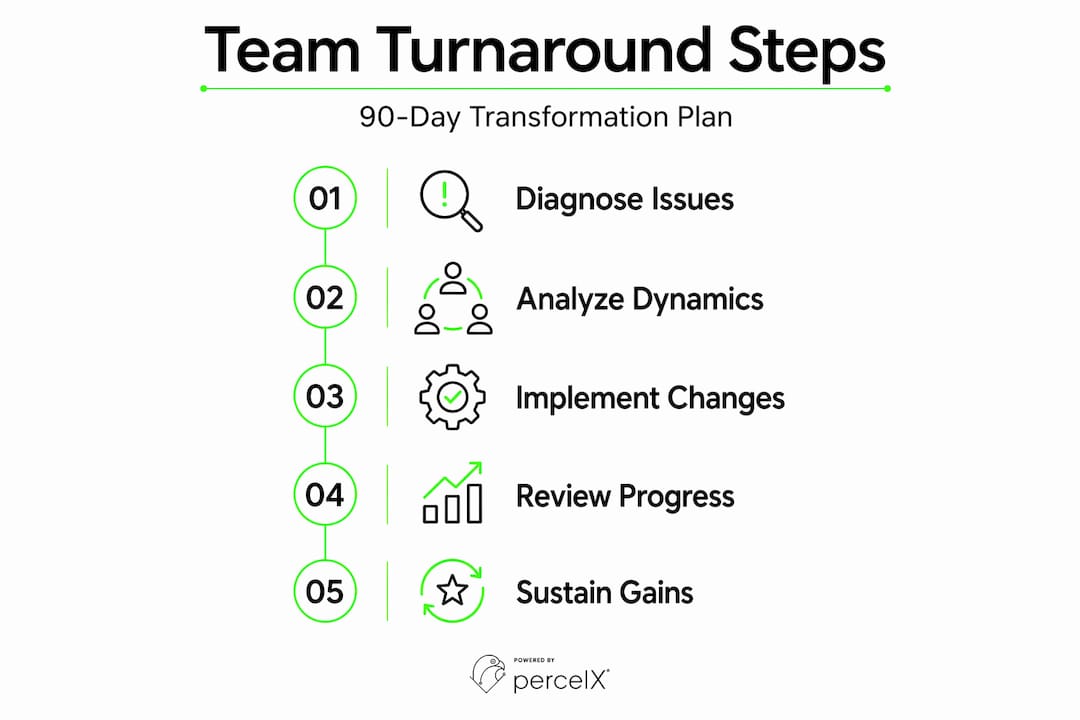
A well-designed TPIP runs in three phases across 60 to 90 days:
- Days 1 to 14: Diagnosis. Gather data, identify root causes, and communicate transparently with the team about the process. Do not hide that you are running an intervention.
- Days 15 to 60: Intervention. Implement the targeted changes per root cause. Install the operating cadence described below. Make the behavior changes visible.
- Days 61 to 90: Assessment. Measure progress against your baseline. Decide whether the intervention is working, needs adjustment, or has reached its limit.
The operating cadence is the glue that holds the plan together. Without it, improvement efforts dissolve into good intentions. Install these rhythms from day 15:
- Weekly 1:1s with each team member focused on blockers and momentum
- Biweekly retrospectives examining what is working and what needs to change
- A shared decision log to create accountability and reduce revisited decisions
- Monthly pulse checks to track psychological safety and engagement trends
Transparent communication with your team throughout this process is non-negotiable. Tell them what you observed, what you are changing, and what you expect to see improve. People perform better when they understand the plan and feel respected enough to be included in it. You can also review effective management review practices to structure your progress check-ins with more rigor.
The 90-day boundary is a feature, not a limitation. TPIPs should not exceed 90 days because extended interventions mask root causes that require escalation. If you reach day 90 without meaningful progress, the issue likely requires a different kind of intervention, whether that is a structural reorganization, a resourcing decision, or a role change.
Pro Tip: At day 45, schedule a mid-point review with yourself. Ask: which of my three biggest assumptions from the diagnosis phase have been confirmed, and which have been wrong? Adjust your remaining intervention based on what you have actually learned.
My honest take on what actually moves the needle
I have seen leaders run every tool in this article and still get stuck. More often than not, the sticking point is not the framework. It is the leader's willingness to audit their own behavior with the same rigor they apply to their team's performance.
Blaming individuals feels faster and cleaner than examining your own behavioral patterns. But in my experience, when a team shifts, it is almost always because the leader changed something visible and consistent about how they behaved in critical moments, not because one underperformer was managed out.
The idea that psychological safety is "soft" is one of the most expensive misconceptions in management. A 2026 study of 84 teams found psychological safety directly influenced both cooperation and dynamic capabilities in teams, two mechanisms that drive measurable performance improvement. That is not a culture metric. That is a performance metric.
What I have found works most reliably is what I call diagnostic humility: the practice of staying genuinely curious about root causes rather than defaulting to the most convenient explanation. The leaders who do this well tend to run shorter, more targeted interventions with better outcomes. They are also the ones their teams trust most, which is not a coincidence.
If you are willing to do that kind of honest self-assessment, you already have the most important ingredient for turning your team around.
— Percell
See your team's hidden patterns with Percelx
You now have the framework. The next step is getting the data to make it work. Percelx's behavioral intelligence platform helps team leaders identify the hidden behavioral patterns affecting decision-making, communication, and performance across their teams.
Through Percelx's 360° team assessment, you get a customized transformation plan built around your team's specific gaps, not generic advice. The platform diagnoses foundational behavioral dynamics, tracks progress over time, and gives you a clear path from where your team is now to where it needs to be. With a 4.9-star satisfaction rating, Percelx is the partner serious leaders turn to when they are ready to stop guessing and start growing. Start your team assessment today.
FAQ
What does an underperforming team actually look like?
Underperforming teams typically show symptoms like missed deadlines, low initiative, frequent conflict, and disengagement. The root cause is often a systems or leadership issue rather than individual failure.
How long does it take to improve team performance?
A structured 60 to 90 day Team Performance Improvement Plan gives most leaders enough time to diagnose root causes, implement targeted changes, and assess measurable progress before deciding on next steps.
Why is psychological safety so important for team dynamics?
Psychological safety is the foundation for candor, risk-taking, and learning in teams. Google's research found it outperforms talent and composition as a predictor of high performance.
What is the Waterline Model for teams?
The Waterline Model is a diagnostic framework that separates team issues into four layers: structure, dynamics, interpersonal, and individual. It guides leaders to solve problems from the surface level downward to avoid misdiagnosis.
How do I know if my leadership behavior is causing team problems?
Audit how you handle decisions, conflict, and failure in meetings. Leader behavior patterns in these moments are the primary driver of team dynamics and can either reinforce or undermine psychological safety.