

A customized team transformation plan is a behavior-focused operating system designed to align how a specific team makes decisions, communicates, and performs against measurable strategic goals. Unlike a generic training program or a company-wide mandate, this plan is built around the actual behavioral patterns, capability gaps, and performance barriers unique to your team. Organizations like McKinsey, Asana, and specialized consulting firms have moved toward this model precisely because top-down transformation initiatives consistently fail to produce lasting behavior change at the team level. The plan combines tailored activation sessions, defined decision rights, and structured operating rhythms to convert reactive team habits into intentional, high-performance patterns.
What are the core components of a customized team transformation plan?
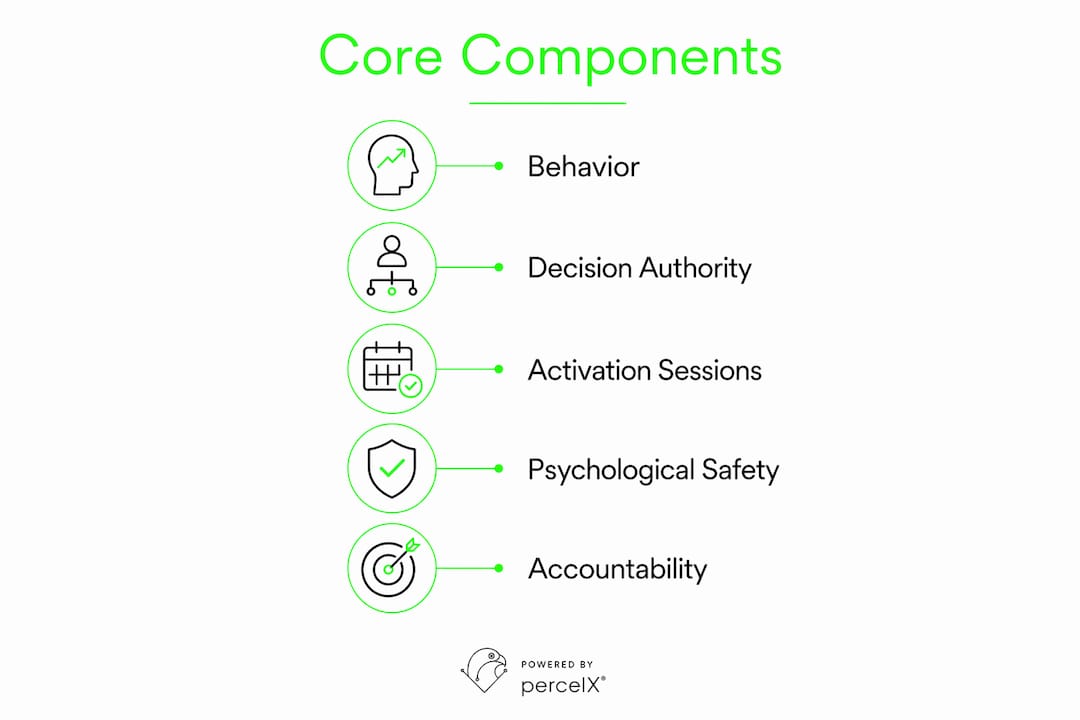
A customized team transformation plan is built on four structural elements that work together to shift both behavior and results. Each component addresses a different layer of how teams actually function day to day.
Activation sessions with time-bounded outcomes anchor the plan in real timelines. A 2-day activation session with 30-day and 90-day outcome milestones and fixed retrospectives gives the team a concrete operating cadence rather than an open-ended aspiration. This structure prevents the most common failure mode in team development: momentum that fades after the first workshop.
Decision authority matrices define who decides, who consults, and who is simply informed on every major category of team work. Without this clarity, teams default to either over-consensus (slow, frustrating) or unilateral calls that erode trust. Mapping decision rights is one of the highest-leverage moves a team leader can make in the first 30 days of any transformation effort.
Psychological safety paired with performance accountability forms the behavioral foundation. Safety without accountability produces groupthink; accountability without safety produces silence. Both conditions kill the fast feedback loops that transformation depends on. The plan must explicitly build both conditions simultaneously, not treat them as separate initiatives.

Operating rhythms include the recurring check-ins, feedback loops, and retrospective cycles that reinforce new behaviors between activation events. These are not optional add-ons. They are the mechanism through which behavioral change becomes habit.
Here is what a well-structured plan includes at the component level:
- Activation session agenda with defined outcomes and assigned owners
- Decision rights matrix covering at least five to eight recurring decision categories
- Psychological safety norms documented and agreed upon by the full team
- 30/60/90-day behavioral milestones with acceptance criteria and success metrics
- Biweekly pulse surveys to track alignment, trust, and workload balance
- Fixed retrospective schedule with structured reflection questions
Pro Tip: Write your behavioral milestones with explicit acceptance criteria. "Improved communication" is not a milestone. "All project decisions documented and shared within 24 hours" is.
How does a customized plan differ from generic transformation approaches?
The difference between a customized team transformation plan and a generic approach is not just depth. It is the unit of change. Generic transformation programs target the enterprise. Customized plans target the team.
| Dimension | Generic transformation | Customized team plan |
|---|---|---|
| Unit of focus | Organization-wide | Individual team |
| Design basis | Best practice templates | Team-specific barrier assessment |
| Activation method | Cascaded mandate or training | Facilitated activation sessions with stakeholders |
| Decision authority | Assumed or unclear | Explicitly mapped per decision category |
| Reinforcement | One-time training event | Ongoing operating rhythms and retrospectives |
| Measurement | Lagging indicators (annual surveys) | Leading indicators (biweekly pulse, decision cycle time) |
McKinsey research shows that unit-by-unit tailoring based on honest conversations about barriers is the critical differentiator in team-based transformation. This means leaders sit down with their teams, identify the specific performance gaps, and design interventions that match those gaps rather than applying a company-wide playbook.
Generic programs also suffer from plan churn. When team assembly and transformation planning happen sequentially rather than in parallel, the plan is often rewritten after the team is finalized. Running distinct workstreams for team assembly and planning simultaneously prevents this waste. The team that activates the plan is the same team that shaped it.
Customization also changes the measurement model. Generic programs rely on annual engagement surveys or post-training assessments. Customized plans use behavioral practices with explicit acceptance criteria, 30/60/90-day timelines, and frequent monitoring checkpoints. That frequency is what separates a plan that sticks from one that fades.
How to create and implement an effective team transformation plan
Building a customized team development strategy requires a phased approach. The following sequence reflects what consulting practitioners and research-backed frameworks identify as the most reliable path from diagnosis to sustained performance.
-
Map capability gaps before you build the plan. The 90-Day Formation Window methodology starts with internal assessments to identify what skills, roles, and behavioral patterns are missing. This step often surfaces gaps that leaders assumed were filled. External hires or role reassignments happen here, before the plan launches.
-
Select your highest-impact teams first. Prioritize 10 to 20 teams based on strategic impact and assign each an executive sponsor with a clear 90-day value target. Early wins in high-visibility teams create cultural credibility that makes scaling to subsequent waves far easier.
-
Run a structured activation session. Bring the team and its executive sponsor together for a facilitated session. Asana's change management process emphasizes that early stakeholder engagement and a documented roadmap are non-negotiable for adoption. The activation session is where the team co-creates its decision rights matrix, behavioral norms, and 90-day milestones.
-
Set measurable outcomes across three time horizons. Define what success looks like at 30 days, 90 days, and six months. Each milestone needs a specific metric, an owner, and a review date. Vague goals produce vague results.
-
Build the operating rhythm into the calendar immediately. Schedule retrospectives, pulse surveys, and check-ins before the activation session ends. If these are left to be scheduled later, they rarely happen consistently.
-
Shift leader behavior from command to coaching. Transformation scales through peer proof and internal team coaches, not through mandates. Leaders who model the behavioral changes they are asking for create the credibility that sustains momentum across waves.
-
Expand in waves, not mandates. Once the first cohort of teams demonstrates measurable results, use those teams as proof points and internal coaches for the next wave. This approach builds organic momentum rather than compliance.
Pro Tip: Treat your first activation session as a diagnostic as much as a launch event. The conversations that surface during it will tell you more about your team's real barriers than any survey.
What are the measurable benefits of a tailored team performance plan?
The business case for customized team development strategies is grounded in measurable outcomes, not theory. McKinsey data shows that team-based transformation approaches produce efficiency gains of up to 30% and significantly faster decision cycles compared to enterprise-wide programs. That speed matters because slow decisions are one of the most consistent drags on team execution quality.
Tracking the right metrics is what separates a plan that delivers from one that simply runs. The most reliable leading indicators include:
- Decision cycle time: How long does it take the team to move from a decision trigger to a committed course of action?
- Error and rework rates: Are quality issues declining as behavioral norms take hold?
- Employee engagement scores: Biweekly pulse surveys tracking alignment, trust, and workload give you a real-time read on team health between formal retrospectives.
- Customer satisfaction scores: For customer-facing teams, this is the ultimate downstream indicator of whether internal behavior change is translating to external results.
Behavioral analytics tools and outcome dashboards make these metrics visible without requiring manual reporting. When teams can see their own progress in real time, the data itself becomes a reinforcement mechanism. The retrospective cycle then becomes a conversation about what the numbers mean rather than a debate about whether progress is happening.
The team improvement plan benefits compound over time. Teams that complete a full 90-day cycle with disciplined operating rhythms report stronger trust, cleaner decision processes, and higher retention of high performers. The plan does not just improve output. It changes the conditions under which people choose to stay and contribute.
Key takeaways
A customized team transformation plan works because it targets the specific behavioral patterns, decision gaps, and operating rhythms of a single team rather than applying a generic program across an entire organization.
| Point | Details |
|---|---|
| Customization is the core differentiator | Plans built on team-specific barrier assessments outperform enterprise-wide mandates consistently. |
| Operating rhythms sustain change | Biweekly pulse surveys, retrospectives, and check-ins are the mechanism that converts activation into habit. |
| Decision rights clarity accelerates performance | Mapping who decides, consults, and is informed removes the friction that slows most teams down. |
| Psychological safety requires accountability | Safety alone produces groupthink; both conditions must be built simultaneously for fast feedback to work. |
| Measure leading indicators, not just outcomes | Decision cycle time and engagement scores reveal whether transformation is working before lagging metrics catch up. |
What I've learned about team transformation that most frameworks miss
Here is the uncomfortable truth I have observed working across team transformation engagements: most plans fail not because the framework is wrong but because leaders underestimate how much their own behavior needs to change first.
You can design a perfect decision rights matrix and a disciplined retrospective schedule. If the team leader still defaults to making unilateral calls or skips the pulse survey review because the week got busy, the plan collapses. The team reads leader behavior as the real signal of what is expected, not the documented norms.
The second pattern I see consistently is rushing the formation phase. Skipping integration steps to get to activation faster creates capability gaps that surface at the worst possible moment, usually during the first high-stakes decision the team faces together. The 90-day formation window exists for a reason. Compressing it to 30 days to hit a launch date is a false economy.
What actually works is treating the plan as a living operating system rather than a project deliverable. Transformation does not scale through memos or speeches. It scales through teams that have clear goals, real authority, and the discipline to learn from their own data. When those three conditions are present, the plan becomes self-reinforcing. When any one of them is missing, you are managing compliance rather than building capability.
The leaders who get this right are the ones who show up to retrospectives with genuine curiosity rather than a defense of past decisions. That posture, more than any framework element, is what makes the difference.
— Percell
How Percelx supports your team transformation
Percelx is built for exactly the kind of behavioral intelligence work that makes customized team transformation plans succeed. The platform's 360° assessment approach surfaces the hidden behavioral patterns that affect how your team makes decisions, handles conflict, and sustains performance under pressure. Rather than waiting for a quarterly review to discover what is not working, Percelx delivers real-time behavioral data that feeds directly into your operating rhythms and retrospective cycles.
For team leaders and HR professionals ready to move beyond generic training, the Percelx team platform provides tailored assessments, coaching support, and outcome dashboards designed to track transformation progress at the team level. If you are building or scaling a customized plan, explore Percelx to see how behavioral intelligence accelerates every phase from activation to sustained performance.
FAQ
What is a customized team transformation plan?
A customized team transformation plan is a tailored operating system that aligns a specific team's behaviors, decision rights, and operating rhythms to measurable performance goals. It differs from generic training by targeting the unique barriers and dynamics of a single team rather than applying a one-size-fits-all program.
How long does a team transformation plan take to implement?
Most structured plans use a 90-day formation and activation window, with measurable milestones at 30, 60, and 90 days. Full behavioral embedding typically requires six months of consistent operating rhythms and retrospective cycles.
What metrics should I track in a team improvement plan?
Track decision cycle time, error and rework rates, biweekly pulse survey scores for alignment and trust, and customer satisfaction for customer-facing teams. These leading indicators reveal whether behavioral change is taking hold before lagging metrics like annual engagement scores catch up.
Why do generic transformation programs fail at the team level?
Generic programs apply enterprise-wide templates without accounting for the specific performance gaps, decision authority gaps, and behavioral patterns of individual teams. McKinsey research confirms that unit-by-unit tailoring based on honest barrier assessments is the critical factor that separates successful team transformation from programs that produce short-term compliance and long-term drift.
How does psychological safety fit into a team transformation plan?
Psychological safety is a structural component, not a cultural nice-to-have. It must be paired with performance accountability to produce the fast feedback loops that transformation depends on. Safety without accountability leads to groupthink; accountability without safety leads to silence. Both conditions must be built simultaneously from the first activation session.