

Decision-making under pressure is the skilled process of choosing a course of action quickly and effectively despite stress, uncertainty, and time constraints. Professionals face this challenge daily, from emergency responders choosing triage priorities to executives calling a market pivot in real time. The stakes are real: your brain physically changes how it processes information when cortisol and adrenaline flood your system. Understanding what is decision-making under pressure, and how to manage it, is the difference between reactive choices and intentional ones. This guide covers the neuroscience, proven techniques, and structured frameworks that improve your outcomes when the clock is running.
What is decision-making under pressure and why does it matter?
Decision-making under pressure is defined as the cognitive and emotional process of selecting among options when time is short, stakes are high, or stress is elevated. Psychologists often call this "high-stakes cognition," a term that captures both the speed requirement and the emotional load involved. The process draws on two competing mental systems: System 1, which is fast and automatic, and System 2, which is slow and analytical. Under pressure, your brain defaults to System 1. That shift is efficient but error-prone.
Pressure decision-making scenarios appear across every professional domain. A surgeon deciding whether to extend an operation. A coach calling a timeout with two seconds left. A manager responding to a data breach at midnight. Each scenario compresses the time available for deliberate thought and amplifies the emotional weight of the outcome. The consequences of poor choices in these moments are not abstract. They affect careers, teams, and lives.

The physiological side of this process is well documented. Cortisol narrows your attention to the most obvious threat. Adrenaline speeds up your heart rate and sharpens short-term focus, but it also reduces the range of options you perceive. Decision fatigue compounds the problem, draining mental energy and pushing you toward simpler, safer choices even when bolder ones are warranted. Recognizing these forces at work is the first step toward managing them.
How does stress affect decision quality?
Stress alone has a surprisingly small effect on decision quality. The real damage happens when stress combines with time pressure. Combined stress and time pressure reduce decision accuracy from 83% to 57%, a drop of 26 percentage points. That gap represents the difference between a reliable decision-maker and one who is essentially guessing under fire.
The neuroscience behind this shift is clear. When your threat response activates, the prefrontal cortex, which handles analysis, planning, and impulse control, loses influence. The amygdala, your brain's alarm system, takes over. You become more pessimistic, perceive fewer options, and fixate on the most salient piece of information rather than the most relevant one. This is not a character flaw. It is biology.
The practical implication is that pressure compresses what experts call the "veto window" for thoughtful responses. That window is the brief moment between stimulus and reaction where deliberate thought can intervene. When pressure is high and that window closes, impulsive decisions fill the gap. Building habits that reopen that window is the core goal of every effective technique covered below.
Pro Tip: Track your decision quality in low-stakes situations first. Patterns in calm conditions reveal your default cognitive style, which is exactly what pressure will amplify.
Effective techniques for making decisions under stress
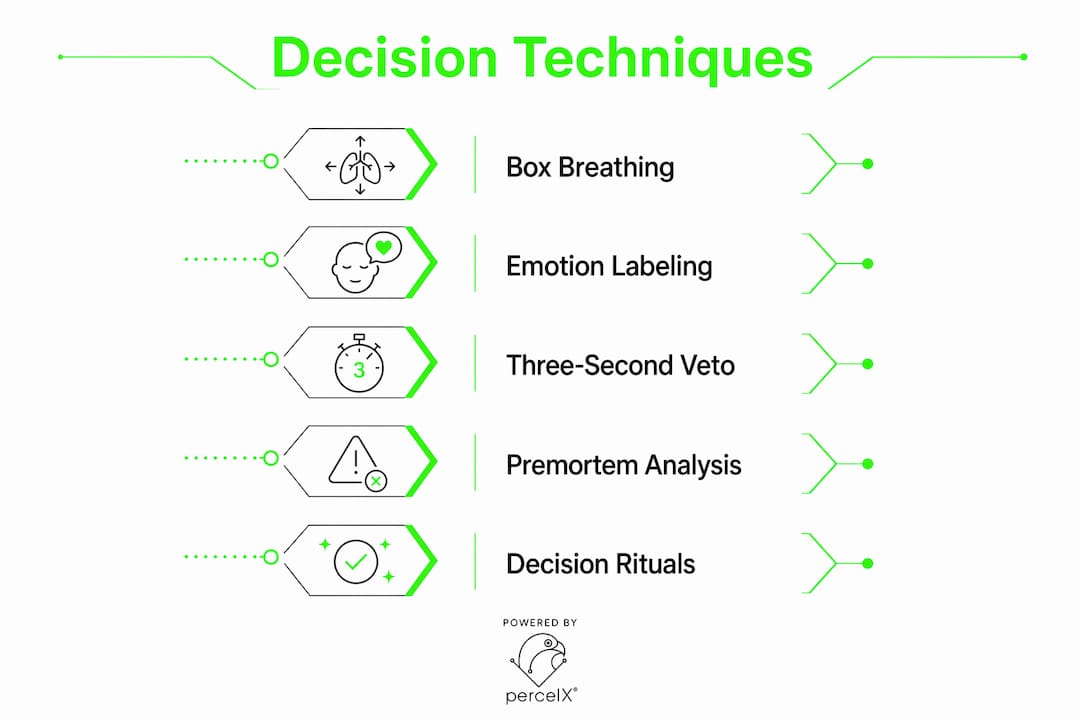
Three techniques consistently show up in research on how to make decisions under stress: box breathing, specific emotion labeling, and the three-second veto. Each one targets a different layer of the pressure response.
Box breathing
Box breathing for 90 seconds activates the parasympathetic nervous system, lowers cortisol, and restores cognitive clarity. The technique is simple: inhale for four counts, hold for four, exhale for four, hold for four. Navy SEALs and emergency physicians use it before high-stakes decisions for exactly this reason. The physiological reset it creates is measurable, not motivational. You are literally changing your brain chemistry before you choose.
Specific emotion labeling
Naming your emotions accurately reduces the amygdala's threat response and recruits the prefrontal cortex back into the process. The key word is "specific." Saying "I feel anxious" is less effective than "I feel anxious because I don't have enough information yet." Specificity gives your brain a problem to solve rather than a threat to flee. This technique, sometimes called affect labeling in neuroscience literature, takes under ten seconds and measurably shifts your mental state.
The three-second veto
The three-second veto technique works by inserting a deliberate pause before you act on an impulse. Count three seconds internally before responding to any high-pressure prompt. That pause is long enough for the prefrontal cortex to engage and short enough to avoid appearing indecisive. It prevents the costly errors that come from reacting before you have processed the full situation.
Here are four steps to build these techniques into your daily practice:
- Practice box breathing for two minutes each morning so it becomes automatic under pressure.
- Label your emotional state before any significant decision, even in low-stakes moments.
- Use the three-second veto in routine conversations to build the habit before you need it in a crisis.
- Debrief your decisions after the fact to identify which technique helped most and where gaps remain.
For athletes and performers, mental skills training integrates these same physiological tools into structured practice, reinforcing them before competition pressure arrives.
Decision frameworks for high-pressure situations
Techniques manage your state. Frameworks manage your process. The most effective strategies for pressured choices combine both, giving you a repeatable structure that reduces cognitive load when your mental energy is already depleted.
Two-way doors vs. one-way doors
Reversible decisions require speed, not perfection. Irreversible ones require caution, not speed. Amazon CEO Jeff Bezos popularized this distinction as "two-way door" versus "one-way door" decisions. A two-way door decision can be undone if it proves wrong. A one-way door cannot. Under pressure, most people treat every decision like a one-way door, which creates paralysis. Sorting your choice into the right category takes ten seconds and immediately clarifies how much deliberation is warranted.
Premortem analysis
Premortem analysis asks you to imagine that your decision has already failed, then work backward to identify why. This technique, developed by psychologist Gary Klein, surfaces hidden risks without the pessimism that comes from catastrophizing. It takes two minutes and consistently reveals blind spots that forward-looking analysis misses. Under pressure, those blind spots are where the most costly errors hide.
Decision rituals as cognitive scaffolding
Building decision rituals creates a cognitive scaffold that maintains quality when emotions run high. A ritual is a standardized sequence: breathe, name the decision type, list two options, apply the three-second veto, choose. The sequence itself becomes automatic, which means your mental energy goes toward the content of the decision rather than the process of making it.
The table below compares three frameworks by situation type:
| Framework | Best for | Speed | Risk of error |
|---|---|---|---|
| Two-way door vs. one-way door | Sorting decision urgency | Very fast | Low |
| Premortem analysis | Irreversible, high-stakes choices | Moderate | Very low |
| Decision ritual | Repeated high-pressure scenarios | Fast once practiced | Low |
Apply these frameworks in sequence when facing a complex pressured choice:
- Classify the decision as reversible or irreversible.
- If irreversible, run a two-minute premortem.
- Apply your decision ritual to generate and narrow options.
- Use the three-second veto before committing.
- Debrief within 24 hours to refine your process.
For teams, improving decision-making across leadership requires embedding these frameworks into shared protocols, not just individual practice.
Common cognitive biases that derail pressured choices
Pressure does not create cognitive biases. It amplifies the ones already present. Confirmation bias, the tendency to favor information that confirms your existing view, becomes more pronounced when time is short and you are scanning for quick validation. Analysis paralysis, the inability to choose because no option feels perfect, intensifies when the stakes feel high. Both patterns destroy decision quality in crisis moments.
Cognitive load reduction before deciding helps maintain goal clarity and reduces errors triggered by overwhelming information. The practical version of this is writing down your top priority before you begin evaluating options. That single sentence anchors your thinking and prevents you from drifting toward the loudest option rather than the best one.
Reappraisal is one of the most research-supported tools for managing these biases. Labeling anxiety as excitement shifts your brain from a threat state to a performance state. The physiological arousal is identical. The interpretation is not. That reframe changes which cognitive resources you access. Red-teaming, where you assign someone to argue against your preferred option, counters confirmation bias directly. It forces your brain to process disconfirming evidence before you commit.
Key cognitive traps and their countermeasures:
- Confirmation bias: Assign a red-team role to challenge your preferred option before deciding.
- Analysis paralysis: Focus on the next action, not the perfect solution, to maintain forward momentum.
- Stress-induced pessimism: Use reappraisal to relabel anxiety as readiness.
- Availability bias: Write down at least three options before evaluating any of them.
- Decision fatigue: Schedule high-stakes decisions earlier in the day when mental energy is highest.
Key takeaways
Effective decision-making under pressure requires managing your physiology, your process, and your cognitive biases simultaneously, not sequentially.
| Point | Details |
|---|---|
| Stress plus time pressure is the real threat | Decision accuracy drops from 83% to 57% when stress combines with time constraints. |
| Box breathing resets your brain chemistry | Ninety seconds of box breathing lowers cortisol and restores prefrontal function before you choose. |
| Classify decisions before you make them | Sorting choices as reversible or irreversible tells you exactly how much deliberation each one deserves. |
| Rituals outperform willpower under pressure | A practiced decision sequence preserves quality when emotional intensity is highest. |
| Reappraisal shifts your mental state fast | Labeling anxiety as excitement moves your brain from threat response to performance mode. |
What I've learned watching people decide under fire
The most common mistake I see is treating pressure as the enemy of good decisions. Pressure is not the enemy. Unmanaged pressure is. The professionals who decide well under fire are not calmer by nature. They have built systems that work when calm is not available.
The second pattern I notice is that people invest heavily in frameworks and almost nothing in physiology. You can know every decision model ever published and still make a terrible call if your cortisol is spiking and your prefrontal cortex is offline. The techniques in this guide, especially box breathing and emotion labeling, are not soft skills. They are performance prerequisites, the same way warming up before a sprint is not optional.
The third thing I have observed is that debrief culture separates good decision-makers from great ones. Reviewing your choices within 24 hours, even briefly, builds the pattern recognition that makes future pressured decisions faster and more accurate. You are not just learning from mistakes. You are training your System 1 to make better automatic calls the next time the window is short.
Pressure is manageable. The evidence is clear, the techniques are proven, and the frameworks are repeatable. What is missing for most people is consistent practice before the crisis arrives.
— Percell
How Percelx helps you build better decision patterns
Percelx is built for exactly this challenge. The platform's 360° behavioral assessment reveals the hidden patterns driving your decisions under stress, including the reactive behaviors that surface when pressure is highest. Rather than generic coaching, Percelx delivers a personalized transformation plan that targets your specific gaps in emotional regulation, cognitive flexibility, and decision consistency. Whether you are an individual professional, an athlete, or part of a leadership team, Percelx gives you the behavioral intelligence to turn reactive choices into intentional ones. Explore the Percelx platform to see how behavioral intelligence translates directly into better performance under pressure.
FAQ
What is decision-making under pressure?
Decision-making under pressure is the process of selecting a course of action quickly and effectively when stress, time constraints, or high stakes are present. It requires managing both physiological stress responses and cognitive biases simultaneously.
How does stress impact decision quality?
Stress alone has little effect, but combined with time pressure, decision accuracy drops from 83% to 57%. The brain shifts from analytical thinking to fast, automatic responses, increasing the risk of error.
What is the fastest technique for improving decisions under pressure?
The three-second veto is the fastest technique. Pausing three seconds before responding gives the prefrontal cortex enough time to engage and override impulsive reactions.
What is decision fatigue and how does it affect pressured choices?
Decision fatigue is the depletion of mental energy from making repeated choices. Under stress, it causes people to default to simpler or safer options, even when a bolder decision is clearly better.
How do decision frameworks reduce errors in crisis situations?
Frameworks like the two-way door distinction and premortem analysis reduce cognitive load by giving your brain a structured process to follow. That structure preserves decision quality when emotional intensity would otherwise degrade it.