

Mental performance coaching is the structured training of psychological skills — confidence, focus, motivation, resilience, and pressure management — designed to optimize how you perform when it counts most. Known formally as psychological skills training (PST), this approach is used by Certified Mental Performance Consultants (CMPCs), sports psychologists, and performance coaches across athletics, business, and the performing arts. Unlike therapy, it targets mentally healthy performers building execution skills, not diagnosing or treating clinical conditions. The distinction matters because it defines what you can expect from the process and who it is designed to serve.
What is mental performance coaching and how does it work?
Mental performance coaching is defined as a non-clinical, performance-focused approach that trains psychological skills through deliberate, repeated practice. The goal is not to fix a problem. The goal is to build a mental toolbox you can access reliably under pressure. Think of it the same way you think about physical conditioning: a sprinter does not just run races to get faster. She runs drills, builds strength, and rehearses starts. Mental performance training works the same way.
The core skills targeted include attention control, self-confidence, arousal regulation, and motivation. Mental skills are trainable competencies that regulate your internal state, not fixed personality traits or the result of positive thinking. An athlete who refocuses quickly after an error has trained that skill deliberately. A surgeon who stays calm during a complication has practiced that response. Neither outcome is accidental.
CMPCs are credentialed through the Association for Applied Sport Psychology (AASP) and must complete graduate-level education, supervised hours, and an ethics exam. This credential separates trained practitioners from general life coaches or motivational speakers. When you are selecting a mental performance coach, credential verification is not optional.
What mental performance coaching techniques are commonly used?
The mental coaching techniques used in structured programs fall into four primary categories, each targeting a different layer of performance readiness.
- Visualization and mental imagery: You mentally rehearse a performance scenario in vivid detail, engaging the same neural pathways activated during physical execution. Research confirms that imagery improves preparedness and confidence by reinforcing motor patterns and decision sequences before the moment arrives. A quarterback visualizing a two-minute drill is not daydreaming. He is training.
- Self-talk training: Your inner narrative directly shapes your focus and emotional state. Self-talk training teaches you to identify unhelpful thought patterns and replace them with instructional or motivational cues. "Stay low through the turn" is more effective than "don't fall behind" because it directs attention rather than amplifying fear.
- Relaxation and breathing techniques: Controlled breathing, progressive muscle relaxation, and box breathing regulate the autonomic nervous system. These tools reduce cortisol, lower heart rate, and shift you from reactive to responsive. They are the fastest physiological reset available without medication.
- Performance routines: Pre-performance routines anchor your mental state before high-stakes moments. A free-throw routine, a pre-presentation breathing sequence, or a consistent warm-up ritual all serve the same function: they create a reliable on-ramp to your optimal performance state.
Pro Tip: Practice your pre-performance routine in low-stakes settings first. A routine you have only rehearsed mentally will not hold under real pressure. Build it into daily practice until it becomes automatic.
These techniques are not used in isolation. A well-designed program layers them, starting with foundational skills like goal setting and breathing, then building toward advanced skills like imagery and pressure simulation. The sequence matters because basic psychological skills serve as the foundation for more complex ones.
How is mental performance coaching structured and delivered?
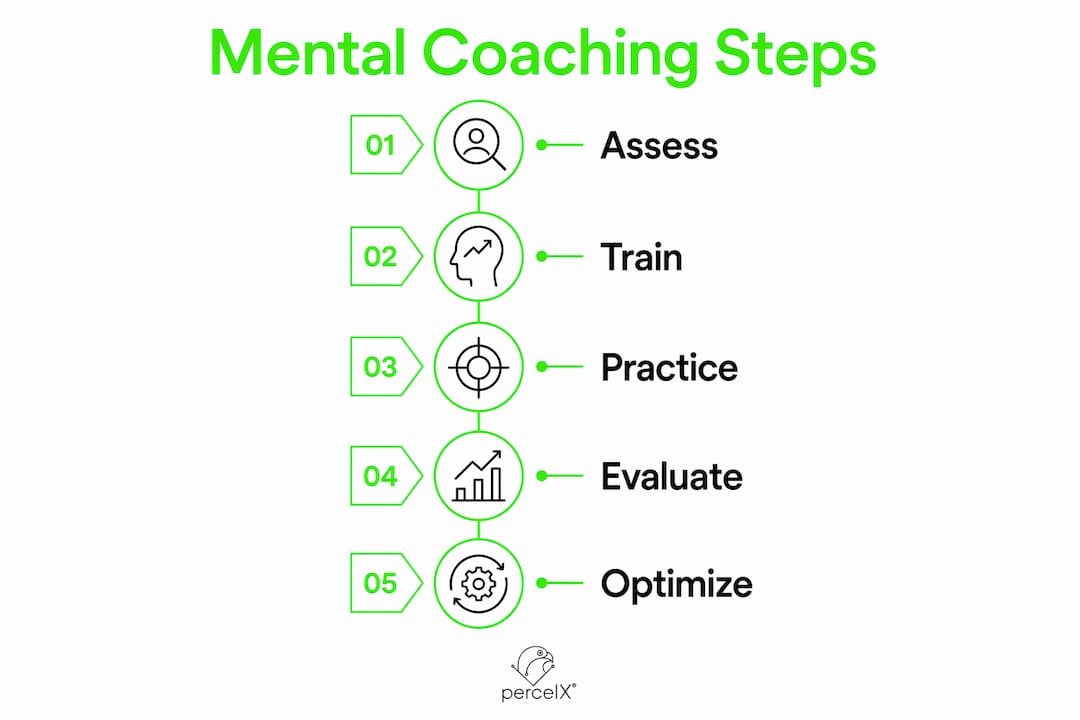
Mental performance coaching is not a single conversation. It is a structured program delivered across multiple sessions, typically over several weeks, with deliberate skill rehearsal between sessions. Here is what a well-designed program looks like in practice:
- Assessment phase: The coach identifies your current mental skill strengths and gaps using validated tools, interviews, or performance observation. This drives everything that follows.
- Skill introduction: Each technique is explained, demonstrated, and practiced in a low-pressure context so you understand the mechanism before applying it under stress.
- Rehearsal and repetition: Skills are practiced between sessions, much like physical homework. Without this repetition, the skills do not transfer to performance environments.
- Performance integration: Techniques are applied progressively in higher-pressure simulations, competition, or real-world performance settings.
- Evaluation and adjustment: The program is assessed for effectiveness and adjusted based on your progress and emerging needs.
A 2026 football study published in Frontiers in Psychology found that a structured 16-hour PSI program delivered over 8 weeks significantly improved mental toughness, decision-making, and tactical skills compared to regular training alone. The program included breathing exercises, positive self-talk, imagery, and autogenic relaxation. This confirms that the format matters as much as the content.
"Programs are needs-led, tailored, participant-driven, and evaluated for effectiveness, differing fundamentally from casual coaching conversations." — Psychological Skills Training Research
The distinction between mental performance coaching and casual coaching is structural. A credentialed program produces measurable outcomes. A motivational conversation produces temporary inspiration. You need to know which one you are paying for.
What are the benefits of mental performance coaching beyond sports?
The benefits of mental performance coaching extend well beyond the athletic field. Any domain where performance under pressure matters is a legitimate application. That includes corporate leadership, surgical teams, first responders, musicians, and trial attorneys.
The core benefits documented across populations include:
- Improved focus under pressure: Attention control training reduces distraction and keeps you task-focused during high-stakes moments.
- Greater confidence: Structured confidence-building through mastery experiences and self-talk recalibration produces durable self-belief, not just temporary motivation. Explore how confidence shapes performance across athletic and professional contexts.
- Emotional regulation: You learn to recognize and shift your emotional state before it derails your performance. This is not suppression. It is skilled management.
- Resilience under adversity: Mental resilience coaching builds the capacity to recover from setbacks faster and maintain momentum through difficulty.
- Reduced anxiety and burnout risk: Tech-enabled coaching with certified coaches reduces depression and anxiety symptoms and improves resilience as a preventive, lower-intensity support. This positions coaching as a scalable mental wellness tool, not just a performance enhancer.
Neuroscience-informed approaches add another layer. Somatic coaching integrates nervous system regulation techniques like breathwork and grounding to help clients shift physiological stress states in real time. When your nervous system is chronically activated, cognitive tools alone are insufficient. You cannot think your way out of a threat response. Somatic techniques address the physiological layer first, enabling higher cognitive functions to come back online.
For organizations, the case is equally strong. Early coaching interventions reduce moderate-need employees' symptoms and preserve therapist resources for severe cases. This makes mental performance coaching a scalable, cost-effective component of any workforce wellbeing strategy. For professionals building long-term careers, pairing mental performance strategies with a structured career growth plan creates compounding returns on both skill and mindset.
How does mental performance coaching compare to sports psychology and therapy?
Understanding what mental performance coaching is also means understanding what it is not. The three most commonly confused approaches are mental performance coaching, sports psychology, and clinical therapy.
| Approach | Primary focus | Credential required | Treats clinical conditions? | Typical setting |
|---|---|---|---|---|
| Mental performance coaching | Skill-building for performance optimization | CMPC (preferred) | No | Sports, business, performing arts |
| Sports psychology | Performance and psychological well-being in sport | Licensed psychologist or CMPC | Sometimes | Athletic programs, clinical practice |
| Clinical therapy | Diagnosis and treatment of mental health conditions | Licensed therapist or psychologist | Yes | Clinical or medical settings |
Mental performance coaching sits in a clearly defined lane. It works with performers who are psychologically healthy and want to perform better. Sports psychology overlaps with this but also encompasses clinical work. Therapy addresses diagnosed conditions and is not designed for performance optimization.
The ethical boundary is non-negotiable. Ethical coaching incorporates clear boundary setting with referrals to clinical care when mental health symptoms exceed the coaching scope. A reputable mental performance coach will recognize when a client needs a therapist and make that referral without hesitation. If a coach you are working with avoids that conversation, that is a red flag.
Pro Tip: Before hiring a mental performance coach, ask directly: "What is your credential, and what happens if I present symptoms outside your scope?" The answer tells you everything about their training and ethics.
For a deeper look at how sports psychology and mental coaching intersect, the distinctions become even more practical when you are selecting the right support for your specific goals.
Key takeaways
Mental performance coaching is a structured, evidence-based system for training psychological skills that directly improve focus, confidence, resilience, and decision-making under pressure.
| Point | Details |
|---|---|
| Defined scope | Mental performance coaching targets skill-building for healthy performers, not clinical treatment. |
| Structured programs work | Evidence shows multi-week programs with rehearsal produce measurable gains in mental toughness and decision-making. |
| Techniques are specific | Visualization, self-talk, breathing, and performance routines each target distinct layers of performance readiness. |
| Applications are broad | Benefits extend to business, performing arts, and high-stress professions, not just competitive sports. |
| Credentials matter | Look for CMPCs or licensed practitioners with defined scope boundaries and referral protocols. |
The mental edge most people skip
Here is what I have observed working at the intersection of behavioral intelligence and performance transformation: most people treat mental skills like a bonus, something you add after the physical or technical work is done. That framing is exactly backward.
The performers who plateau are almost always technically capable. Their ceiling is mental, not physical. They have the skills. They cannot access them consistently when the pressure spikes. That gap is not a character flaw. It is a training gap. And like any training gap, it closes with the right structure and repetition.
What I find most underappreciated is the physiological layer. Combining nervous system regulation with cognitive coaching produces better outcomes than cognitive tools alone, especially when stress is chronic. You cannot visualize your way through a full-body threat response. Breath comes first. Cognition follows.
The other thing I push back on consistently is the idea that a few coaching conversations constitute mental performance training. They do not. Skipping structured rehearsal means your skills will not be available when you need them most. The pressure moment is not the time to try a technique for the first time. Build it in practice. Test it in simulation. Then trust it in competition or the boardroom.
Mental skills are not soft. They are the hardest skills to build because they require you to train your own mind with the same discipline you apply to everything else. Start there.
— Percell
Build your mental performance foundation with Percelx

Percelx is built for performers who want more than motivation. The Percelx behavioral intelligence platform reveals the hidden behavioral patterns shaping your decisions, focus, and performance under pressure. Using a 360° assessment approach, Percelx delivers a personalized transformation plan that targets your specific mental performance gaps, not a generic program designed for someone else. Whether you are an athlete, a leader, or a coach building team capacity, Percelx gives you the data and the direction to move from reactive to intentional. For organizations, the Percelx 360 Enterprise solution scales this approach across teams, creating measurable alignment between individual mental performance and collective results.
FAQ
What does a mental performance coach do?
A mental performance coach trains psychological skills like focus, confidence, and resilience through structured, repeated practice. They design individualized programs, teach techniques like visualization and self-talk, and help clients apply those skills in high-pressure performance settings.
How long does mental performance training take to show results?
Research shows that structured programs delivered over 8 weeks with consistent rehearsal produce significant improvements in mental toughness and decision-making. Single sessions or casual conversations do not produce the same measurable gains.
Is mental performance coaching the same as therapy?
No. Mental performance coaching targets skill-building for psychologically healthy performers and does not diagnose or treat clinical conditions. Therapy addresses diagnosed mental health conditions and is delivered by licensed clinicians. A qualified coach will refer clients to therapy when symptoms fall outside the coaching scope.
Who benefits most from mental performance strategies?
Athletes, corporate leaders, surgeons, musicians, first responders, and coaches all benefit from mental performance strategies. Any role requiring consistent execution under pressure is a strong fit for this type of training.
How do I find a qualified mental performance coach?
Look for coaches credentialed as Certified Mental Performance Consultants (CMPCs) through the Association for Applied Sport Psychology, or licensed psychologists with a performance specialization. Ask about their scope boundaries and referral protocols before committing to a program.