

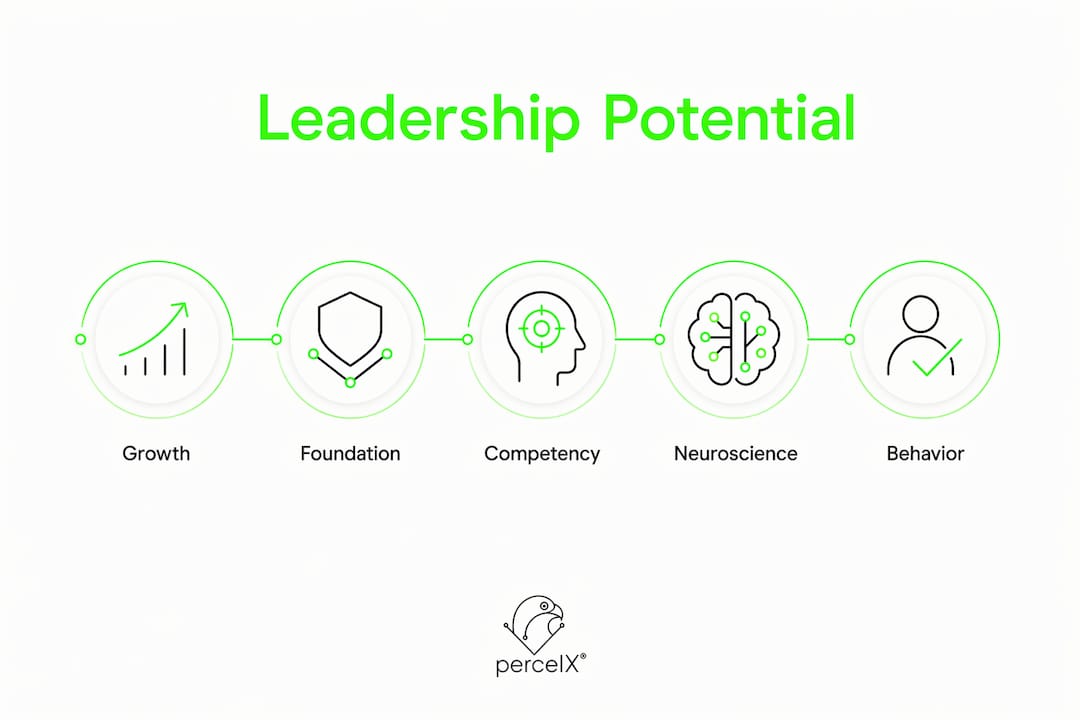
Leadership potential identification is defined as a multidimensional, evidence-based process of evaluating an individual's future capability to lead, not simply their current performance level. How organizations identify leadership potential has shifted decisively in 2026, combining behavioral observation, psychometric frameworks, and AI-powered cognitive assessments to surface leaders before they step into formal roles. Research from Wharton and validated competency models from firms like Korn Ferry confirm that the most accurate identification methods look beyond job titles and performance ratings. The Growth dimension of validated frameworks, covering adaptability, proactiveness, and promotability, predicts leadership readiness more reliably than any single trait or interview score. Organizations that adopt integrated, data-informed approaches build deeper pipelines and reduce the costly mistake of promoting the wrong people.
How organizations identify leadership potential: core traits and dimensions
The most validated framework for identifying future leaders organizes potential into three dimensions: Foundation, Growth, and Career. Foundation, Growth, and Career dimensions each capture distinct aspects of readiness, but research on 276 managerial employees confirms the Growth dimension carries the strongest predictive weight. This means adaptability, initiative, and promotability matter more than credentials or tenure when forecasting who will lead effectively.
The Growth dimension is not abstract. It shows up in specific, observable behaviors: an employee who volunteers for cross-functional projects, adjusts their approach when a strategy fails, or actively seeks feedback without being prompted. These behaviors signal the cognitive and emotional flexibility that leadership demands under pressure. Criteria for leadership traits rooted in the Growth dimension give HR teams a concrete, measurable target rather than a vague sense of "leadership presence."

The Foundation dimension covers baseline competencies such as technical proficiency and professional conduct. The Career dimension addresses ambition, long-term orientation, and organizational alignment. Both matter, but neither predicts leadership emergence as consistently as Growth. Understanding this hierarchy helps HR professionals prioritize what to measure first.
High-potential employees consistently demonstrate a specific cluster of behaviors before they hold any formal authority:
- Proactive initiative: Taking ownership of problems without being asked
- Coachability: Actively incorporating feedback and changing behavior as a result
- Peer influence: Earning trust and shifting group direction through credibility, not position
- Curiosity: Asking questions that challenge assumptions and open new possibilities
- Consistency: Delivering reliable results across different contexts and pressure levels
- Adaptability: Adjusting strategies and communication styles as circumstances shift
Early high-potential behaviors like these appear before formal leadership roles, which means organizations that wait for a promotion to assess potential are already too late. Emotional intelligence sits at the intersection of nearly all these traits. Emotional intelligence predicts an employee's ability to lead through change and conflict, making it a non-negotiable criterion in any serious leadership potential assessment.
| Dimension | Key Traits | Predictive Strength |
|---|---|---|
| Growth | Adaptability, proactiveness, promotability | Highest |
| Foundation | Technical skill, professional conduct | Moderate |
| Career | Ambition, organizational alignment | Moderate |
How do modern tools combine behavioral observation with AI and neuroscience?
Traditional interviews and annual performance reviews capture a narrow slice of leadership behavior. They reflect how someone performs in a structured, low-stakes conversation, not how they process information under pressure or shift strategy when a plan collapses. This limitation is why leadership potential assessment is evolving from static personality snapshots to dynamic cognitive and behavioral patterns captured through AI and neuroscience.
Wharton's WiN (Wharton Neuroscience Initiative) research demonstrates that decision strategy switching and attention distribution, both measurable through cognitive tasks, predict leadership emergence early and accurately. This is a significant finding. It means you can identify a future leader's cognitive signature before they have managed a single person. Platforms informed by this research, including neuroscience-informed tools like Lazul.ai, translate these cognitive signals into structured data that HR teams can act on.
Korn Ferry's psychometric frameworks add another layer by mapping personality, learning agility, and leadership style against validated competency models. When AI-enabled behavioral analytics combine with Korn Ferry-style psychometrics, the result is a richer, less biased picture of potential. The data surfaces candidates who would be overlooked in a purely subjective review process, particularly those from underrepresented groups whose leadership style differs from the dominant organizational norm.
Pro Tip: Never rely on AI assessment data alone. Use it to challenge your assumptions, not replace your judgment. The most effective talent evaluation combines algorithmic scoring with structured human observation, so that technology reduces bias while experienced leaders validate behavioral context.
Measuring leadership capabilities through this combined lens also reduces the halo effect, the tendency to rate high performers as high-potential leaders even when the two are not the same. Performance tells you what someone has done. Potential tells you what they are capable of doing next.
What structured frameworks do organizations use for consistent evaluation?
Consistency is the difference between a leadership identification process and a gut-feel exercise. Structured assessments combining psychometrics, situational judgment tests, and 360-degree feedback yield more reliable and less biased results than any single method. The key is building a system where every candidate is evaluated against the same criteria, by multiple raters, using tools calibrated for the specific leadership context.
Competency frameworks define what leadership looks like inside a specific organization. A competency model for a fast-scaling technology company will weight strategic thinking and ambiguity tolerance differently than one built for a regulated financial institution. Korn Ferry's Leadership Architect and similar frameworks give HR teams a structured vocabulary for describing and measuring leadership expectations across levels.
Situational judgment tests bring real-world complexity into the assessment room. The True-to-Life™ Leader V2, for example, simulates on-the-job leadership challenges and provides detailed feedback on candidate readiness. This format captures decision-making quality in context, not just self-reported preferences. Candidates cannot easily game a simulation the way they can rehearse answers to behavioral interview questions.
360-degree feedback adds the multi-rater dimension. Peers, direct reports, and managers each observe different facets of leadership behavior. Aggregating these perspectives through a structured instrument reduces the distortion that comes from any single evaluator's blind spots. Panel reviews and consistent rubric scoring prevent favoritism and personal bias from skewing results, which is especially important when identifying leaders across diverse teams.
| Tool | Strength | Best Use Case |
|---|---|---|
| Situational judgment tests | Captures decision-making in context | Early-stage candidate screening |
| 360-degree feedback | Multi-rater behavioral perspective | Mid-level and senior identification |
| Psychometric assessments | Personality and cognitive profiling | Pipeline benchmarking |
| Structured interviews with scorecards | Reduces interviewer bias | Final-stage evaluation |
| AI behavioral analytics | Reveals hidden cognitive patterns | Broad talent pool screening |
Pro Tip: Build your structured interview scorecard around Growth dimension behaviors, not job-specific skills. Ask candidates to describe a time they changed their approach after a failure, then score the quality of their self-awareness and adaptation, not just the outcome they describe.
How can organizations apply assessment results to develop future leaders?
Identifying potential without acting on it is the most common and most costly mistake in talent management. Successful organizations implement active development pathways like mentoring, stretch assignments, and coaching that translate assessment data into real growth. The assessment is the starting point, not the destination.
Stretch assignments are among the most effective development tools available. Placing a high-potential employee in a cross-functional project, a turnaround situation, or a role that requires managing upward forces rapid development of the exact Growth dimension traits that assessments measure. The assignment creates the conditions for adaptability and proactiveness to either emerge or reveal their absence. You learn more about a person's leadership potential in 90 days of a stretch assignment than in three years of standard performance reviews.
Mentoring and coaching accelerate development when they are tied directly to assessment findings. A generic mentoring program adds limited value. A program where a mentor receives the mentee's behavioral assessment data and focuses specifically on identified gaps creates measurable momentum. Platforms that track behavioral patterns over time, such as those built on behavioral intelligence solutions, allow both the individual and the organization to see progress against specific development targets.
The "labeling trap" is a real risk. When organizations identify someone as high-potential and then fail to provide structured development, two things happen. The individual either stagnates because they receive no meaningful challenge, or they leave because the label came with no substance behind it. Effective leadership pipelines depend on linking identification data directly to personalized development programs so that potential translates into performance.
Best practices for applying assessment results include:
- Share specific, behavioral feedback with the individual, not just a score or category
- Create a written development plan with 90-day milestones tied to assessment findings
- Assign a sponsor, not just a mentor, who advocates for the individual's visibility
- Revisit assessment data every six months to track behavioral change
- Integrate career growth planning with assessment outcomes so development aligns with organizational needs
Pro Tip: Use assessment data to customize development intensity, not just content. A high-potential employee who scores low on emotional regulation needs a different coaching cadence than one who scores low on strategic thinking. Personalization at this level is what separates programs that produce leaders from programs that produce reports.
Key takeaways
Organizations that identify leadership potential most accurately combine validated competency frameworks, AI-powered behavioral analytics, and structured multi-rater assessments, then link findings directly to personalized development programs.
| Point | Details |
|---|---|
| Growth dimension leads prediction | Adaptability, proactiveness, and promotability outperform credentials in forecasting leadership readiness. |
| AI and neuroscience reveal hidden patterns | Cognitive flexibility and decision-making under pressure are measurable early signals of leadership emergence. |
| Structured tools reduce bias | Situational judgment tests, scorecards, and 360 feedback create consistent, equitable evaluation across diverse candidates. |
| Identification without development wastes data | Assessment results must connect to stretch assignments, coaching, and personalized plans to produce real leaders. |
| Multidimensional approaches outperform single methods | Integrated assessment combining data, observation, and frameworks yields the most accurate and equitable identification. |
What I've learned about finding leaders before they raise their hand
The most talented leaders I have encountered in organizational work were rarely the ones who announced themselves. They were the ones who quietly changed the direction of a meeting, absorbed a setback and came back with a sharper plan, or earned the trust of their peers without any formal authority. Traditional identification processes, built around performance ratings and manager nominations, missed them consistently.
What changed my thinking was watching AI-informed behavioral assessments surface candidates that experienced managers had overlooked. Not because the managers were careless, but because the patterns these candidates displayed, cognitive flexibility, subtle peer influence, consistent adaptation under pressure, are genuinely hard to see without structured data. Neuroscience-informed tools do not replace human judgment. They make human judgment more honest by showing you what you were not trained to notice.
The uncomfortable truth about leadership identification is that most organizations are still running a system optimized for the past. They reward visibility and confidence, which correlates with leadership in some contexts and actively misleads in others. Broadening the pipeline means accepting that the next great leader in your organization might be the quietest person in the room. The data will find them. Your job is to build the system that lets the data speak.
HR leaders who adopt an integrated, people-centric mindset, one that treats assessment as a conversation starter rather than a verdict, will build pipelines that are both deeper and more diverse. That is not optimism. That is what the research consistently shows.
— Percell
How Percelx can strengthen your leadership identification process
Percelx is built for exactly the challenge this article describes. The platform's 360° behavioral intelligence system combines cognitive, personality, and behavioral data to reveal the hidden patterns that predict leadership fit, blind spots, and development readiness. HR teams and organizational leaders use Percelx to move from subjective nominations to data-driven identification, with personalized transformation plans delivered immediately after assessment. For organizations building or scaling a leadership pipeline, the Percelx enterprise solution for teams provides the multi-rater assessment infrastructure and behavioral tracking needed to turn identification into measurable development outcomes. With a 4.9-star satisfaction rating, Percelx delivers results that go beyond the report.
FAQ
What is leadership potential assessment?
Leadership potential assessment is a structured process of evaluating an individual's future capacity to lead using behavioral observation, psychometric tools, and cognitive measures. It focuses on future capability rather than current performance.
What traits best predict leadership potential?
Adaptability, proactiveness, and promotability within the Growth dimension are the strongest predictors of leadership readiness, outperforming technical skills or tenure in validated research.
How do organizations reduce bias in leadership identification?
Panel reviews, structured scorecards, and consistent rubric scoring reduce favoritism and personal bias, while AI behavioral analytics surface candidates who might be overlooked in subjective nomination processes.
How does 360-degree feedback support leadership identification?
360-degree feedback aggregates perspectives from peers, direct reports, and managers to capture a fuller behavioral picture than any single evaluator can provide, making it one of the most reliable tools for identifying leadership potential across diverse teams.
Why is identifying potential not enough on its own?
Assessment data loses its value without structured follow-through. Organizations must connect identification results to stretch assignments, mentoring, and personalized coaching plans to ensure that potential translates into actual leadership performance.