

Mental performance progress tracking is defined as the systematic use of validated assessments, daily wellness data, and cognitive metrics to measure and improve an athlete's psychological readiness for competition. Elite and youth athletes experience mental distress at rates between 20–35%, particularly during injury or career transitions. That figure means roughly one in four athletes on any roster is carrying a mental load that directly affects their output. To track mental performance progress in athletes effectively, you need three things working together: standardized screening tools, consistent data collection routines, and a clear method for interpreting what the numbers actually mean.
What tools and assessments are used to track mental performance progress in athletes
The foundation of any mental performance tracking system is a validated assessment. Without one, you are measuring feelings, not data.
The SMHAT-1 is a standardized three-step screening tool endorsed by the International Olympic Committee. It assesses six mental health domains, including anxiety, depression, sleep quality, alcohol use, substance use, and disordered eating, in 10–15 minutes. That efficiency makes it practical for team settings where time is always limited.

Beyond general mental health screening, psychometric tools like CSAI-2R and MIQ-3 measure mental skills specific to competition. The CSAI-2R (Competitive State Anxiety Inventory) quantifies pre-competition anxiety at the cognitive and somatic level. The MIQ-3 (Movement Imagery Questionnaire) evaluates an athlete's ability to use mental imagery, a core mental training technique for athletes. These tools give you a picture of the competitive mental game that general wellbeing surveys simply cannot provide.
Here is a practical breakdown of the primary assessment categories:
- General mental health screening: SMHAT-1, PHQ-9 (depression), GAD-7 (anxiety)
- Competitive mental skills: CSAI-2R for anxiety, MIQ-3 for imagery, TOPS (Test of Performance Strategies) for mental skills profiling
- Daily wellness monitoring: Mood, sleep quality, stress, and mental fatigue check-ins via digital platforms
- Cognitive performance metrics: Reaction time, attention control, and decision speed measured through cognitive testing apps
Digital platforms that support daily mental wellness check-ins add a real-time layer to what periodic assessments capture. The best of these platforms use gamification to improve honesty and team accountability, turning a mandatory data entry task into a shared mindfulness practice. That shift in framing matters because athlete buy-in is the single biggest variable in whether tracking data stays clean.
Pro Tip: Run the SMHAT-1 at the start of each training block, not just at the beginning of the season. Mental health status shifts with training load, and a single annual screen misses the periods of highest risk.
How to build consistent mental performance monitoring routines
Consistency in data collection is more predictive than the absolute scores themselves. A sudden drop in an athlete's morning mood score tells you more than a single low score taken in isolation.
Consistent timing in data collection, such as daily morning check-ins before training, helps differentiate meaningful trends from random noise. When athletes report at the same time each day, you build a personal baseline. Deviations from that baseline, not comparisons to team averages, are what signal burnout risk or performance readiness.
A practical monitoring routine for athletes and trainers looks like this:
- Daily morning check-in (2–3 minutes): Mood rating, sleep quality score, perceived stress level, and one open-text field for anything unusual. Keep it short or athletes will skip it.
- Weekly mental skills self-assessment (10 minutes): Use a brief version of a validated tool like the TOPS to track focus, confidence, and activation control across the week.
- Monthly psychometric review (15–20 minutes): Administer the CSAI-2R before a key training session or simulated competition to track anxiety trends over time.
- Seasonal SMHAT-1 screening: Run at the start of each major training block to catch emerging mental health concerns before they affect performance.
The weekly and monthly layers are where sports psychology performance tracking moves from reactive to proactive. You stop waiting for an athlete to show visible signs of distress and start reading the data before the problem surfaces in competition.
Pro Tip: Assign a team captain or designated peer to lead the daily check-in process. Peer accountability increases completion rates and reduces the social stigma around reporting low mental states.
How do you interpret mental performance data to improve athlete outcomes?
Raw data without interpretation is just noise. The goal is to connect cognitive metrics to training decisions.
The most important rule in data interpretation is to compare each athlete to their own baseline, not to the group average. An athlete who normally scores 8 out of 10 on focus and drops to 5 is showing a significant deviation. An athlete who consistently scores 5 is simply at their baseline. Treating both the same way leads to bad coaching decisions.
Neural adaptations often precede behavioral gains in mental training programs. Studies using fNIRS (functional near-infrared spectroscopy) show that prefrontal brain activity changes before any improvement in observable performance. This means an athlete can be making real cognitive progress weeks before their times, scores, or decisions improve visibly. Coaches who abandon mental training programs too early because they see no immediate results are cutting the program at exactly the wrong moment.
Brain endurance training (BET) improves endurance-related outcomes like time to exhaustion primarily through mental fatigue tolerance. It does not consistently affect maximal strength. That distinction matters when you are deciding which athletes benefit most from cognitive load training and which need a different mental training approach.
Use this framework when reviewing your data:
| Signal type | What it means | Recommended action |
|---|---|---|
| Sudden mood drop (2+ points) | Acute stressor or early burnout | Immediate coach-athlete conversation |
| Sustained low sleep scores | Chronic recovery deficit | Adjust training load, refer to sleep specialist |
| Rising CSAI-2R cognitive anxiety | Pre-competition mental overload | Add imagery and self-talk sessions |
| Flat MIQ-3 scores over 4 weeks | Imagery skill plateau | Modify imagery protocol, add video modeling |
| No change in daily check-ins | Possible disengagement with tracking | Review gamification approach, reset buy-in |
When data shows a sustained pattern across two or more metrics, that is the signal to involve a sport psychologist. A single bad week is noise. Two consecutive weeks of declining mood, rising anxiety scores, and poor sleep is a pattern that requires a structured response. Knowing the difference is what separates athlete cognitive performance metrics from guesswork.
What are the best practices and common challenges in mental performance monitoring?
The biggest barrier to effective mental performance tracking is stigma. Athletes, particularly in team sports, often resist reporting low mental states because they fear being seen as weak or losing their starting position.
Hybrid monitoring models that combine face-to-face psychological support with digital tracking tools are the most effective approach for overcoming stigma and logistical barriers. Digital check-ins give athletes a private channel to report honestly. In-person sessions give coaches and sport psychologists the context to interpret what the data is showing.
Team culture is the infrastructure that makes tracking work long-term. When coaches model vulnerability by discussing their own stress management openly, athletes follow. When tracking data is used to support athletes rather than evaluate or punish them, completion rates stay high and data quality improves.
"The teams that get the most from mental performance tracking are the ones where the coach treats the data as a tool for support, not surveillance." This distinction shapes everything from athlete honesty to long-term program adherence.
Common challenges and how to address them:
- Travel and schedule disruption: Use mobile-first digital platforms that athletes can complete in under three minutes from anywhere.
- Data noise from inconsistent timing: Standardize check-in windows (for example, within 30 minutes of waking) to reduce variability.
- Low athlete buy-in: Introduce gamified tracking approaches that reward consistency rather than score outcomes.
- Overinterpretation of single data points: Establish a written protocol that defines what constitutes a meaningful deviation before the season starts.
- Coaching staff skepticism: Share the research on neural efficiency and BET outcomes to build internal credibility for the program.
The athletes and trainers who succeed with mental performance monitoring treat it the same way they treat physical conditioning data. They collect it consistently, interpret it carefully, and act on it deliberately.
Key takeaways
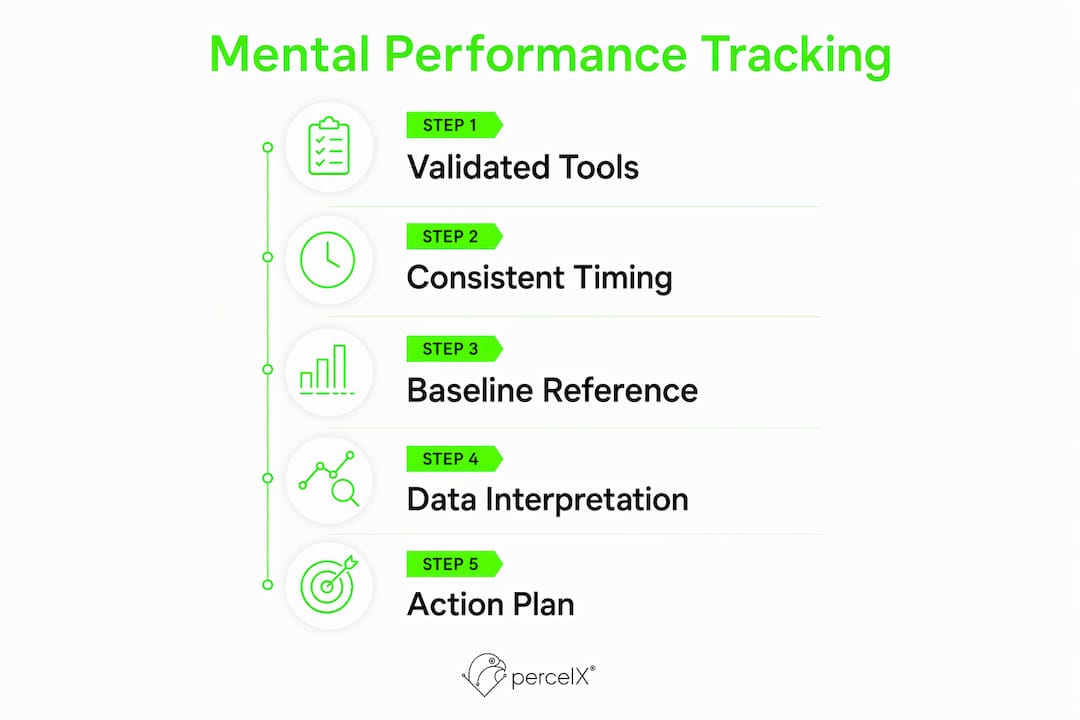
Tracking mental performance progress in athletes requires validated tools, consistent timing, and baseline-referenced interpretation to produce data that actually improves competitive outcomes.
| Point | Details |
|---|---|
| Use validated assessments | SMHAT-1, CSAI-2R, and MIQ-3 give you reliable, comparable data across time. |
| Prioritize consistency over frequency | Daily check-ins at the same time each day produce cleaner signals than sporadic deep assessments. |
| Compare to individual baselines | Deviations from an athlete's own norm reveal more than comparisons to team averages. |
| Expect cognitive gains before visible results | Neural adaptations precede behavioral improvements, so maintain programs through the lag period. |
| Address stigma with hybrid models | Combining digital tools with in-person support increases honesty and long-term adherence. |
What I have learned from tracking mental performance in the field
The most common mistake I see athletes and trainers make is treating mental performance tracking as a one-time diagnostic rather than an ongoing practice. They run the SMHAT-1 in preseason, file the results, and move on. By midseason, they are reacting to problems that the data would have predicted weeks earlier.
Consistency matters more than the sophistication of the tool. An athlete who completes a simple three-question daily check-in for six months gives you more usable data than one who completes a comprehensive psychometric battery twice a year. The pattern is the insight. The pattern only appears when you collect data regularly.
The second thing I have learned is that cognitive changes are invisible before they are visible. Coaches expect to see performance gains within two or three weeks of starting a mental training program. When they do not, they cut the program. But the mental skills development research is clear: the brain adapts before the body shows it. Patience is not passive. It is a data-informed decision to stay the course.
Finally, the athletes who benefit most from tracking are not the ones with the highest scores. They are the ones who engage honestly with the process. A low score reported accurately is far more valuable than a high score reported to impress a coach. Building a culture where honesty is rewarded over performance on the check-in itself is the real work of mental performance monitoring.
— Percell
How Percelx supports mental performance tracking for teams and athletes
Percelx is built for exactly this kind of work. Its 360° behavioral intelligence platform reveals the hidden behavioral patterns that affect decision-making, focus, and performance under pressure. Athletes and trainers get customized assessment plans, real-time analytics, and personalized insights that connect mental and behavioral data in one place.

For teams ready to move beyond generic wellness surveys, Percelx offers enterprise team solutions that integrate mental health screening, cognitive performance metrics, and behavioral pattern analysis into a unified monitoring system. With a 4.9-star satisfaction rating, Percelx delivers measurable results for individual athletes and full rosters alike. The platform turns raw mental performance data into clear, personalized growth plans that coaches and athletes can act on immediately.
FAQ
What does it mean to track mental performance progress in athletes?
Tracking mental performance progress means using validated tools like the SMHAT-1 and psychometric assessments such as CSAI-2R to measure an athlete's psychological readiness, mental skills, and wellbeing over time. The goal is to identify trends and deviations that inform training adjustments before they affect competitive results.
How often should athletes complete mental health check-ins?
Daily morning check-ins are the most effective frequency for detecting meaningful trends. Consistency in timing matters more than the depth of each check-in, since regular data points build the individual baseline needed for accurate interpretation.
What is the SMHAT-1 and why is it used in sports?
The SMHAT-1 is an IOC-endorsed screening tool that assesses six mental health domains in 10–15 minutes. It is used in sports because it is fast enough for team settings and covers the full range of mental health concerns most likely to affect athletic performance.
Can mental training improve physical performance outcomes?
Brain endurance training improves endurance-related outcomes like time to exhaustion through mental fatigue tolerance mechanisms. Neural adaptations from mental training also precede observable physical performance gains, meaning the benefits are real even when they are not yet visible.
How do you get athletes to engage honestly with mental performance tracking?
Gamified check-in systems that reward consistency rather than score outcomes significantly improve honesty and completion rates. Combining digital tools with in-person psychological support creates a hybrid model that reduces stigma and builds the trust athletes need to report accurately.