

Athletic identity is defined as the degree to which a person identifies with the athlete role as a core part of their self-concept. This concept sits at the heart of what is identity in sport psychology, shaping how athletes think, behave, and respond to pressure, injury, and career change. Researchers measure it using the Athletic Identity Measurement Scale (AIMS), a validated tool refined to seven items across three subscales. Understanding your own athletic identity is not just academic. It directly affects your performance, your mental health, and your ability to adapt when sport no longer defines your daily life.
What is identity in sport psychology, and why does it matter?
Athletic identity is the recognized industry term for the psychological construct that describes how strongly a person sees themselves as an athlete. The stronger that identification, the more sport shapes their decisions, relationships, and emotional responses. A gymnast who organizes her entire social life around training, or a college quarterback who cannot picture himself outside of football, both demonstrate high athletic identity. The AIMS scale captures this across three dimensions: social identity (how others see you as an athlete), exclusivity (how much the athlete role crowds out other roles), and negative affectivity (emotional distress when sport is disrupted).
The role of identity in athletics goes well beyond self-description. Athletes with strong athletic identity show higher motivation, greater training consistency, and faster return-to-sport after minor setbacks. The risk appears when that identity becomes the only identity. When sport is everything, any threat to sport becomes a threat to the self.
What are the main components of athletic identity?
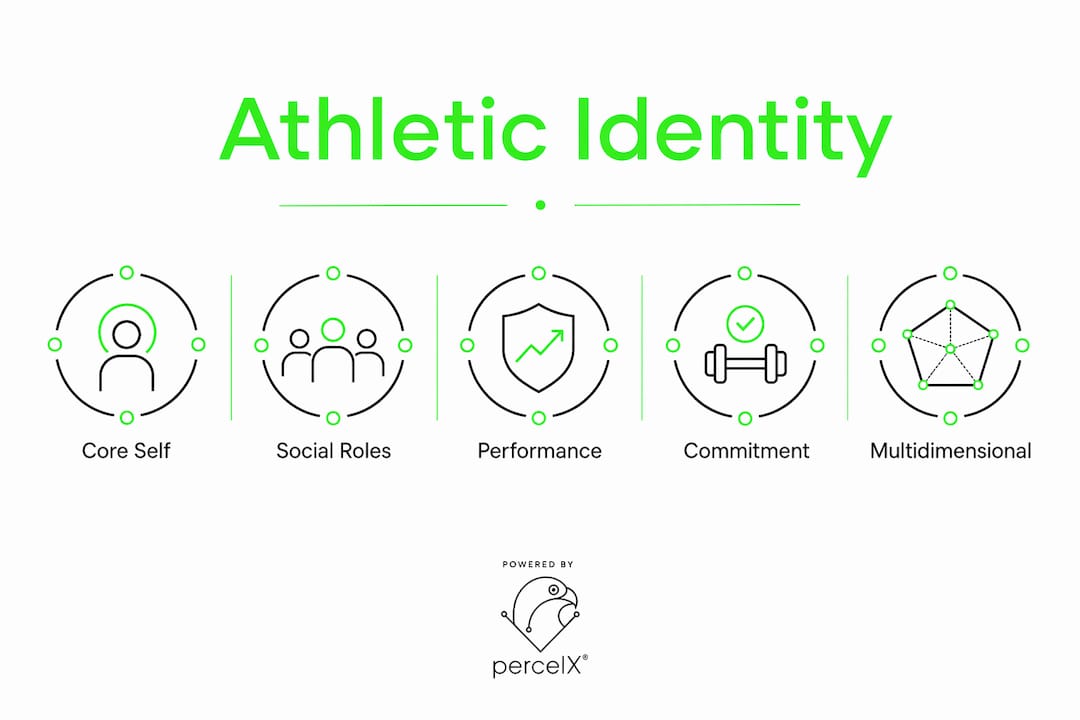
Athletic identity is multidimensional, not a single score on a scale. The three AIMS subscales each capture a different facet of how sport shapes the self.
- Social identity: How much others recognize and reinforce your athlete role. A swimmer whose coaches, family, and peers consistently call her "the swimmer" builds a strong social identity component.
- Exclusivity: The degree to which the athlete role crowds out student, professional, or personal identities. High exclusivity is the clearest predictor of identity-related distress.
- Negative affectivity: Emotional sensitivity to disruptions in sport participation, such as injury, deselection, or poor performance.
Research shows that identity profiles vary widely among student-athletes. Specifically, 71% hold a high multidimensional identity, 24% hold a low multidimensional identity, and only 5% carry an exclusive athletic identity. That 5% figure matters because exclusive identity is the profile most linked to psychological distress during transitions.
| Identity Profile | Prevalence | Key Characteristic |
|---|---|---|
| High multidimensional | 71% | Strong athlete identity alongside other roles |
| Low multidimensional | 24% | Moderate identification across all roles |
| Exclusive athletic | 5% | Athlete role dominates; other roles are minimal |
Athletic, student, and exercise identities interact constantly. A college athlete who also identifies strongly as a student tends to adapt better after graduation. That overlap is not a weakness in athletic commitment. It is a psychological buffer.
Pro Tip: Ask your athletes to rate how much they agree with the statement "Sport is the most important thing in my life" on a scale of 1–10. Athletes who score 9 or 10 consistently warrant a conversation about identity breadth.
How does athletic identity develop over a career?
Sports identity formation is an active, ongoing process rather than something that simply happens to an athlete. Researchers describe four phases using the Dimensions of Identity Development Scale (DIDS): exploration in breadth, commitment making, exploration in depth, and ruminative exploration. The first three phases build a stable, grounded identity. The fourth, ruminative exploration, involves obsessive questioning without resolution and hinders identity stability.

Early specialization accelerates identity commitment. A child who trains in a single sport from age eight receives constant social reinforcement of the athlete role. Parents, coaches, and peers all reflect that identity back. By adolescence, the athlete role can feel like the only real option. This is where identity foreclosure becomes a genuine risk. Foreclosure means committing to an identity without adequately exploring alternatives, which leaves athletes psychologically unprepared for any disruption.
Mastery transitions, such as moving from youth to elite competition, can boost self-concept and confidence. The same transition, however, can deepen foreclosure if the athlete's entire sense of worth becomes tied to performance outcomes. Elite Gaelic athletes, for example, report that early success intensified their athlete identity to the point where non-sport roles felt irrelevant.
Identity work describes the continuous, deliberate activities athletes use to build and maintain their sense of self. This includes training rituals, community involvement, mentoring younger athletes, and pursuing education or hobbies. Athletes who engage in identity work across multiple domains show stronger long-term wellbeing and greater emotional resilience.
Pro Tip: Coaches can support healthy identity development by asking athletes one question each month: "What are you proud of this week that has nothing to do with sport?" That single habit builds identity breadth over time.
What is the role of social identity in athlete performance?
Social identity refers to the group-based facets of self-concept that come from belonging to a team, squad, or sporting community. In sport psychology, the social identity approach treats team membership as a core source of psychological strength, not just a logistical arrangement. Strong team identity correlates directly with increased resilience under stress, better communication, and improved performance under pressure.
"When athletes share a strong sense of 'we,' they draw on collective resources that no individual identity can provide alone. The group becomes a psychological resource, not just a social one."
Coaches who build team identity deliberately create an environment where athletes feel they belong to something larger than their individual performance. This matters most during adversity. A team with a strong shared identity recovers faster from losses, handles conflict more constructively, and supports injured teammates more effectively.
Social identity loss is one of the most underestimated risks in sport. When an athlete retires or suffers a serious injury, they lose not just a role but a community. Research on the Social Identity Model of Identity Change shows that athletes with multiple social group memberships before a transition adapt significantly better. The group connections they built outside of sport serve as a buffer against the identity vacuum that retirement or injury can create.
Coaches can actively build positive team identity through several practices:
- Create shared rituals that reinforce collective values, not just performance metrics.
- Recognize contributions that go beyond statistics, such as leadership, mentorship, and communication.
- Facilitate team discussions about shared goals and group history.
- Include retired or injured athletes in team activities to maintain their sense of belonging.
How does athletic identity affect performance, wellbeing, and transitions?
The psychological identity in athletes directly shapes how they respond to injury, career change, and retirement. Athletic identity loss disrupts rehabilitation outcomes and affects return-to-sport readiness. An athlete who defines herself entirely through sport will experience injury as an identity threat, not just a physical setback. That psychological response slows recovery and increases the risk of premature return.
Identity foreclosure creates a specific vulnerability during career transitions. Athletes who never explored non-sport roles face retirement without a ready alternative self-concept. The result is emotional distress, loss of purpose, and in serious cases, depression or anxiety. This is the identity crisis in sports psychology that practitioners most frequently encounter in clinical settings.
The good news is that multidimensional identity profiles consistently predict better post-career adaptation. Athletes who balanced their sport identity with student, professional, or community roles before retirement reported stronger social support and smoother transitions. The data is clear: identity breadth is a performance asset, not a distraction.
Practical strategies for managing identity risks include:
- Assess identity breadth early. Use the AIMS scale or structured interviews to identify athletes with exclusive identity profiles before a crisis occurs.
- Build non-sport roles deliberately. Encourage education, community involvement, and skill development outside of training.
- Prepare for transitions proactively. Start career transition conversations at least two years before anticipated retirement.
- Maintain social connections during injury. Keep injured athletes connected to the team to preserve their social identity.
- Work with a sport psychologist. Professional support during transitions reduces the risk of identity-related distress significantly.
Pro Tip: Sport psychologists can use performance profiling as an entry point for identity conversations. Asking athletes to rate themselves on non-sport qualities opens the door to broader self-concept work.
Key Takeaways
Athletic identity is a multidimensional construct that shapes performance, wellbeing, and career transitions, and athletes with broader identity profiles consistently show better psychological outcomes.
| Point | Details |
|---|---|
| Athletic identity is measurable | The AIMS scale captures social identity, exclusivity, and negative affectivity across seven items. |
| Most athletes are multidimensional | 71% of student-athletes hold high multidimensional identity; only 5% hold an exclusive athletic identity. |
| Foreclosure creates real risk | Athletes who commit to sport identity without exploring other roles face greater distress during transitions. |
| Social identity buffers stress | Multiple group memberships before retirement or injury significantly improve adaptation and support. |
| Identity work builds resilience | Continuous, deliberate identity activities outside sport strengthen long-term wellbeing and performance. |
Why I think we underestimate identity as a performance variable
Most coaches and sport psychologists treat identity as a background factor, something to address only when an athlete is struggling. That approach is backwards. Identity shapes behavioral patterns every single day, from how an athlete responds to a bad training session to how they communicate with teammates under pressure.
What I have seen consistently is that athletes with exclusive identity profiles do not just struggle at retirement. They struggle during the season too. Their self-worth is so tightly coupled to performance that every setback becomes a personal crisis. That emotional volatility costs them focus, recovery time, and team cohesion.
The research on identity work confirms what good coaches have known intuitively: athletes who have a life outside sport perform better inside it. The security of a broader identity frees them to take risks, accept coaching, and bounce back from failure without catastrophizing.
Coaches carry more responsibility here than they often realize. The language you use, the questions you ask, and the values you reinforce all shape how athletes construct their identities. Calling an athlete "a natural leader" rather than just "a great scorer" is identity work. It costs nothing and compounds over time.
My honest recommendation: treat identity assessment as a standard part of your performance profiling process, not an afterthought. The athletes who thrive long-term are not always the most talented. They are the ones who know who they are beyond the scoreboard.
— Percell
How Percelx supports athlete identity and performance development
Understanding athletic identity is one thing. Acting on it is another. Percelx is a behavioral intelligence platform built to reveal the hidden patterns that shape how athletes think, lead, and perform under pressure.

Through its 360° behavioral assessment, Percelx delivers personalized profiles that map identity-related behavioral patterns across athletic, professional, and personal domains. Coaches and sport psychologists use these profiles to identify exclusive identity risks early, support multidimensional development, and prepare athletes for career transitions before a crisis hits. The Uri behavioral profiling feature goes deeper, offering individual athletes a clear picture of how their self-concept drives their decisions on and off the field. Percelx holds a 4.9-star satisfaction rating and delivers customized plans instantly, giving you a concrete foundation for identity-informed coaching.
FAQ
What is athletic identity in sport psychology?
Athletic identity is the degree to which a person identifies with the athlete role as a central part of their self-concept. It is measured using the Athletic Identity Measurement Scale (AIMS) across three dimensions: social identity, exclusivity, and negative affectivity.
What causes an identity crisis in sports psychology?
An identity crisis in sport psychology typically occurs when an athlete's exclusive identification with sport is disrupted by injury, deselection, or retirement. Athletes who have not developed non-sport roles are most vulnerable to this form of distress.
How does athletic identity affect performance?
Strong athletic identity increases motivation and training consistency, but exclusive identity raises emotional vulnerability to setbacks. Athletes with multidimensional identity profiles show better resilience and more stable performance across a season.
Can coaches influence an athlete's identity development?
Coaches directly shape identity through the language they use, the roles they reinforce, and the team culture they build. Deliberate practices such as recognizing non-sport contributions and facilitating team rituals strengthen both individual and group identity.
What is identity foreclosure in sport?
Identity foreclosure occurs when an athlete commits to the athlete role without exploring alternative identities. It reduces psychological flexibility and increases the risk of distress during career transitions such as retirement or serious injury.