
Pre-competition nerves feel universal. Your heart pounds, your palms sweat, your stomach turns. Most athletes accept this as part of the deal. But for an estimated 30 to 60% of athletes, what starts as normal nerves crosses into something clinically different. Understanding what is performance anxiety in sport means recognizing when those feelings stop sharpening your focus and start dismantling it. This guide breaks down the symptoms, psychological mechanisms, evidence-based management strategies, and the signs that tell you it's time to get professional support.
Table of Contents
- Key Takeaways
- What is performance anxiety in sport
- Causes and psychological mechanisms behind sports anxiety
- Evidence-based strategies to overcome sports performance anxiety
- When to seek professional support
- Practical mental preparation tips before competition
- My perspective on managing competitive anxiety
- Take your mental performance further with Percelx
- FAQ
Key Takeaways
| Point | Details |
|---|---|
| Anxiety vs. nerves | Normal pre-competition nerves sharpen focus; clinical performance anxiety causes distress and impairs execution. |
| Three symptom domains | Somatic, cognitive, and behavioral symptoms together define the full picture of competitive anxiety. |
| Perception drives anxiety | Anxiety spikes when you believe demands exceed your ability, not when difficulty is objectively high. |
| Tailored interventions work best | Matching the intervention to your anxiety type and competition level produces the strongest results. |
| Early recognition matters | Catching anxiety early through self-report or coach observation leads to faster, more effective recovery. |
What is performance anxiety in sport
Performance anxiety in sport, more formally called competitive anxiety or sport performance anxiety, is a psychological response characterized by clinically significant distress and measurable impairment in athletic performance. It goes well beyond ordinary nervousness. According to clinical frameworks, performance anxiety causes distress that interferes with an athlete's ability to execute skills they have already mastered. That last part matters. You are not struggling with a skill you haven't learned. You are struggling to access one you own.
The distinction between normal nerves and debilitating anxiety comes down to symptom domains. Three distinct categories define the full symptom picture:
- Somatic symptoms: Racing heart, excessive sweating, muscle tremors, nausea, shortness of breath, and gastrointestinal distress. These are the physical signals your body sends before and during competition.
- Cognitive symptoms: Worry, self-doubt, negative expectations, difficulty concentrating, and intrusive thoughts about failure. Your mind pulls attention away from execution and toward worst-case scenarios.
- Behavioral symptoms: Avoidance of competition, excessive fidgeting, withdrawal from teammates, and subtle patterns like refusing to warm up near opponents or skipping pre-game rituals.
The table below maps how these symptoms show up across severity levels:
| Severity level | Somatic signs | Cognitive signs | Behavioral signs |
|---|---|---|---|
| Mild | Elevated heart rate, light sweating | Minor worry, brief distraction | Slight fidgeting |
| Moderate | Nausea, tremors, chest tightness | Persistent self-doubt, fear of failure | Withdrawal, ritual disruption |
| Severe | Loss of motor control, vomiting | Inability to focus, cognitive shutdown | Complete avoidance, refusal to compete |
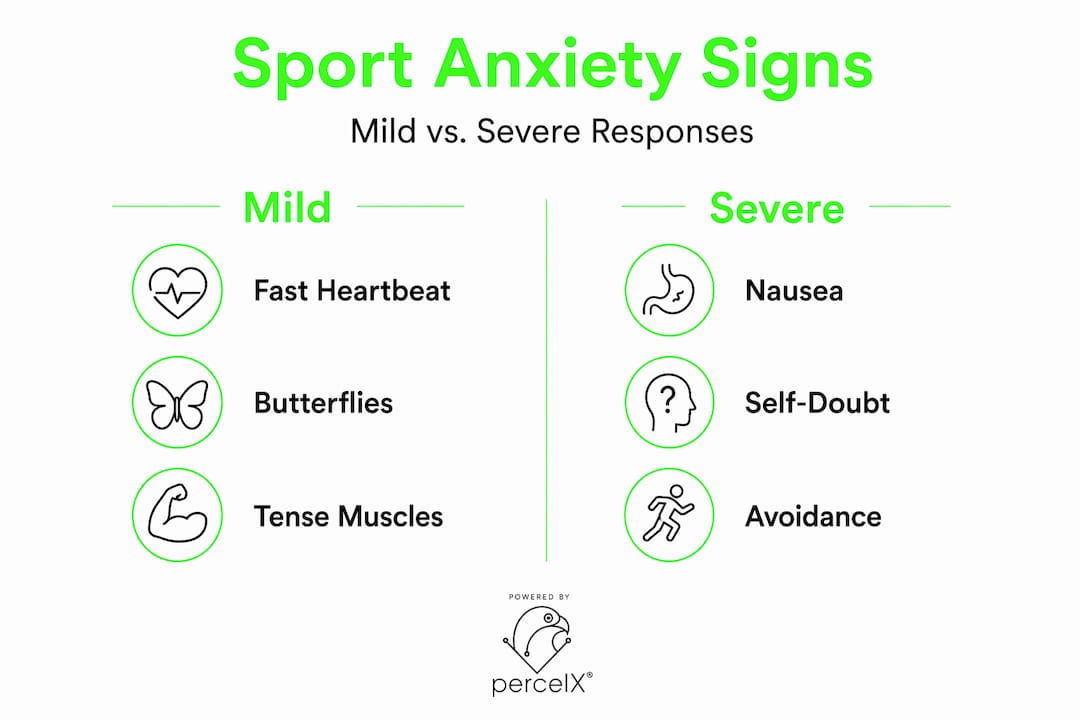
Normal anxiety sits at the mild end and resolves once competition begins. Clinical performance anxiety persists through competition or worsens under pressure, directly causing underperformance or withdrawal. Learning to read your own symptom pattern is the first step toward changing it.
Causes and psychological mechanisms behind sports anxiety
The core driver of competitive anxiety is perception, not reality. Anxiety arises when you perceive that the demands of a situation exceed your ability to handle them. Two athletes facing the same competition can experience radically different anxiety levels depending on how they interpret the stakes and their own readiness.
Psychologists distinguish between two components of competitive anxiety with different causes and effects:
- Cognitive anxiety involves mental worry, negative self-talk, and fear of failure. It disrupts attention and task planning. Cognitive anxiety tends to be more stable across a competition once it sets in.
- Somatic anxiety involves physiological arousal, the physical sensations of your fight-or-flight system activating. It tends to peak right before competition and can taper as you get into action.
These two components do not always move together, and that gap is clinically meaningful. Multidimensional anxiety theory confirms that cognitive and somatic anxiety have different trajectories and different effects on performance, which is why treating them requires different tools.
One counterintuitive truth: anxiety at lower levels can actually sharpen performance. That familiar pre-game buzz is your body allocating resources. The problem starts when arousal climbs past the point where it focuses attention and begins to fragment it. Knowing where you sit on that spectrum before competition is a skill athletes rarely develop, but it might be the most useful one available to you.
Sport type and athlete characteristics also shape anxiety levels. Individual sport athletes tend to experience higher competitive anxiety than team sport athletes, partly because there is nowhere to distribute responsibility when you lose.
Pro Tip: Before your next competition, take two minutes to label what you feel. Ask yourself: Is this physical tension, mental worry, or both? Naming the type of anxiety you experience is not just self-awareness. It tells you which strategy to reach for.
Evidence-based strategies to overcome sports performance anxiety
Managing competitive anxiety does not mean eliminating it. Pre-competition nerves are functional, and the goal is calibration, not suppression. Research identifies several psychological approaches with strong track records. The key is matching the intervention to your specific anxiety profile.
-
Psychological Skills Training (PST): PST bundles tools like goal setting, imagery, self-talk regulation, and attention control into a structured program. PST shows larger effect sizes reducing anxiety in adolescent and individual sport athletes than most other single interventions. If you compete solo or are in your teens, this is where to start.
-
Cognitive Behavioral Therapy (CBT): CBT targets the thought patterns driving cognitive anxiety. A CBT-trained sport psychologist helps you identify distorted beliefs about failure, challenge them, and replace them with realistic appraisals. This works best when your primary symptoms are mental worry rather than physical tension.
-
Mindfulness and Acceptance-Commitment approaches: Mindfulness-based interventions work particularly well for somatic anxiety. Instead of fighting physical sensations, you learn to observe them without judgment and keep executing. This is especially useful in endurance sports where physical discomfort is unavoidable.
-
Progressive muscle relaxation and breathing techniques: For somatic symptoms specifically, controlled breathing and progressive muscle relaxation lower physiological arousal before competition. These are accessible, require no therapist to practice, and show consistent results as standalone techniques for managing physical tension.
-
Biofeedback: Biofeedback devices measure real-time physiological data like heart rate variability and teach you to recognize and self-regulate arousal states. This approach closes the gap between abstract mental training and concrete body awareness.
The evidence is clear: tailored interventions outperform generic ones. A relaxation protocol handed to every athlete on a team will help some and do nothing for others. Knowing your anxiety type first, whether cognitive or somatic, makes every hour you invest in mental training more effective.
Pro Tip: Use the Competitive State Anxiety Inventory-2 (CSAI-2) before your next major competition. It separates cognitive and somatic anxiety scores in minutes and gives you and your coach or psychologist a clear starting point for choosing the right intervention.
You can also deepen your foundation by understanding sports psychology fundamentals, which shows how mental skills work alongside physical preparation.
When to seek professional support
Not every athlete who feels anxious before a game needs a sport psychologist. But some do, and missing that line has real costs. Here are the signs that indicate your anxiety has moved beyond what self-managed techniques can address:
- You consistently underperform relative to your training level, and the gap is widening.
- You experience panic attacks, dissociation, or physical symptoms severe enough to disrupt daily life outside sport.
- You begin avoiding competitions, making excuses not to attend, or quit activities you previously enjoyed.
- You lose access to skills you have mastered in practice the moment competition pressure arrives.
- Anxiety persists for extended periods before events, not just in the final minutes.
Early identification via clinical history and observation by coaches or parents enables much better intervention outcomes. This is especially true in youth sports, where anxiety often goes unreported by athletes and unnoticed by adults. A proactive screening question during a sports physical takes less than five minutes and can catch a pattern that would otherwise compound for years.
The biggest barrier to getting help is stigma. Athletes equate mental struggles with weakness, which is backwards logic. Seeking support for cognitive anxiety is no different than seeing a physiotherapist for a muscle strain. Both are about returning your body and mind to full function. Confidence in athletic performance is directly tied to how well you manage mental load, and that is a trainable skill, not a fixed trait.
Practical mental preparation tips before competition
Daily habits and pre-competition rituals build the psychological armor that keeps anxiety in a productive range. These are not complex programs. They are consistent, small decisions that compound over time.
- Reframe the sensation. Tell yourself your racing heart is preparation, not panic. Research confirms that reappraising arousal as excitement preserves performance better than trying to calm down.
- Stick to your routine. Consistency in warm-up, nutrition, and sleep signals safety to your nervous system. Disruption, even minor, amplifies uncertainty and feeds anxiety.
- Use brief visualization. Before you compete, spend two to three minutes seeing yourself execute the first key skill successfully. Visualization primes neural pathways and reduces the novelty that fuels anxiety.
- Accept uncertainty. You cannot control outcomes. You can control preparation and focus. Athletes who accept that uncertainty is part of the deal report lower cognitive anxiety and higher satisfaction regardless of results.
- Channel physical energy outward. If somatic arousal is high, use it. Light movement, dynamic warm-up, or power poses have measurable effects on cortisol and testosterone that shape your mental state going into competition.
None of these require a therapist. They do require practice. Mental preparation is a skill set, and like every other skill set in sport, it degrades without repetition.
My perspective on managing competitive anxiety
I've worked with athletes across levels, and the pattern I see most consistently is this: the ones who struggle most are not the ones with the most anxiety. They are the ones who have decided anxiety means something is wrong with them.
What I've found is that the reframe is everything. The athlete who walks into competition thinking "I'm nervous, which means I care and my body is ready" performs better than the athlete who walks in thinking "I'm nervous, which means I might fail." Same physiological state. Completely different outcomes.
What coaches and athletes overlook most often is the specificity problem. They treat all anxiety the same and wonder why generic breathing exercises don't help someone driven by cognitive worry about judgment. The research is clear: matching interventions to anxiety type produces significantly better results. One size fits no one in mental performance work.
My honest take: start mental skills training earlier than you think you need to. The athletes who build these habits at 14 are the ones who execute under pressure at 24. Waiting until anxiety becomes a crisis means you are learning stress management tools while already under stress. That is the hardest way to do it.
And if you need professional support, get it without apology. The stigma is eroding, but not fast enough. Your mental architecture is as trainable as your physical one.
— Percell
Take your mental performance further with Percelx

If you are serious about managing anxiety and optimizing your performance, understanding your behavioral patterns is where transformation begins. Percelx uses a 360° behavioral intelligence platform to reveal the hidden patterns shaping how you respond under pressure, whether you are an individual athlete or part of a team. The platform delivers personalized transformation plans instantly, turning reactive stress responses into intentional performance habits. For teams and organizations, Percelx for Teams offers performance analytics and behavioral insights that give coaches and athletes a shared language for mental excellence. Start building your mental edge today with tools designed for measurable results.
FAQ
What is the difference between nerves and performance anxiety?
Normal pre-competition nerves are temporary, manageable, and can sharpen focus. Performance anxiety is a clinical condition where distress and impairment are significant, causing athletes to underperform or avoid competition entirely.
What are the most common signs of performance anxiety in athletes?
The most common signs include a racing heart, nausea, muscle tremors, persistent worry, self-doubt, difficulty concentrating, and avoidance behaviors like skipping warm-ups or withdrawing from competition.
Can performance anxiety actually hurt athletic performance?
Yes. Cognitive anxiety disrupts attention and decision-making, while somatic anxiety can interfere with fine motor control. Research also shows that severe anxiety may increase injury risk by fragmenting an athlete's focus during high-demand movements.
What is the most effective way to overcome performance anxiety in sports?
The most effective approach depends on your anxiety type. Psychological Skills Training works best for adolescents and individual sport athletes, while mindfulness-based methods are better suited for somatic symptoms. A tailored assessment is the most reliable starting point.
When should an athlete seek professional help for anxiety?
If anxiety is causing you to consistently underperform relative to your training, avoid competitions, or experience symptoms in daily life outside sport, it's time to consult a sport psychologist or mental health professional.