

Transformation planning for teams is defined as the structured process of moving a team from its current state to a clearly defined future state, with deliberate capability transfer, operational continuity, and milestone accountability built in at every stage. This is not change management, which focuses on managing people's reactions to change. Transformation planning is the operational blueprint that governs how the change actually gets executed. It covers cutover sequences, knowledge transfer, readiness assessments, training, and post-transition support as distinct workstreams running in parallel. For team leaders and managers, understanding what is transformation planning for teams means understanding the difference between reacting to disruption and designing your team's evolution with intention.
What is transformation planning for teams, and why does it matter?
Transformation planning for teams is a standalone discipline, not a subset of project management or HR strategy. It answers three questions every team leader must resolve before launching any significant change: What does the future state look like in operational terms? Who owns each milestone? And how will you know when you are off track before it is too late?
The distinction from standard change management is critical. Change management addresses the human response to disruption. Transformation planning addresses the structural mechanics of getting from point A to point B without losing capability, momentum, or team cohesion along the way. McKinsey research confirms that teams with clear mandates and aligned outcomes are the ones that successfully scale transformation across an organization.
What makes this discipline distinct is its insistence on separating workstreams. Team formation, knowledge transfer, cutover planning, and communication strategy each require dedicated attention. Collapsing them into a single "change initiative" is one of the most common reasons transformation efforts stall at the 60-day mark. Percelx works with teams that have experienced exactly this pattern, and the behavioral data consistently shows that confusion about ownership is the root cause.

Pro Tip: Before you write a single milestone, map your current team's capabilities against the future state requirements. The gap between those two points is your transformation plan's actual scope.
What are the key components of effective transformation planning?
Effective transformation planning rests on six operational components that must be designed before execution begins. Each one addresses a specific failure mode that derails team change efforts.
- Cutover sequence and rollback readiness. The cutover plan defines sequence, timing, fallback scenarios, and rollback triggers. Most teams skip rollback planning because it feels pessimistic. It is not. It is the mechanism that gives your team permission to move fast without catastrophic risk.
- Knowledge transfer plan. This specifies knowledge topics, holders, recipients, and transfer methods including documentation, shadowing, walkthroughs, and hands-on practice. Knowledge transfer plans are consistently underestimated and require coordinated time from both project and operational teams.
- Readiness assessment. A structured checkpoint that confirms whether the team has the skills, tools, and authority to operate in the future state before the cutover happens.
- Milestone ownership. Every milestone must have a single named owner, not a team or a department. Shared ownership is the organizational equivalent of no ownership.
- Governance cadence. BCG research identifies a transformation office with defined roles, weekly leadership meetings, and quarterly town halls as the structure that maintains alignment and stage-gate discipline throughout execution.
- Communication plan. A scheduled, audience-specific communication plan that keeps stakeholders informed without creating noise or ambiguity.
| Component | Primary function |
|---|---|
| Cutover sequence | Defines the exact transition steps and fallback options |
| Knowledge transfer | Moves critical capability from current to future team |
| Readiness assessment | Confirms team is prepared before the switch |
| Milestone ownership | Assigns single-person accountability to every deliverable |
| Governance cadence | Maintains alignment and tracks progress through a transformation office |
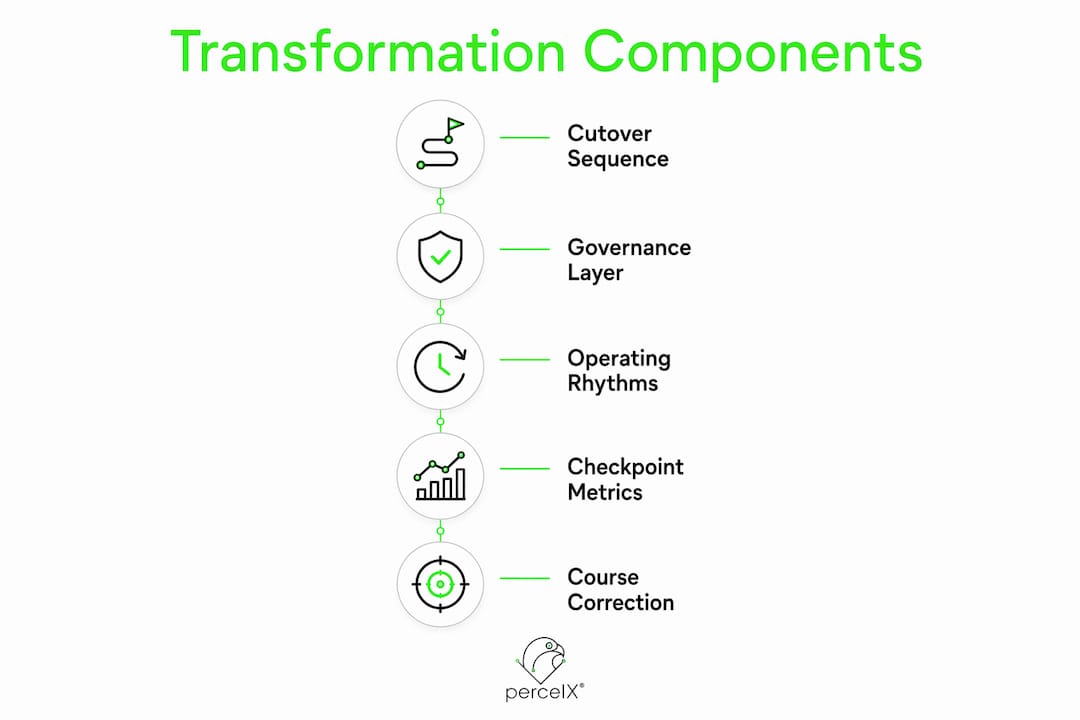
The governance layer deserves special attention. Visible operating rhythms managed by a transformation office make accountability tangible and increase a team's ability to adapt when conditions shift. Without this structure, transformation plans become documents rather than operating systems.
How does a 90-day operating rhythm drive team transformation?
The 90-day transformation plan is the most proven time-bounded structure for converting strategy into structural team change. It is not a quarterly operating plan. A quarterly plan manages ongoing performance. A 90-day transformation plan converts strategy into structural changes with milestones and checkpoint metrics designed specifically to signal when the team is drifting off course.
The three phases work as follows:
- Foundation and quick wins (Days 1 to 30). Establish operating norms, confirm milestone ownership, and deliver two or three visible wins that build team confidence and stakeholder trust. These early wins are not cosmetic. They set the behavioral tone for the entire plan.
- Core execution (Days 31 to 60). Execute the primary structural changes. This is where most teams experience energy loss, and it is entirely predictable. Mid-plan energy loss results from missing early quick wins communication, insufficient checkpoint metrics, or spreading team capacity too thin across too many initiatives.
- Integration and stabilization (Days 61 to 90). Embed new behaviors into routines, confirm knowledge transfer is complete, and run a final readiness assessment before declaring the transformation operational.
Checkpoint metrics are the control system that separates high-performing transformation teams from those that rely on gut feel. When checkpoint metrics function as signals, leadership discussions shift from impressionistic to evidence-based. You stop asking "How do you think it's going?" and start asking "What does the data show?"
Course-correction protocols must be built into the plan from day one. When a milestone signals off-track, the protocol defines who convenes, what options are evaluated, and how quickly a decision gets made. Teams that build this in advance move three times faster when problems surface than teams that improvise.
Pro Tip: Design your milestone structure so that at least one visible win lands before Day 21. Early momentum is not a morale exercise. It is a retention mechanism for team commitment to the full 90 days.
What strategies activate and sustain high-value team transformations?
Activation is the moment a team stops planning transformation and starts living it. The strategies that make this transition stick are grounded in both McKinsey and BCG research, and they share a common thread: the team must own the process, not just execute instructions from above.
- Clear mandate and shared outcomes. Teams that develop their own change process aligned with organizational strategy and values outperform teams that receive a change plan handed down from leadership. The mandate must be specific enough to guide decisions and flexible enough to allow experimentation.
- Embedded learning loops. Feedback practices built into weekly routines, not reserved for retrospectives, allow teams to catch behavioral drift before it becomes structural failure. Percelx's 360° assessment approach identifies these behavioral patterns in real time, giving leaders data they can act on within the operating cycle.
- Leader enablement over leader direction. The leader's role in transformation is to remove obstacles, model the target behaviors, and communicate authentically about progress and setbacks. BCG's research on human-centric transformation approaches consistently shows that leadership enablement, not directive management, produces sustainable outcomes.
- Change champions within the team. Identifying two or three team members who embody the target behaviors and giving them a visible role in the transformation accelerates adoption across the rest of the team.
"Culture change and behavior modeling from leadership are fundamental for sustainable transformation outcomes. Embedding new behaviors into routines, processes, and measuring progress with quantifiable metrics is not optional. It is the mechanism." — BCG, 2026
The culture dimension is where most transformation plans underinvest. You can redesign every process and still fail if the behavioral patterns driving daily decisions remain unchanged. Employee involvement up to 30% in transformation design correlates with higher shareholder returns, which means the teams you involve in building the plan are the ones most likely to execute it successfully.
How should teams be formed before launching transformation planning?
The single most expensive mistake in team transformation is launching the planning process before the team is fully formed. Mixing team formation with transformation planning prematurely leads to costly plan revisions because the capabilities needed to execute the plan are not yet present when the plan is written.
The 90-day formation window is the structured period for assembling transformation-specific capabilities before planning runs in parallel. It follows four sequential steps:
- Capability assessment. Evaluate the four transformation-specific roles every high-performing team needs: the Provocateur who challenges assumptions, the Pragmatist who stress-tests feasibility, the People Champion who maintains team cohesion, and the Pattern Reader who spots systemic risks early.
- Internal development. Identify existing team members who can grow into these roles with targeted development. This is faster and less disruptive than external recruitment when the capability gap is moderate.
- External recruitment. Fill critical capability gaps that internal development cannot close within the formation window. Rushing this step produces the wrong hire. Skipping it produces a plan that cannot be executed.
- Integration and operating norms. Before the transformation plan launches, the team must have established authority boundaries, conflict resolution protocols, and a shared understanding of how decisions get made under pressure.
Pro Tip: Run a final readiness assessment at Day 85 of the formation window, not Day 90. Give yourself five days to address gaps before the transformation planning phase begins. Teams that skip this step spend the first 30 days of execution fixing formation problems instead of executing milestones.
The formation window also requires you to establish operating norms explicitly. How will the team handle disagreement about milestone priorities? Who has authority to escalate a risk to the transformation office? These questions feel administrative until the first real conflict surfaces, at which point they become the difference between a team that adapts and one that fractures.
For leaders who want to measure transformation progress objectively throughout both the formation and execution phases, building behavioral baselines during the formation window gives you a reference point that makes later checkpoint metrics far more meaningful.
Key takeaways
Transformation planning for teams requires operational structure, single-person milestone ownership, and a governance cadence before any execution begins.
| Point | Details |
|---|---|
| Define the discipline clearly | Transformation planning is distinct from change management and covers cutover, knowledge transfer, and readiness assessment as separate workstreams. |
| Use a 90-day rhythm | Structure execution in three phases with checkpoint metrics that signal off-track progress before it becomes a crisis. |
| Form the team first | Complete the 90-day formation window before launching the transformation plan to avoid costly revisions mid-execution. |
| Activate with ownership | Assign single named owners to every milestone and embed learning loops into weekly routines, not just retrospectives. |
| Sustain through culture | Embed target behaviors into daily processes and measure them with quantifiable metrics to prevent behavioral drift. |
What I've learned about transformation planning that most guides won't tell you
Most transformation planning frameworks are technically sound and operationally incomplete. They tell you what to build but not what to watch for when the plan meets reality. After working with teams across professional development, athletics, and organizational leadership, the pattern I see most consistently is this: teams fail at transformation not because the plan was wrong, but because the behavioral patterns driving daily decisions were never addressed.
You can have a perfect 90-day plan, a transformation office with weekly cadence, and milestone ownership assigned to every deliverable. If the team leader is still making decisions reactively, if the Pragmatist on the team is being ignored in favor of the loudest voice, if feedback loops exist on paper but not in practice, the plan will drift. Not dramatically. Gradually. And by the time the drift is visible in the checkpoint metrics, you have lost three to four weeks of execution momentum.
The human side of transformation is not a soft add-on to the operational plan. It is the load-bearing structure. BCG's research on human-centric transformation confirms what I have observed directly: leadership enablement, people engagement, execution certainty, and culture must be integrated, not sequenced. You cannot fix culture after the plan is done. You build it into the plan from the first day of the formation window.
My strongest advice to any team leader reading this: do not skip the formation window. Do not mix formation and planning because you are under time pressure. The two weeks you save by rushing formation will cost you six weeks of plan revision. And run your behavioral assessment before you write a single milestone. The patterns shaping your team's decisions today are the patterns that will either execute your transformation or quietly undermine it.
— Percell
How Percelx supports your team's transformation
Percelx is built for exactly the moment when a transformation plan meets the behavioral reality of your team. The platform's 360° assessment reveals the hidden behavioral patterns affecting how your team makes decisions, handles conflict, and responds to milestone pressure. These are the patterns that determine whether your transformation plan gets executed or quietly abandoned.
With Percelx, you get a personalized transformation plan for your team delivered instantly, along with ongoing behavioral tracking that turns your checkpoint metrics from guesswork into signal-based decisions. Whether you are in the formation window or deep in core execution, Percelx gives you the behavioral intelligence to lead with clarity. Explore the Percelx for Teams platform and see what your team's patterns are telling you.
FAQ
What is transformation planning for teams?
Transformation planning for teams is the structured process of moving a team from its current state to a defined future state, covering cutover sequences, knowledge transfer, readiness assessments, and milestone accountability as distinct workstreams. It differs from change management by focusing on operational execution rather than managing people's reactions to change.
How long does a team transformation plan typically take?
A 90-day transformation plan is the most proven time-bounded structure, divided into foundation and quick wins, core execution, and integration and stabilization phases. Longer transformations use multiple 90-day cycles rather than extending a single plan indefinitely.
What is the difference between team formation and transformation planning?
Team formation is the 90-day process of assembling the right capabilities before the transformation plan launches. Mixing formation with planning prematurely leads to costly plan revisions because the team lacks the skills needed to execute the plan as written.
Why do most team transformation plans fail mid-execution?
Mid-plan energy loss results from missing early quick wins communication, insufficient checkpoint metrics, and spreading team capacity across too many simultaneous initiatives. Designing milestone structure and clear metrics before execution begins prevents this predictable dip.
How do you sustain team transformation after the initial plan ends?
Sustainable transformation requires embedding target behaviors into daily routines and measuring them with quantifiable metrics. BCG research confirms that culture change and behavior modeling from leadership are the mechanisms that prevent teams from reverting to pre-transformation patterns once the formal plan concludes.