

Leadership derailment is defined as the process by which a leader's unmanaged behaviors and interpersonal blind spots cause stalled career progression and reduced organizational effectiveness. The term comes from decades of research in organizational psychology, and the concept is sometimes called "executive derailment" in academic literature. What makes it particularly dangerous is that it rarely announces itself. Leadership derailment is a slow erosion, not a sudden collapse. Understanding what is leadership derailment gives you the foundation to recognize it early, in yourself and in others, before it costs you your team, your reputation, or your career.
What behavioral patterns cause leadership derailment?
The 11 primary derailment behaviors identified in leadership research include arrogance, volatility, aloofness, perfectionism, eagerness to please, caution, habitual distrust, eccentricity, passive resistance, excessive drama, and mischievousness. Each one sounds manageable in isolation. The problem is that most of them start as genuine strengths.

A leader who is confident becomes arrogant when that confidence stops including input from others. A detail-oriented leader becomes a perfectionist who bottlenecks every decision. A calm leader becomes aloof when the team needs visible engagement. These behaviors often stem from strengths overused in the wrong context, especially under stress. That is the core paradox of leadership derailment: your best qualities, pushed too far, become your biggest liabilities.
The slow erosion is what makes it so hard to catch. A leader does not wake up one day and decide to stop listening. The pattern builds over months or years, reinforced by people who are too cautious to give honest feedback. Leaders who see themselves as natural-born leaders tend not to develop self-awareness or management skills, which accelerates the risk significantly.
Here are the most common behavioral blind spots that precede derailment:
- Arrogance: Dismissing feedback as irrelevant or beneath consideration
- Volatility: Unpredictable emotional reactions that make the team walk on eggshells
- Aloofness: Withdrawing from the team, especially under pressure
- Perfectionism: Holding standards so high that delegation becomes impossible
- Passive resistance: Agreeing in meetings, then quietly blocking progress
- Habitual distrust: Micromanaging because the leader cannot accept that others can perform
Pro Tip: Ask three people you lead to describe one behavior of yours that sometimes gets in the way. Their answers will tell you more than any self-assessment alone.
What are the signs and consequences of leadership derailment?
The early warning signs of leadership derailment are behavioral, not performance-based. A leader's output numbers may still look fine while the team underneath is quietly disengaging. Recognizing these signs early is the difference between a course correction and a career setback.
Early warning signs to watch for:
- Team members stop volunteering ideas in meetings
- Turnover increases among high performers specifically
- The leader avoids or delays difficult conversations
- Feedback from peers becomes vague or stops entirely
- The leader takes credit for wins but distances from failures
The consequences extend well beyond the individual. Unmanaged derailment behaviors impact 100% of a leader's direct reports through decreased engagement. That is not a rounding error. Every person on the team absorbs the effect of a derailing leader's behavior, whether through reduced morale, lost productivity, or a culture of fear.
| Warning Sign | Linked Consequence |
|---|---|
| Avoidance of difficult conversations | Eroded team trust and rising disengagement |
| Micromanaging direct reports | High-performer turnover and reduced initiative |
| Inconsistent accountability | Team confusion, lowered standards, and resentment |
| Emotional volatility | Psychological safety collapses, creativity drops |
| Aloofness under pressure | Team feels unsupported, alignment breaks down |
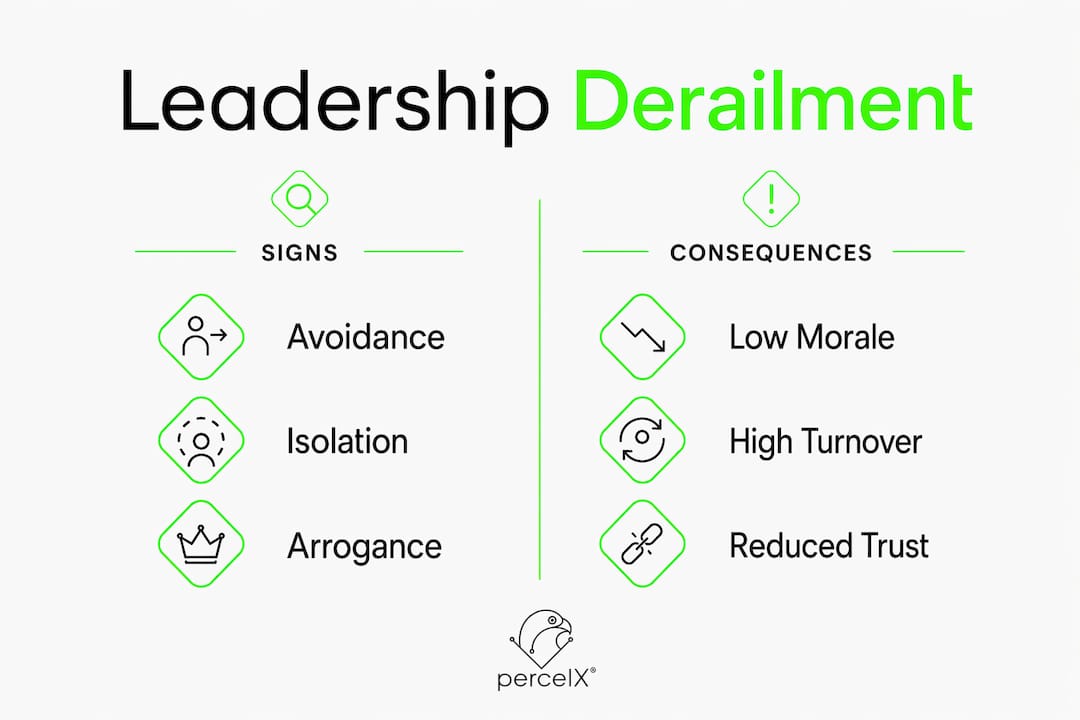
The organizational costs compound quickly. Leadership derailment produces low staff morale, reduced productivity, and measurable damage to organizational reputation. Replacing a derailed senior leader costs far more than the investment required to develop them proactively. The business case for prevention is not philosophical. It is financial.
Why do capable leaders derail? The causes beyond skills
Technical competence does not protect a leader from derailment. This is the most common misconception in organizational life. A brilliant engineer, analyst, or salesperson gets promoted because they perform at the top of their individual role. Then they step into leadership and discover that influence, emotional regulation, and accountability are entirely different skills from the ones that earned them the promotion.
Promoting high performers without leadership training is one of the most consistent contributors to derailment. Technical skill does not automatically translate to the influence and emotional intelligence that effective leadership requires. The transition from individual contributor to leader demands a fundamentally new operating model, and most organizations do not provide the support to make that shift successfully.
Leaders who avoid difficult conversations, motivated by fear of conflict, undermine trust and accelerate derailment faster than almost any other single behavior. Good intentions do not substitute for clarity and accountability. A leader who wants to be liked more than they want to be effective is already on a derailment path.
Emotional intelligence deficits rank among the most common causes of leadership failure. Leaders who lack emotional awareness erode team trust and collaboration rapidly, often without realizing it. They read a tense meeting as a productive challenge when the team reads it as a threat. That gap in perception is where derailment takes root.
Stress is the accelerant. Stress triggers weaken self-regulation in leaders, intensifying derailer behaviors that must be managed with disciplined practices, not ignored. A leader who is slightly arrogant in calm conditions becomes dismissive and combative under deadline pressure. The trait does not change. The volume does.
Pro Tip: When you feel pressure building, name the specific derailer behavior you are most likely to default to. Naming it creates a pause between the trigger and the reaction.
How can leaders prevent and recover from derailment?
Prevention starts with self-awareness, but self-awareness alone is not enough. You need structured feedback, consistent practice, and accountability systems that outlast good intentions. The leaders who sustain high performance over time are not the ones without derailers. They are the ones who know their derailers and manage them deliberately.
Proactive development through executive coaching, feedback systems, and self-awareness programs effectively prevents leadership derailment. Leaders who engage in continuous development maintain performance and reduce their derailment risk over time. That is not a soft finding. It is the clearest evidence-based path available.
Here is a practical prevention framework you can apply now:
- Request a 360-degree assessment. Gather structured feedback from peers, direct reports, and supervisors. Patterns across multiple sources reveal blind spots that self-reflection misses.
- Identify your top two derailers. You do not need to fix everything at once. Focus on the behaviors most likely to surface under your specific stress conditions.
- Build a behavioral contract. Write down what you will do differently when you feel a derailer activating. Share it with one trusted colleague who will hold you to it.
- Seek a coach or mentor with direct feedback experience. Coaches who avoid hard conversations are not useful here. You need someone who will tell you what your team cannot.
- Review your leadership behavior monthly. Ask yourself whether your actions over the past 30 days aligned with the leader you intend to be. Adjust before patterns solidify.
- Pursue intentional leadership development continuously. One-time training does not prevent derailment. Sustained development does.
Recovery from derailment is possible, but it requires more than awareness. It requires visible behavioral change over time. Teams do not trust declarations. They trust consistent actions repeated across enough situations that the pattern becomes undeniable. If you have already seen warning signs in your own leadership, the path forward is not to defend your past behavior. It is to build a new track record.
Pro Tip: The leaders who recover most successfully from derailment are the ones who name what happened directly to their team. Accountability spoken aloud rebuilds trust faster than any amount of improved behavior done quietly.
Key takeaways
Leadership derailment is a behavioral process, not a skills gap, and it is preventable through self-awareness, structured feedback, and disciplined development practices.
| Point | Details |
|---|---|
| Derailment is behavioral | Unmanaged blind spots and overused strengths cause stalled careers, not lack of intelligence or effort. |
| Strengths become liabilities | Confidence becomes arrogance, detail-focus becomes perfectionism when pushed too far under stress. |
| Consequences reach the whole team | Every direct report absorbs the impact of a derailing leader through disengagement and reduced trust. |
| Stress is the accelerant | Derailer behaviors intensify under pressure and must be managed with disciplined practices, not suppressed. |
| Prevention requires structure | Coaching, 360-degree assessments, and continuous development reduce derailment risk more than good intentions alone. |
What I've learned watching leaders derail in slow motion
The most striking thing about leadership derailment, from where I sit, is how predictable it is once you know what to look for. The pattern almost never starts with a bad leader. It starts with a good leader who stops getting honest feedback.
I have seen leaders with exceptional track records begin to isolate themselves from their teams, not out of malice, but out of the quiet belief that they have already figured it out. That belief is the beginning of the end. The moment a leader stops treating feedback as data, they lose the ability to course-correct. And the team, sensing that feedback is no longer welcome, stops offering it.
What conventional leadership development often gets wrong is the focus on skills acquisition over behavioral awareness. You can teach someone to run a better meeting or structure a clearer strategy. You cannot teach someone to manage their arrogance or volatility through a workshop. Those behaviors require ongoing self-monitoring, honest relationships, and a willingness to be uncomfortable. Most development programs are not designed for that level of depth.
The leaders I have seen recover from derailment share one quality: they got specific. Not "I need to communicate better," but "I interrupted my team lead three times in Tuesday's meeting and I am going to stop doing that." Specificity is what separates real change from performance. If you want to transform reactive leadership tendencies into something that actually sticks, start with the smallest, most concrete behavior you can name. Then hold yourself to it publicly.
— Percell
How Percelx helps leaders identify blind spots before they derail

Percelx is built for exactly the kind of behavioral self-awareness that prevents leadership derailment. The platform uses a 360° assessment approach to surface hidden behavioral patterns that affect decision-making, team dynamics, and long-term performance. You get a customized development plan instantly, grounded in your specific behavioral profile rather than generic leadership advice.
Leaders who use Percelx gain visibility into the blind spots that standard performance reviews miss. The platform tracks behavioral patterns over time, so you can see whether your development is producing real change or just surface-level adjustment. With a 4.9-star satisfaction rating, Percelx delivers the kind of behavioral intelligence that turns self-awareness into sustained leadership performance. If you are serious about preventing derailment, that level of specificity is where you start.
FAQ
What is leadership derailment in simple terms?
Leadership derailment is when a leader's unmanaged behaviors and blind spots cause their career to stall or their team's performance to decline. It is a behavioral process, not a sudden failure, and it is preventable with self-awareness and structured development.
What are the most common signs of leadership derailment?
The clearest signs include team members disengaging, high performers leaving, the leader avoiding difficult conversations, and inconsistent accountability. These behavioral signals typically appear before any measurable drop in performance metrics.
Can a derailing leader recover?
Yes. Recovery requires visible, consistent behavioral change over time, not just acknowledgment of the problem. Leaders who name their specific derailing behaviors and build accountability structures around them recover more successfully than those who rely on intention alone.
How does stress contribute to leadership derailment?
Stress weakens self-regulation, which causes derailer behaviors to intensify. A leader who is mildly arrogant in calm conditions can become dismissive and combative under pressure. Managing stress triggers with disciplined practices is the most effective way to keep derailers from surfacing.
How does a 360-degree assessment help prevent derailment?
A 360-degree assessment gathers structured feedback from multiple sources, revealing behavioral patterns that self-reflection alone cannot surface. Leaders with four or more derailer behaviors face significantly higher risk of interpersonal and performance challenges, making early identification through multi-source feedback a critical prevention tool.