

Reactive leadership is defined as a pattern where leaders respond to events automatically, driven by stress and emotion rather than deliberate choice. The ability to transform reactive leadership tendencies into proactive ones separates high-performing leaders from those who stay stuck in constant firefighting. Proactive moves succeed 92% of the time, yet most organizations score low on proactive leadership effectiveness. That gap is not a talent problem. It is a behavioral pattern problem, and it is solvable. Models like the R→R Shift, the STOP method, and the IMD Modes framework give leaders a concrete path from automatic reaction to intentional response.
What are common reactive leadership tendencies and how do they manifest under pressure?
Reactive leadership operates through automatic modes that activate under stress, often before a leader consciously registers what is happening. IMD Business School identifies four primary reactive modes: Controller, Defender, Avoider, and Pleaser. Each one feels justified in the moment. Each one undermines your actual leadership goals.
Here is how each mode shows up in practice:
- Controller: You override your team's input, micromanage decisions, and push for speed over accuracy. This mode activates when you feel a loss of control or fear of failure.
- Defender: You become defensive when challenged, dismiss feedback, and protect your position rather than the team's outcome. Criticism feels like a personal attack.
- Avoider: You delay difficult conversations, sidestep conflict, and hope problems resolve themselves. This mode often masquerades as patience.
- Pleaser: You agree with whoever holds the most authority in the room, even when your own judgment says otherwise. Short-term harmony replaces long-term clarity.
The neuroscience behind these modes is direct. A six-second neurochemical window opens after a trigger before your automatic response fires. That window is your only natural opportunity to choose a different path. Most leaders never learn it exists.
Stress compounds the problem. Accumulated emotional weight compresses your perspective, making every problem feel urgent and every challenge feel personal. The difference between a reactive behavior and a deliberate response is not willpower. It is awareness of the trigger and a trained capacity to pause before acting. Leaders who have not built that capacity default to whichever reactive mode their history has reinforced most.
How can leaders interrupt and transform reactive tendencies with neuroscience-backed techniques?
Overcoming reactive leadership requires more than good intentions. It requires a repeatable physical and cognitive process you can execute in seconds. The following steps build that process.
-
Name the trigger. Before you can interrupt a reactive pattern, you must recognize what activated it. Common triggers include public criticism, unexpected setbacks, and perceived disrespect. Write your top three triggers down. Naming them reduces their automatic power.
-
Use the 6-second neurochemical reset. Training the brain to engage this window with a physical reset, such as a slow deep breath, a deliberate pause, or a brief physical movement, gives you access to conscious choice before the automatic response fires.
-
Apply the STOP method. Stop what you are doing. Take a breath. Observe your internal state without judgment. Proceed with intention. The R→R Shift Model and STOP method are designed to move you from reaction to response within seconds, not minutes.
-
Use the Line of Choice. This is a 10-second mental boundary you draw between the trigger and your response. Ask yourself: "Is my next action aligned with my values and my team's best interest?" If the answer is no, pause longer.
-
Practice in low-stakes conditions first. Anchor new behavioral changes in safe, low-pressure practice sessions before relying on them in high-stakes moments. Trying to rewire a pattern during a crisis is like learning to swim during a flood.
-
Seek honest feedback after each practice. Ask a trusted colleague to observe your responses in meetings and give you direct input. Self-assessment alone misses the blind spots that reactive patterns create.
Pro Tip: Set a recurring 5-minute weekly review where you identify one situation where you reacted instead of responded. Write down what triggered it, which mode you entered, and what a deliberate response would have looked like. This single habit accelerates pattern recognition faster than most formal training programs.
The goal is not to eliminate emotion from your leadership. Emotion is data. The goal is to build the gap between stimulus and response wide enough that you can choose your next move with clarity. Leaders who improve decision-making under pressure consistently report that the pause itself builds team trust, because teams see a leader who thinks before acting.

What team-level strategies foster a culture of proactivity and reduce reactive firefighting?
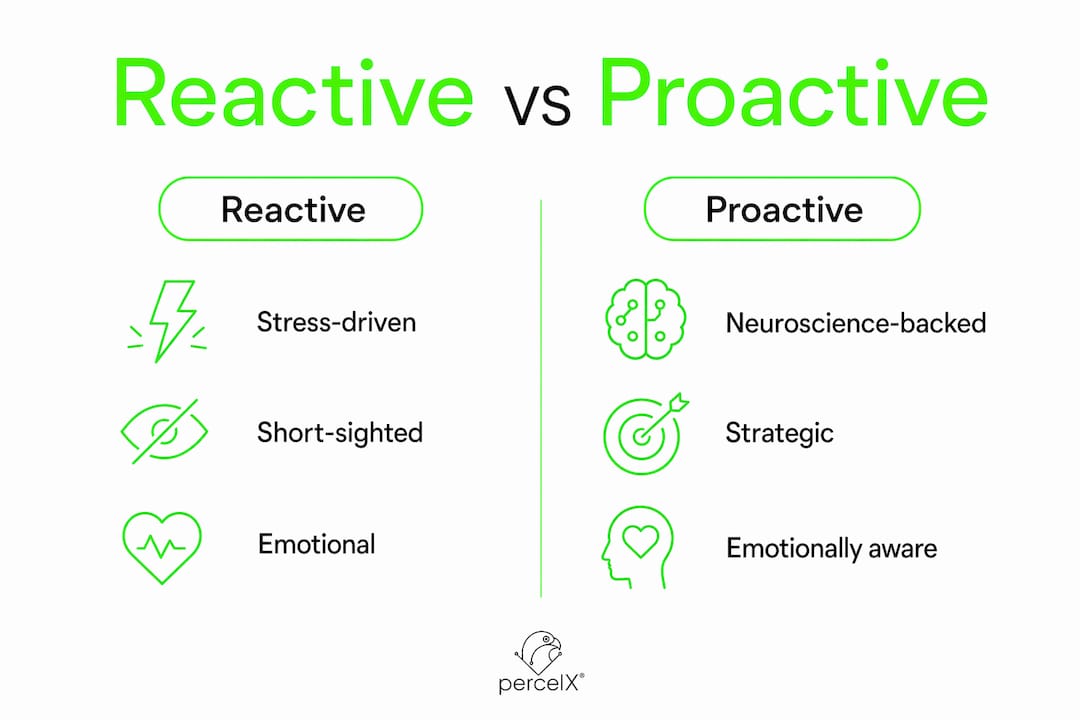
Individual behavioral change is necessary but not sufficient. Proactive leadership at scale requires co-created imperatives and systemic approaches, not reliance on isolated proactive leaders. Your team's default behavior mirrors yours. When you model deliberate responses, your team learns that deliberate responses are the standard.
Run a weekly friction audit
Removing a single recurring friction point weekly compounds proactivity across the team and reduces firefighting crises over time. A friction audit is simple: at the end of each week, ask your team one question. "What slowed you down most this week?" Then remove or reduce that obstacle before the next week begins. Repeated consistently, this practice shifts the team's orientation from reacting to problems to anticipating and preventing them.
Build psychological safety as a structural priority
High-performing teams report more errors because they surface issues early and address them collaboratively. That is not a failure signal. It is a safety signal. Teams that feel safe enough to flag problems early give you the lead time to respond proactively rather than reactively. Psychological safety is not a culture initiative. It is a tactical performance asset.
Co-create a burning imperative
A burning imperative is a shared, specific statement of what the team must accomplish and why it matters now. When every team member understands the priority and their role in it, they make proactive decisions independently rather than waiting for direction. This reduces the reactive load on you as a leader.
Here is a comparison of reactive versus proactive team behaviors across key dimensions:
| Dimension | Reactive team behavior | Proactive team behavior |
|---|---|---|
| Problem awareness | Issues surface after impact | Issues flagged before impact |
| Decision-making | Waits for leader direction | Acts within agreed boundaries |
| Feedback culture | Avoids difficult conversations | Surfaces concerns early |
| Error handling | Blames and defends | Analyzes and improves |
| Goal alignment | Unclear on priorities | Shared burning imperative |
Pro Tip: Use new hires as friction detectors. Fresh team members notice organizational inefficiencies that veterans have normalized. Schedule a structured conversation with every new hire in their first 30 days specifically to capture what seems unnecessarily slow, confusing, or redundant. Their observations are your roadmap for proactive improvement.
Anticipatory leadership takes this further. Successful leaders schedule foresight by identifying predictable trends and pre-solving problems before they become crises. This is not prediction. It is preparation, and it is a learnable discipline.
How to troubleshoot common challenges when shifting from reactive to proactive leadership?
Leadership style transformation rarely follows a straight line. Most leaders hit predictable obstacles, and knowing them in advance reduces the chance they derail your progress.
-
Confusing decisiveness with reactivity. True effective leadership seldom views every situation as an emergency. Speed is valuable when the situation demands it. But treating every decision as urgent trains your team to operate in permanent crisis mode. Ask yourself whether the deadline is real or self-imposed before accelerating.
-
Trying to change under extreme stress. New behavioral patterns require cognitive resources. High-stress moments deplete those resources. Attempting to rewire reactive habits during a crisis almost always fails. Build the patterns during calm periods so they are available when pressure peaks.
-
Dismissing the pause as weakness. Leaders under pressure tend to assume and escalate prematurely. Pausing is not indecision. It is the space where discernment happens. Teams do not lose confidence in leaders who pause. They lose confidence in leaders who react badly.
-
Skipping the feedback loop. Self-assessment alone is insufficient. Reactive patterns are, by definition, partially invisible to the person running them. Trusted colleagues and structured assessments give you the external view your self-perception cannot.
-
Expecting linear progress. Behavioral change is not linear. You will revert to reactive modes under sufficient stress. The measure of progress is not perfection. It is how quickly you recognize the reversion and correct it.
"The pause is not indecision. It is the space where discernment and clarity occur. Effective leaders cultivate this skill intentionally." — Leaders under pressure
Tracking your team transformation over time gives you objective evidence of progress and keeps you accountable when the work feels slow.
Key takeaways
Shifting from reactive to proactive leadership is a behavioral skill built through consistent practice, honest feedback, and structural team changes, not a personality trait you either have or lack.
| Point | Details |
|---|---|
| Name your reactive mode | Identify whether you default to Controller, Defender, Avoider, or Pleaser under stress. |
| Use the 6-second reset | Apply a physical pause within the neurochemical window to choose your response deliberately. |
| Run weekly friction audits | Remove one team friction point per week to build a proactive culture over time. |
| Build psychological safety | Teams that surface issues early give leaders the lead time to respond rather than react. |
| Practice in low-stakes settings | Anchor new behavioral patterns during calm periods so they hold under pressure. |
What I have learned coaching leaders through this shift
The leaders who struggle most with reactive patterns are rarely the ones who lack self-awareness. They are the ones who have been rewarded for reactivity. Fast decisions, visible urgency, and constant availability get praised in many organizations. So the reactive mode gets reinforced until it becomes identity.
What actually breaks the pattern is not a technique. It is honest feedback delivered by someone the leader trusts. Every leader I have seen make a lasting shift had at least one person willing to say, "That response cost you credibility in the room." Without that external mirror, the pattern stays invisible.
The ripple effect on team culture is real and measurable. When you shift from reacting to responding, your team stops bracing for your reactions. They start bringing you problems earlier, which gives you more options. The trust that builds from consistent, deliberate responses compounds faster than most leaders expect.
Treat this as a daily practice, not a project with a completion date. The goal is not to eliminate reactive responses forever. The goal is to shorten the gap between reaction and recognition, and to lengthen the gap between trigger and response. That is a practice you build over months, not a skill you acquire in a workshop.
— Percell
Percelx: behavioral intelligence for proactive leaders
Leaders who want to move beyond self-assessment need data. Percelx is a behavioral intelligence platform that reveals the hidden patterns shaping your decisions, your leadership style, and your team's performance.

Through its 360° behavioral assessment, Percelx delivers a personalized transformation plan instantly, mapping the specific reactive patterns that hold you back and showing you exactly where to focus. The Percelx Developer Platform gives organizations the behavioral analytics infrastructure to track leadership behavior change at scale, with a 4.9-star satisfaction rating across individual and team assessments. For leaders serious about building proactive habits that last, Percelx provides the structure, data, and ongoing support to make that shift measurable.
FAQ
What is reactive leadership?
Reactive leadership is a pattern where leaders respond to events automatically under stress, driven by emotion rather than deliberate choice. IMD Business School identifies four reactive modes: Controller, Defender, Avoider, and Pleaser.
How long does it take to shift from reactive to proactive leadership?
Behavioral pattern change typically requires consistent practice over several months. Progress accelerates with honest external feedback and structured low-stakes practice sessions before high-pressure situations.
What is the 6-second neurochemical window?
The 6-second neurochemical window is the brief period after a trigger fires before your automatic response activates. Training yourself to use a physical reset, such as a deep breath, during this window enables deliberate choice over automatic reaction.
Does pausing under pressure signal weakness to your team?
Pausing does not signal weakness. Research shows leaders who pause under pressure make better decisions and build more team trust than those who escalate prematurely. Teams read a deliberate pause as composure, not hesitation.
What is the most common pitfall when building proactive leadership habits?
The most common pitfall is trying to change reactive patterns during high-stress moments. New behavioral habits require cognitive resources that stress depletes. Build the patterns during calm periods so they are available when pressure peaks.