

A peak performance mindset is defined as a trainable set of mental skills and beliefs that enables you to consistently perform at your best by managing pressure, attention, emotions, and effort. This is not about relentless positivity or motivational slogans. It is grounded in sport psychology and positive psychology research, where constructs like self-efficacy, mental imagery, growth mindset, and anxiety regulation are the actual mechanisms that separate high achievers from everyone else. Whether you are an athlete, a professional climbing the leadership ladder, or someone pursuing personal transformation, understanding peak performance psychology gives you a concrete foundation to build on. The mental skills are learnable. The behaviors are measurable. The results are real.
What psychological skills define the peak performance mindset?
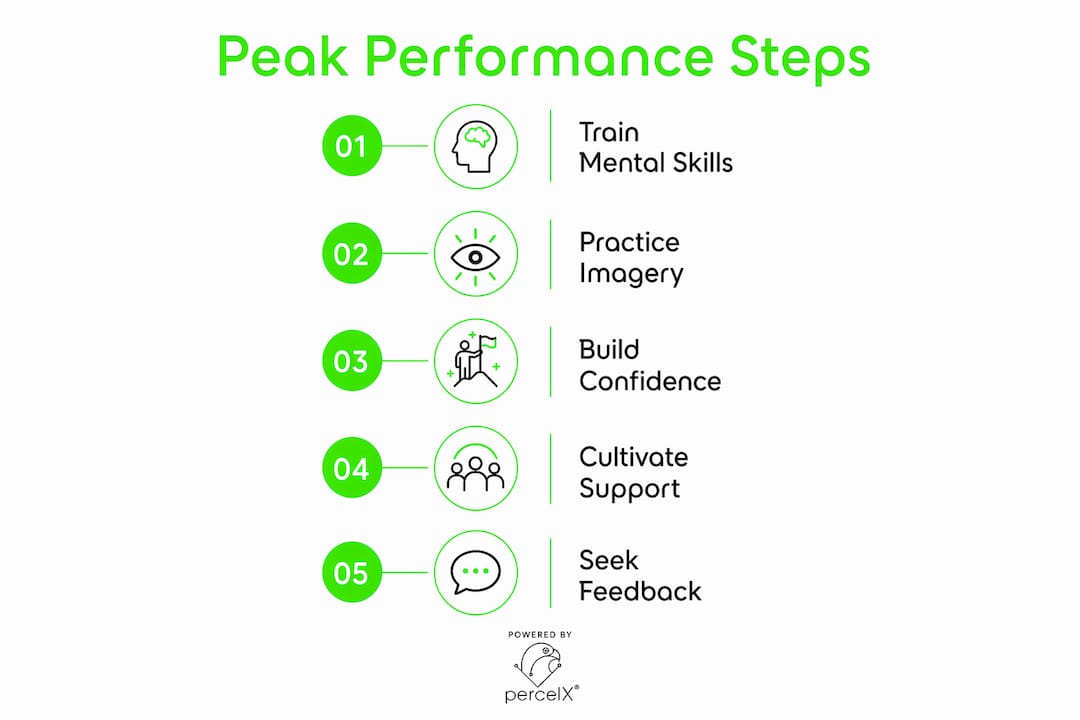
Meta-analyses spanning 50 years of sport psychology research identify four core constructs at the heart of peak mental performance: mental imagery, confidence, achievement goals, and anxiety management. Each one is trainable, and each one interacts with the others to shape how you perform under pressure.
Mental imagery is the practice of vividly rehearsing performance scenarios in your mind before they happen. Elite athletes use it to pre-program movement patterns, decision sequences, and emotional responses. The research is specific: imagery practice of about 45 minutes weekly over 100 days is linked to measurable improvements in mental health and confidence. That dosage matters. Treating imagery like a scheduled mental workout, rather than something you do when you feel like it, is what produces results.

Self-efficacy and confidence are not the same thing, though they are closely related. Self-efficacy is your belief in your capacity to execute a specific task. Confidence is the broader emotional state that supports performance. Both are built through mastery experiences, vicarious learning (watching others succeed), and verbal encouragement from coaches or mentors. When self-efficacy is high, you interpret pressure as a challenge rather than a threat. That shift alone changes your physiological response and your decision quality.
Growth mindset, a concept developed by Stanford psychologist Carol Dweck, is the belief that your abilities are malleable rather than fixed. In peak performance psychology, this belief is not just philosophical. Studies link incremental beliefs to proactive learning behaviors, challenge seeking, and sustained effort regulation. You do not just believe you can improve. You act differently because of that belief.
Competitive anxiety has two components: cognitive (worried thoughts) and somatic (physical tension). Managing both requires different strategies. A 2026 systematic review of 46 trials found that Mindfulness-Acceptance-Commitment therapy, biofeedback, and cognitive behavioral therapy each reduce competitive anxiety, but their effectiveness varies by anxiety type and athlete experience level. This means a one-size-fits-all approach to anxiety management does not work.
- Mental imagery: schedule it like a training session, not an afterthought
- Self-efficacy: build it through progressive mastery experiences
- Growth mindset: operationalize it through specific learning behaviors
- Anxiety management: match the intervention to your specific anxiety profile
Pro Tip: Track your self-efficacy score before and after high-stress events. A consistent drop signals that your current mental preparation routine needs adjustment, not just more effort.
How does environment and social support shape your mindset?
Your mental skills do not develop in a vacuum. The people around you, and the psychological climate they create, directly shape your capacity to build and sustain a peak mental state. A 2026 study with Turkish athletes found that supportive coaching behaviors improve performance perception, with self-efficacy emerging as the strongest single predictor of performance outcomes. The environment is not background noise. It is a primary input.
Psychological safety, the belief that you can take risks, make mistakes, and speak up without punishment, acts as a mediator between your social environment and your mental skills effectiveness. When psychological safety is low, even technically skilled performers underperform because their cognitive resources are consumed by threat monitoring rather than task execution. This applies equally to sports teams, corporate offices, and personal relationships.
For individuals building a peak mindset outside of formal coaching, the principle translates directly. Surround yourself with people who give honest, constructive feedback. Seek out mentors who model confidence in athletic performance and resilience under pressure. Audit your environment regularly. If your current context consistently erodes your self-efficacy after setbacks, the problem may not be your mindset. It may be your environment.
Practical steps to build a supportive context:
- Identify one person in your network who consistently challenges you toward growth
- Request specific, behavioral feedback rather than general praise or criticism
- After a significant stressor, measure your confidence level. If it drops sharply and stays low, examine the social dynamics at play
- For leaders and managers, recognize that psychological safety is not a soft concept. It is a measurable performance variable
What are effective methods to develop a peak performance mindset?
Building a peak mindset requires a structured approach, not random effort. The research points to specific techniques, timing principles, and sequencing strategies that separate effective mental training from well-intentioned but ineffective habits.
-
Schedule imagery practice with precision. Treat mental rehearsal as a non-negotiable training block. The optimal dosage for imagery is approximately 45 minutes per week sustained over 100 days. Gender and sport type moderate the effects, so your specific program may need adjustment. The key principle is consistency over intensity.
-
Combine cognitive and physical warmups. A 2025 study on pre-performance routines found additive benefits when brief cognitive activities are paired with physical warmup. The combination primes both your nervous system and your attentional focus simultaneously. A five-minute visualization followed by dynamic movement is more effective than either alone.
-
Keep mental priming short and task-relevant. Longer cognitive tasks performed immediately before performance can actually impair outcomes. Timing and dosage of mental preparation matter as much as the technique itself. Short arousal regulation cues, goal focus statements, and process reminders work best when placed close to the performance moment.
-
Tailor your anxiety intervention. If your anxiety is primarily cognitive (racing thoughts, worst-case scenarios), cognitive behavioral techniques and mindfulness practices are most effective. If it is primarily somatic (tight chest, shaky hands), biofeedback and progressive muscle relaxation produce better results. Psychological interventions vary in effectiveness based on anxiety type and experience level, so self-diagnosis matters.
-
Monitor self-efficacy as your performance compass. After each significant challenge or stressor, rate your confidence on a simple 1-10 scale. Tracking this over time reveals whether your mental training is working. If your self-efficacy consistently recovers quickly after setbacks, your routine is effective. If it stays suppressed, something in your preparation or environment needs to change.
Pro Tip: Do not copy elite athletes' pre-performance routines wholesale. The timing, duration, and content of mental preparation must match your specific anxiety profile and performance context. A routine that works for a marathon runner may actively hurt a surgeon or a sales executive.
What behaviors and practices sustain peak performance over time?
Understanding peak mental state is one thing. Translating that understanding into daily behavior is where most people fall short. Growth mindset research makes a critical distinction between proactive and reflective growth practices, and both are required for sustained high performance.
| Practice type | Behaviors | Performance impact |
|---|---|---|
| Proactive growth | Goal-setting, deliberate preparation, effort exertion | Builds momentum and pre-loads confidence before challenges |
| Reflective growth | Feedback seeking, error analysis, persistence after failure | Converts setbacks into learning data and strengthens resilience |
| Belief alignment | Connecting daily actions to core values and identity | Closes the gap between mindset belief and consistent behavior |
| Self-regulated learning | Monitoring progress, adjusting strategies, self-testing | Accelerates skill acquisition and deepens self-awareness |
From beliefs to behaviors, the research is clear: incremental beliefs only produce performance gains when they are expressed through specific, observable actions. Believing you can improve is not enough. You need to seek out challenges that stretch your current capacity, analyze your errors without self-judgment, and persist through difficulty with a focus on process rather than outcome.
The self-regulated learning parallel is worth noting. High achievers in education, athletics, and professional settings all share the same behavioral signature. They set specific goals, monitor their progress honestly, and adjust their strategies based on feedback. This is not a personality trait. It is a professional growth practice that can be assessed, developed, and measured.
The most overlooked behavior in sustaining peak performance is consistent feedback seeking. Most people wait for feedback to come to them. High achievers actively request it, specify what they want feedback on, and use it to recalibrate their approach. This single habit, practiced consistently, compounds into a significant performance advantage over time.
Key takeaways
A peak performance mindset is built from specific, trainable mental skills including imagery, self-efficacy, growth mindset behaviors, and tailored anxiety management, not from generic motivation.
| Point | Details |
|---|---|
| Mindset is trainable | Mental skills like imagery, confidence, and anxiety regulation are learnable through structured practice. |
| Dosage and timing matter | Imagery at roughly 45 minutes per week over 100 days and short pre-performance cues outperform random mental prep. |
| Environment shapes mindset | Supportive coaching and psychological safety directly improve self-efficacy and performance outcomes. |
| Behavior closes the gap | Growth mindset only produces results when expressed through goal-setting, feedback seeking, and error analysis. |
| Measure self-efficacy | Tracking confidence shifts after stressors is the most reliable indicator of whether your mental training is working. |
What I have learned from watching people build and break their peak mindset
Most people approach mental performance the same way they approach physical training: more is better, consistency is king, and copying what elite performers do will get you there. That logic fails in practice, and I have seen it fail repeatedly.
The single biggest mistake I observe is timing. Someone spends 30 minutes on visualization the morning of a high-stakes presentation, then wonders why they feel more anxious walking in, not less. Long cognitive tasks before performance consume the mental resources you need for execution. Brief, specific cues placed close to the moment work. Long rumination sessions placed hours before do not.
The second mistake is ignoring the environment entirely. You can have the most disciplined mental training routine in the world, but if your manager, coach, or closest collaborator consistently undermines your self-efficacy after setbacks, your confidence will not recover at the rate your training predicts. Measuring psychological safety in your environment is not optional. It is part of the performance equation.
What actually works is personalized, measurement-based self-coaching. Know your anxiety profile. Track your self-efficacy after stress. Schedule your imagery like a training block. Build a career growth plan that incorporates mental skills development alongside technical skill building. The people who sustain peak performance over years are not the ones with the most talent or the best routines. They are the ones who know themselves precisely and adjust continuously.
— Percell
Build your peak mindset with Percelx
If you are ready to move from understanding peak performance psychology to actually measuring and developing it, Percelx is built for exactly that.

Percelx uses a 360° behavioral intelligence assessment to reveal the hidden patterns shaping your decision-making, confidence, and performance under pressure. Unlike generic coaching tools, Percelx delivers a personalized transformation plan instantly, identifying the specific gaps in your mental skills and environment that are limiting your results. Whether you are an individual athlete, a professional building toward leadership, or a team looking to raise collective performance, Percelx gives you the measurable mechanisms to track real change. For organizations, the Percelx 360 Enterprise platform extends these insights across teams. Rated 4.9 stars, Percelx turns self-awareness into sustained momentum.
FAQ
What is a peak performance mindset in simple terms?
A peak performance mindset is a set of trainable mental skills and beliefs, including confidence, focus, emotional regulation, and resilience, that allow you to perform consistently at your best under pressure. It is grounded in sport psychology and positive psychology research rather than generic motivation.
How long does it take to develop a peak mindset?
Research on imagery practice suggests meaningful gains emerge after approximately 100 days of consistent practice at roughly 45 minutes per week. Other mental skills like anxiety management and self-efficacy building also require sustained, structured effort rather than short-term interventions.
Can peak performance psychology apply outside of sports?
Yes. Peak performance mindset applies directly to careers, leadership, and personal growth. The same mental skills that help athletes manage competitive pressure translate to high-stakes professional environments and personal challenges.
What is the difference between growth mindset and peak performance mindset?
Growth mindset is one component of peak performance psychology. It refers specifically to the belief that abilities are malleable. A full peak performance mindset also includes mental imagery, anxiety regulation, self-efficacy, and pre-performance routines that growth mindset alone does not address.
How do I know if my mental training is working?
Track your self-efficacy score before and after stressful events. Consistent, rapid recovery of confidence after setbacks signals that your mental preparation is effective. A persistent drop in confidence after stress indicates your current routine or environment needs adjustment.