

A recovery mindset meaningfully reduces reinjury risk and shortens setbacks by aligning your behavior — sleep, stress regulation, and rehab adherence — with the actual demands of healing. NCAA data shows that 44% of female and 17% of male student-athletes feel constantly overwhelmed, and sports psychiatrist Dr. Bridger Battaglia of University of Utah Health warns that rushing recovery consistently leads to longer absences and greater setbacks. The fix is not more willpower. It is a deliberate shift in how you think about the process.
Start here — three things you can do in the next 72 hours:
- Prioritize sleep above all else: 7–9 hours is a non-negotiable recovery input, not a luxury.
- Schedule one mental-skill session (10 minutes of visualization or values clarification) before your next rehab appointment.
- Write a single "strength-first" goal: not "return by week six," but "achieve 90% limb symmetry before progressing load."
Table of Contents
- What does a recovery mindset actually mean?
- What does the research say about mindset and recovery?
- Evidence-based strategies athletes can use right now
- How do you measure psychological and physical progress?
- How can coaches and organizations build a recovery-supportive culture?
- How does a 360° behavioral assessment personalize recovery work?
- What mindset mistakes lengthen recovery and when should you escalate?
- Your 30/60/90-day staged return plan
- Key Takeaways
- The shift that actually changes outcomes
- Percelx helps teams and athletes build measurable recovery plans
- Useful sources for further reading
What does a recovery mindset actually mean?
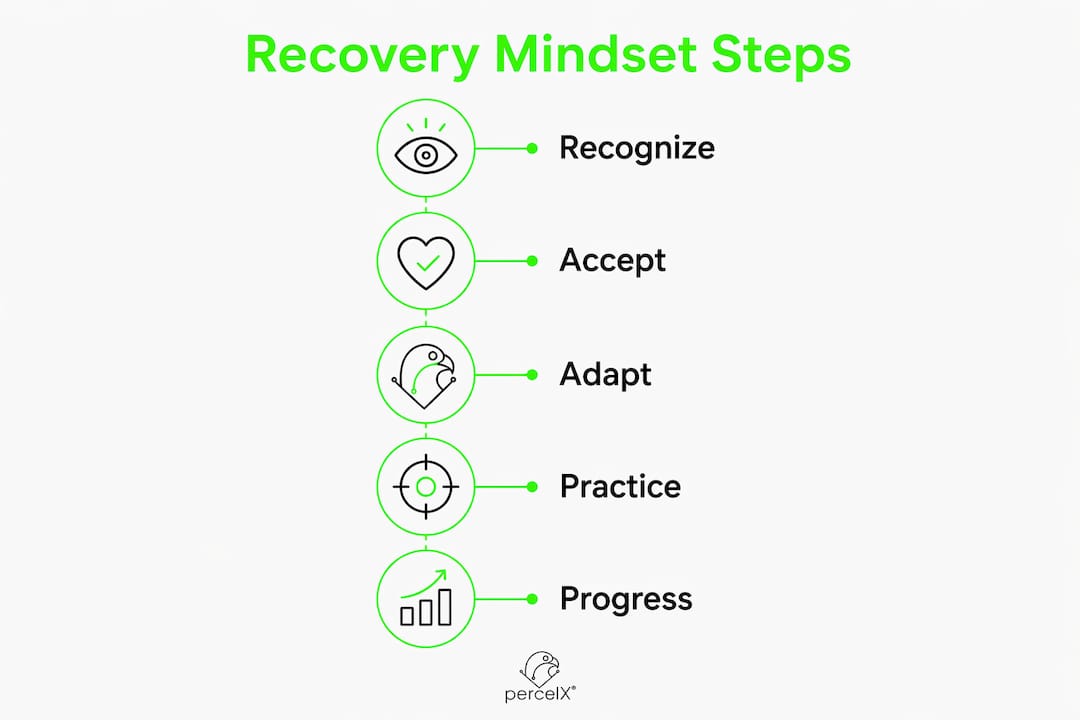
A recovery mindset is the set of attitudes and cognitive habits that prioritize whole-system restoration — sleep, emotion regulation, realistic goal-setting, and consistent rehab adherence — over speed of return. It is not optimism. It is structured, flexible thinking applied to an uncertain timeline.
Three psychological mechanisms drive its effectiveness:
- Stress mindset: Viewing stress as enhancing rather than debilitating improves adaptation, performance, and resilience. Athletes who appraise rehab discomfort as a signal of growth adhere better and catastrophize less.
- Resilience as a dynamic process: Resilience is not a fixed trait you either have or lack. Research frames it as a trainable, adaptive resource that can be built through deliberate practice and monitored over time.
- Flexible thinking: Allowing shades of gray — rather than forcing positivity or catastrophizing — helps athletes tolerate uncertainty and reduces the suffering caused by all-or-nothing thinking.
Watch for these patterns in an athlete's thinking: challenge appraisals ("this is hard but manageable") versus threat appraisals ("I might never get back"), catastrophic forecasting about career outcomes, and all-or-nothing goals that collapse the moment a milestone slips.
What does the research say about mindset and recovery?
The evidence is consistent. A synthesis of studies from 2016–2025 links resilience and psychological readiness to reduced burnout and better return-to-sport outcomes. A study of 177 athletes found that mental resilience and mindfulness correlate significantly and positively, with mindfulness training reducing depression and anxiety while supporting emotion regulation during recovery.

A Frontiers mixed-methods study of 266 performers and performance-support staff found that practitioners rate mindsets as crucial for training adaptation and high-pressure performance. Yet many of those same performers had never received formal mindset training.
The cognitive flexibility research is equally clear: flexible thinking is associated with psychological recovery both directly and through self-regulation. Athletes who can reframe setbacks and avoid rigid thought patterns restore depleted cognitive and emotional resources faster.
Evidence-based strategies athletes can use right now
Cognitive strategies:
- Practice stress-as-enhancing prompts before rehab: "This discomfort means my system is adapting."
- Use values clarification to reconnect with why sport matters beyond performance outcomes.
- Run a 5-minute pre-session visualization: see yourself moving well, not just finishing rehab.
- Replace all-or-nothing goals with process targets (range of motion, sleep hours, adherence rate).
Behavioral strategies:
- Rebuild daily structure around meals, sleep, and one meaningful non-sport activity. Athletes who re-establish routines navigate recovery measurably better than those who let structure collapse.
- Use graded return-to-activity: small, progressive loads with documented feedback after each session.
- Track rehab adherence weekly — not to judge, but to spot drift before it becomes a pattern.
Sample daily recovery routine (30–45 minutes total):
- Morning: 5-minute mindfulness or breathing exercise on waking.
- Pre-rehab: 5-minute visualization and values check.
- Rehab session: physical work with documented effort and pain ratings.
- Post-rehab: 10 minutes of mobility or light movement.
- Evening: sleep hygiene protocol (consistent bedtime, no screens 30 minutes prior).
Pro Tip: When an athlete pushes for a faster return date, redirect the conversation to a measurable strength or stability target. "I want to be back by week five" becomes "I want 85% limb symmetry and full range of motion before we progress." The number removes the emotional charge and gives both athlete and clinician a shared, objective anchor.
How do you measure psychological and physical progress?
| Metric | Frequency | Threshold / Action |
|---|---|---|
| Limb strength symmetry | Weekly | >10% gap: adjust load, do not progress |
| Movement quality score | Bi-weekly | Decline of >1 point: review technique and fatigue |
| Total sleep time | Daily | <7 hours for 3+ consecutive nights: flag for review |
| Rehab adherence rate | Weekly | — |
| Psychological readiness scale | Weekly | Score below threshold: consult sport psychologist |
| Reinjury anxiety rating | Bi-weekly | Persistent high scores: escalate to clinical support |
Subjective markers to track:
- Mood and motivation ratings (1–10 scale, logged daily).
- Reinjury anxiety checklists administered before each return-to-activity progression.
- Athlete self-report on sleep quality and energy levels.
30/60/90-day milestone checklist:
- Day 30: baseline assessment complete, sleep and routine re-established, pain managed.
- Day 60: strength symmetry improving, psychological readiness scores trending up, graded activity progressing.
- Day 90: performance-readiness simulation completed, mental-skill practice embedded in weekly schedule.
Red flags requiring escalation: persistent catastrophic thinking, avoidance of rehab sessions, increasing pain with cleared activity, or mood decline lasting more than two weeks.
How can coaches and organizations build a recovery-supportive culture?
Culture is where individual mindset work either gets reinforced or quietly undermined. These steps move the needle at the team level.
Policy foundations:
- Embed psychological readiness criteria into all return-to-play protocols, not just physical clearance.
- Use staged reintegration: practice observer → limited contact → full participation, with sign-off at each stage.
- Establish shared decision-making between athlete, clinician, and coach before any progression.
Implementation steps:
- Train all coaching and athletic training staff on basic stress-mindset and resilience concepts (a 90-minute workshop is sufficient to shift language and framing).
- Add a 5-minute mental-skill check-in to the start of every rehabilitation session.
- Build a rehab adherence dashboard visible to the athlete and their primary support staff.
- Run a 15-minute pre-practice mental-skill huddle weekly during the athlete's reintegration phase.
A Frontiers study found that many high-performance teams already use deliberate mindset switching in practice, but few have formalized it. Formalizing it is the difference between a culture that accidentally supports recovery and one that does it by design.
Pro Tip: Use this coach script when an athlete expresses urgency about return timing: "I hear you — you want to be back. Let's look at what your body is actually telling us this week and set a target that gets you back strong, not just back fast." That one reframe, repeated consistently, reshapes the team's entire relationship with recovery timelines.
How does a 360° behavioral assessment personalize recovery work?
Hidden behavioral patterns — how an athlete responds to stress, makes decisions under pressure, or defaults to avoidance — often determine whether a recovery plan succeeds or stalls. A 360° behavioral assessment surfaces those patterns before they derail progress.
What a behavioral assessment measures:
- Decision-making style under uncertainty and pressure.
- Stress response tendencies (enhancing vs. debilitating appraisals).
- Adherence patterns and social triggers that affect consistency.
- Self-regulation capacity and emotional control under load.
How assessment outputs map to interventions:
- Low stress-enhancing scores → prioritize mindset framing and stress-appraisal coaching.
- High avoidance tendency → design graded exposure with explicit accountability checkpoints.
- Weak routine adherence → rebuild structure using behavioral anchors (habit stacking, environmental cues).
Organizations benefit most when assessment data drives resource allocation: which athletes need weekly mental-skill sessions, which need a sports psychologist referral, and which are ready to progress without additional support.
Pro Tip: Athletes who have experienced recurrent reinjury or chronic adherence problems benefit most from an assessment-first approach. Starting with behavior data rather than assumptions cuts weeks off the intervention design process.
The self-awareness work that feeds a personalized recovery plan is also the foundation for long-term athletic success beyond any single injury.
What mindset mistakes lengthen recovery and when should you escalate?
The most common mistakes:
- Rushing return based on calendar pressure rather than objective markers.
- Ignoring sleep and routine loss as "minor" when both are primary recovery inputs.
- Using forced positivity ("I'm fine, I'm fine") instead of flexible thinking that acknowledges difficulty without catastrophizing.
- Isolating from teammates, which removes social support and accelerates identity threat.
Red-flag behaviors requiring escalation:
- Persistent catastrophic thoughts about career or identity that do not respond to brief reframing.
- Active avoidance of rehab sessions or medical appointments.
- Increasing pain during cleared activity with no mechanical explanation.
- Mood decline, withdrawal, or signs of depression lasting more than two weeks.
When any of these appear, refer to a sports psychologist or sports psychiatrist promptly. Dr. Battaglia's guidance is explicit: mental health professionals belong on the multidisciplinary rehab team, not as a last resort. Reviewing common mental performance mistakes with your athlete before reintegration can prevent several of these patterns from taking hold.
Your 30/60/90-day staged return plan
Days 1–30: Intake and foundation
- Complete baseline behavioral and physical assessment.
- Establish sleep protocol and daily routine structure.
- Begin mindfulness practice (5–10 minutes daily).
- Set strength-first goals with your clinician.
- Weekly goal: consistent sleep (7–9 hours), pain managed, routine re-established.
Days 31–60: Progressive load and graded exposure
- Introduce graded return-to-activity with weekly load documentation.
- Run bi-weekly psychological readiness checks.
- Add visualization and stress-appraisal prompts to pre-rehab routine.
- Coach check-in every two weeks to review adherence data.
- Weekly goal: strength symmetry improving, psychological readiness scores stable or rising.
Days 61–90: Performance-readiness simulation
- Simulate sport-specific demands in a controlled environment.
- Complete final psychological readiness assessment before full return.
- Embed mental-skill practice permanently into weekly schedule.
- Debrief with full support team before clearance decision.
- Weekly goal: full movement quality, high readiness scores, zero red-flag behaviors.
Pro Tip: Adjust timelines for sport demands and injury severity — a contact-sport athlete returning from an ACL repair needs more simulation time than a swimmer recovering from a shoulder strain. The phase structure stays the same; the milestones shift.
Key Takeaways
A recovery mindset reduces reinjury risk and speeds sustainable return by aligning behavior — sleep, stress regulation, and rehab adherence — with the actual demands of healing.
| Point | Details |
|---|---|
| Mindset drives adherence | Athletes who appraise stress as enhancing adhere better and catastrophize less during rehab. |
| Resilience is trainable | Resilience functions as a dynamic, adaptive resource that can be built and monitored over time. |
| Flexible thinking outperforms forced positivity | Allowing shades of gray reduces suffering and improves decision-making under uncertain timelines. |
| Culture determines outcomes | Embedding psychological readiness into return-to-play protocols shifts recovery from reactive to by design. |
| Percelx 360° assessment | Percelx's behavioral assessment identifies hidden decision patterns and maps them to targeted interventions, rated 4.9★. |
The shift that actually changes outcomes
The conventional wisdom says recovery is mostly physical — get the tissue right and the athlete follows. The evidence says otherwise. Psychological readiness, stress appraisal, and behavioral patterns shape whether physical healing translates into durable performance. The athletes who return strongest are rarely the ones who pushed hardest. They are the ones who stayed honest about where they were, rebuilt their routines with intention, and measured progress against strength targets rather than calendar dates.
One micro-practice worth testing this week: before each rehab session, spend five minutes writing down one value that sport connects to for you (competition, growth, belonging) and one specific thing today's session builds toward. That two-part check takes less time than a warm-up set and consistently reorients attention from "how long is this taking" to "what am I actually building." Track your psychological readiness score before and after for seven days. The shift is measurable.
Percelx helps teams and athletes build measurable recovery plans
For teams dealing with recurrent reinjury or athletes stuck in chronic adherence cycles, the missing piece is usually behavioral data, not more physical protocols. Percelx delivers a 360° behavioral assessment that surfaces the hidden decision patterns, stress-response tendencies, and adherence triggers that standard rehab plans never address. The output is a personalized transformation plan, not a generic recommendation sheet, with a 4.9-star satisfaction rating across individual and organizational users.

Percelx fits athletes with chronic adherence problems, teams with repeated soft-tissue injuries, and organizations that want measurable improvement tracked over time. The assessment takes minutes; the behavioral clarity it produces shapes months of targeted work. Start your assessment at percelx.org and get your personalized plan today.
Useful sources for further reading
-
University of Utah Health — "The Mental Game of Injury Recovery" — Dr. Bridger Battaglia's clinical framing on psychological readiness, reinjury risk, and the "strength over speed" shift. Read it here.
-
HPRC — "What Is Mindset and How Does It Impact Performance" — Explains the stress-as-enhancing vs. stress-as-debilitating mechanism and its performance implications. Read it here.
-
MDPI Sports — "From Slump to Comeback" — Systematic review (2016–2025) linking resilience and psychological readiness to reduced burnout and better return-to-sport outcomes. Read it here.
-
MDPI Sports — "Mental Resilience and Mindfulness in Athletes" — Study of 177 athletes showing positive correlation between resilience and mindfulness, with implications for training design. Read it here.
-
Frontiers in Sports and Active Living — Mindsets and Training Adaptation — Mixed-methods study of 266 performers on mindset use in high-performance environments. Read it here.
-
Frontiers in Psychology — Cognitive Flexibility and Psychological Recovery — Empirical evidence that flexible thinking supports recovery through self-regulation. Read it here.
-
Psychology Today — "The Psychological Side of Sports Injury Recovery" — Applied clinical guidance on flexible thinking, routine rebuilding, and avoiding forced positivity. Read it here.