

360 self-assessment professional development is a structured process of collecting feedback from multiple workplace sources, including managers, peers, and direct reports, and comparing that input with your own self-evaluation to identify leadership blind spots and growth opportunities. The industry standard term for this process is "multi-rater feedback" or "360-degree feedback evaluation." 90% of Fortune 500 companies use it, and systematic programs improve leadership effectiveness by up to 23%. That number reflects something important: the gap between how you see yourself and how others experience you is where real professional growth begins.
The method works because it replaces guesswork with data. You get a clear picture of your behavioral patterns across multiple relationships, not just one manager's opinion. Percelx is built on exactly this principle, revealing hidden behavioral patterns that affect decision-making and performance so you can act with intention rather than react by habit.
What are the essential components of a 360 self-assessment?
A successful 360 feedback evaluation requires more than sending out a survey. It starts with the right people, the right questions, and the right conditions.

Who provides feedback?
Multi-source feedback includes ratings from five key groups:
- Self: Your own honest evaluation of your competencies
- Manager(s): Perspective from those who set your goals and observe your output
- Peers: Colleagues who work alongside you and see your collaboration style
- Direct reports: Team members who experience your leadership daily
- External stakeholders: Clients or partners, included when role-relevant
Each group sees a different dimension of your behavior. No single source gives you the full picture.
Choosing the right competency framework
The questions you ask must align with your career goals or your organization's leadership model. Generic surveys produce generic results. A structured framework aligned with organizational goals increases both the relevance of feedback and the likelihood that you will act on it. Common competency areas include communication, decision-making, accountability, and team development.
Conditions that make feedback honest
The single biggest threat to useful feedback is rater bias. Linking 360 results to pay or promotion causes raters to soften their responses, which destroys developmental value. The assessment must be clearly positioned as a growth tool, not an evaluation tied to consequences.
| Component | Role | Key requirement |
|---|---|---|
| Self-assessment | Baseline for perception gap analysis | Complete before reviewing others' feedback |
| Rater selection | Provides multi-angle behavioral data | 5–10 raters across all relationship types |
| Competency framework | Defines what behaviors are measured | Aligned with career or organizational goals |
| Survey platform | Collects and aggregates responses | Anonymity protection for peer and report ratings |
| Feedback report | Synthesizes all data into themes | Delivered with debrief support for best results |
How do you conduct a 360-degree assessment step by step?
Execution matters as much as intent. A poorly run process produces data you cannot trust.
-
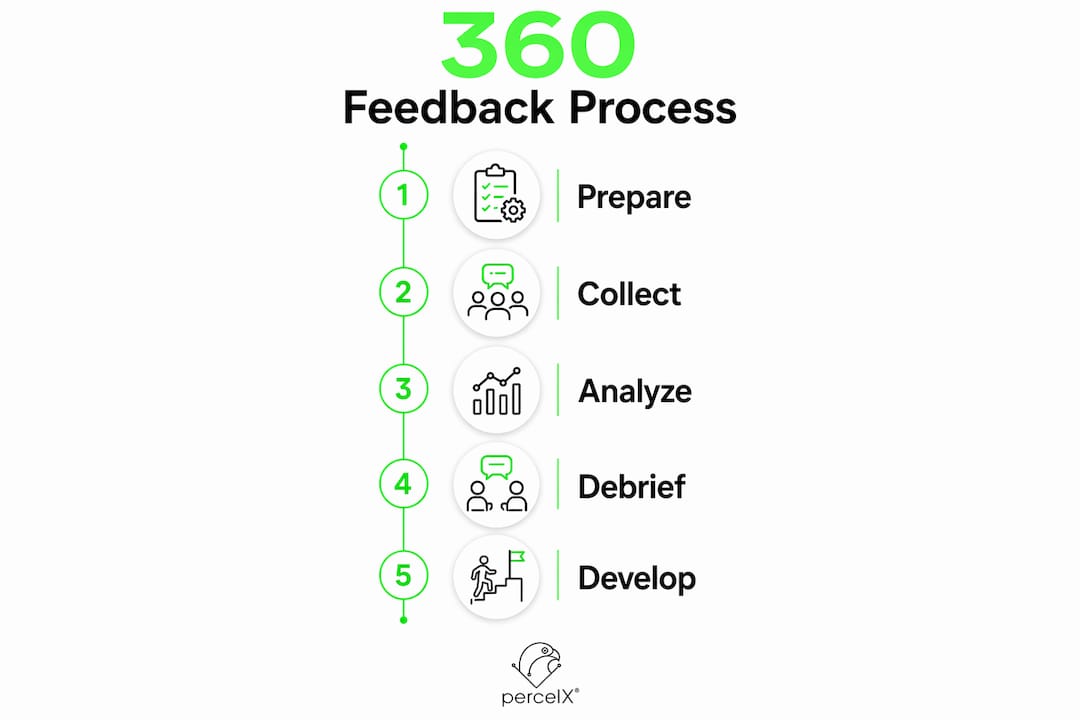
Define your purpose and competencies. Decide what you want to learn. Are you preparing for a leadership role? Addressing a known gap? Pick 4–6 competency areas that matter most for your next career stage. This focus keeps the survey manageable and the results usable.
-
Select and prepare your raters. Choose people who have observed your behavior consistently over the past 6–12 months. Brief them on the purpose: this is for your development, not your performance review. Communicating developmental intent and confidentiality is the most reliable way to get honest, useful ratings.
-
Complete your self-assessment first. Rate yourself before you see any external feedback. This preserves the integrity of your self-perception and makes the gap analysis meaningful. Be specific and honest. Vague self-ratings produce vague comparisons.
-
Collect feedback from raters. Give raters 7–10 days to respond. Keep the survey under 30 minutes. Longer surveys produce lower completion rates and less thoughtful answers. Follow up once with a brief reminder.
-
Consolidate and review the aggregated report. Most platforms group ratings by rater category so you can see patterns. Look for consistency across groups. If peers and direct reports both rate your listening skills low while you rated yourself high, that gap is your signal.
Pro Tip: Run your 360 assessment at a natural career inflection point, such as before a promotion discussion or after taking on a new team. Feedback gathered during periods of change is more specific and more motivating to act on.
The full cycle from launch to report review typically takes 3–4 weeks. Build in time for a structured debrief conversation before you move to planning.
How should you interpret your 360 feedback results?
The report is not the destination. It is the starting point for a focused development conversation with yourself and others.
Understanding perception gaps
Triangulation of perceptions uncovers the most significant development opportunities. A perception gap exists when your self-rating differs meaningfully from the average rating given by others. Two types matter most. First, blind spots: areas where others rate you lower than you rate yourself. Second, hidden strengths: areas where others rate you higher than you rate yourself. Both are worth examining.
Reading quantitative scores and qualitative comments
Scores tell you where gaps exist. Comments tell you why. A low score on "communicates expectations clearly" means little without the comments explaining whether the issue is frequency, tone, or specificity. Read comments after you have reviewed scores so you approach them with context rather than defensiveness.
Managing your emotional reaction
Emotional reactions to 360 feedback are common. Receiving critical feedback from people you respect can feel personal. Give yourself 24–48 hours before you respond or plan. Treat the data as information, not judgment. Your goal is to understand the pattern, not to defend against it.
Focusing on what matters most
Focusing on 1–2 key behavioral priorities produces better outcomes than trying to address every gap at once. Broad, unfocused goals dilute your effort and reduce your momentum. Pick the development theme with the highest impact on your current role and build your Individual Development Plan (IDP) around it. An IDP works best when it connects your behavioral target to a specific business outcome, such as improving team retention or accelerating project decisions.
Pro Tip: Identify one trusted accountability partner, a mentor, coach, or respected peer, to review your IDP with you. Share your top development priority and ask them to check in with you monthly. External accountability doubles the likelihood that you follow through.
What are the common challenges in 360 self-assessment?
The most common reason 360 feedback fails is not bad data. It is what happens after the report is delivered.
Treating the report as a one-time event
360 feedback alone does not improve leadership. Meaningful growth requires structured debriefs and Individual Development Plans with specific behavior targets. Professionals who receive a report and file it away see no change. Those who schedule a debrief conversation within two weeks of receiving results are far more likely to act.
Letting defensiveness block dialogue
Defensiveness is a natural response to critical feedback. The fix is not to suppress the reaction but to channel it into questions. Ask your manager or a trusted peer: "Can you give me a specific example of when you saw this behavior?" Specific examples convert abstract ratings into concrete situations you can work with.
Mixing development with evaluation
When professionals suspect their 360 results will influence their compensation or promotion, raters adjust their scores upward. Separating developmental feedback from performance evaluation is not just good practice. It is the condition that makes honest feedback possible.
| Approach | Ineffective handling | Effective handling |
|---|---|---|
| Report review | Read once, file away | Schedule a structured debrief within two weeks |
| Goal setting | Address all gaps at once | Focus on 1–2 high-impact behavioral priorities |
| Rater honesty | Link results to pay or promotion | Communicate clearly: results are for development only |
| Progress tracking | No follow-up after IDP creation | Monthly check-ins and pulse surveys with raters |
| Emotional response | Dismiss or defend against feedback | Pause, then seek specific examples to understand patterns |
Regular 360 feedback cycles sustain development over time, especially around career transitions. A single cycle gives you a snapshot. Repeated cycles give you a trajectory, and trajectory is what career growth actually looks like.
Key Takeaways
360 self-assessment drives real professional growth only when it combines honest multi-source feedback, focused development priorities, and structured follow-through with an Individual Development Plan.
| Point | Details |
|---|---|
| Separate from performance review | Keep 360 results away from pay and promotion decisions to protect rater honesty. |
| Focus on 1–2 priorities | Narrow your development goals to the highest-impact behavioral gaps for faster progress. |
| Act within two weeks | Schedule a debrief conversation immediately after receiving your report to build momentum. |
| Use an IDP with accountability | Connect your behavioral target to a business outcome and assign a partner to track progress. |
| Repeat the cycle | Run 360 assessments at career inflection points to measure growth and recalibrate goals. |
What I have learned from years of watching 360 feedback succeed and fail
Most professionals approach their first 360 assessment the way they approach a performance review: they brace for judgment. That framing is the first thing to fix. The 360 process is not an evaluation. It is a mirror, and most of us have never had access to one this accurate.
The insight that surprises people most is not the critical feedback. It is the hidden strengths they never knew others valued. I have seen professionals completely reframe their career growth plan after discovering that their peers rated their strategic thinking far higher than they rated themselves. That kind of data changes how you position yourself, how you lead, and how you invest your development time.
The uncomfortable truth is that most 360 programs fail not because the feedback is wrong but because organizations treat the report as the finish line. The report is the starting gun. Without a debrief, a focused IDP, and a real accountability structure, the data evaporates within weeks. I have watched leaders receive genuinely useful feedback and do nothing with it because no one built in the follow-up. That is a waste of everyone's time and trust.
My recommendation: run your first 360 with a clear development question in mind. Not "how am I doing?" but "what one behavioral shift would make me significantly more effective in my current role?" That question focuses your rater selection, your survey design, and your interpretation. It also makes the IDP write itself. The professionals who grow fastest from this process are not the ones who get the best scores. They are the ones who ask the sharpest questions.
— Percell
Percelx: behavioral intelligence built for real development
Percelx is built for professionals who want more than a report. The Percelx platform collects multi-rater behavioral data, identifies the hidden patterns shaping your decisions and relationships, and delivers a personalized development plan instantly.
For teams and organizations, Percelx for Teams scales the 360 process across leadership groups, aggregating behavioral intelligence at the team level so managers can see both individual and collective development needs. With a 4.9-star satisfaction rating, Percelx pairs assessment depth with the follow-through support that turns feedback into measurable performance change. If you are ready to move from insight to growth, Percelx gives you the structure to do it.
FAQ
What is 360 self-assessment in professional development?
360 self-assessment is a multi-rater feedback process where you evaluate your own competencies and collect ratings from managers, peers, and direct reports. The goal is to identify perception gaps and focus your development on the behaviors that matter most.
How is 360 feedback different from a performance review?
A performance review evaluates past results and often influences compensation. A 360 feedback evaluation focuses on behavioral development and must be kept separate from pay and promotion decisions to produce honest, useful ratings.
How many raters should you include in a 360 assessment?
Most practitioners recommend 5–10 raters drawn from all relationship types: at least one manager, three to five peers, and two to four direct reports. More raters increase data reliability and reduce the influence of any single perspective.
How do you turn 360 feedback into real development?
360 feedback requires a structured debrief and an Individual Development Plan with specific behavioral targets. Focusing on 1–2 priorities and scheduling monthly accountability check-ins produces the most consistent growth.
How often should you run a 360 assessment?
Annual cycles work for most professionals, with additional assessments timed around career transitions such as a new role, a new team, or a significant change in responsibilities. Regular cycles let you measure behavioral change over time, not just capture a single snapshot.