

Measuring employee transformation with data means tracking specific, outcome-oriented metrics that prove real change in skills, behaviors, and business impact. The industry term for this practice is workforce transformation measurement, a structured approach within HR analytics frameworks that goes far beyond counting training hours or system logins. 70% of workforce transformations fail due to a lack of clear, quantifiable measurement of human-side outcomes. That number tells you the stakes. Without a defined measurement system, you cannot tell whether your people are genuinely changing or simply going through the motions.
How to measure employee transformation with data: the KPI framework
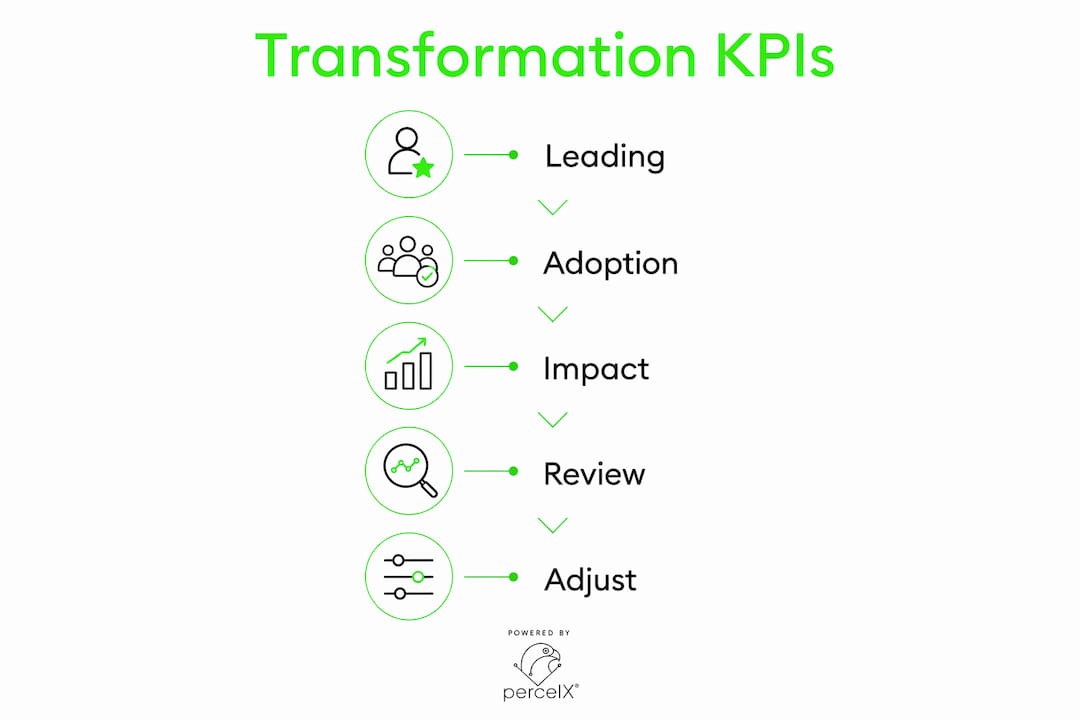
The most effective approach to workforce transformation measurement uses three levels of KPIs: leading indicators, adoption indicators, and impact indicators. Effective change management metrics operate at these three levels, with 2–3 metrics each to avoid overload. This structure surfaces early problems and links daily activities to business results.
Leading indicators
Leading indicators tell you whether the conditions for change exist. They include training completion rates, manager engagement scores, and feedback frequency. These metrics do not prove transformation has occurred. They signal whether your program has the momentum to produce it.
Adoption indicators
Adoption indicators measure whether employees are actually using new skills and processes. Key metrics include process compliance rates, system usage quality, and error rates on new workflows. High usage rates can mask low-quality adoption. Tracking error rates and process completion time gives you a more honest picture of whether change is real.
Impact indicators
Impact indicators connect employee behavior change to business outcomes. These include productivity gains, retention rates, and revenue per employee. Industry standards recommend tracking multi-level KPI strategies, and one firm reported a 20% retention increase after implementing this approach. That result shows what happens when you stop measuring activity and start measuring outcomes.

| Metric level | Examples | What it tells you |
|---|---|---|
| Leading | Training completion, manager engagement | Readiness and program momentum |
| Adoption | Error rates, process compliance | Quality of behavioral change |
| Impact | Retention rate, revenue per employee | Business value of transformation |
Pro Tip: Set your 2–3 metrics per level before the program launches. Defining them after the fact creates bias and makes baseline comparisons unreliable.
Counting training hours or attendance tells you what happened, not whether anything changed. Outcome metrics like skill gap closure and internal mobility rates are the real proof of transformation. Build your KPI framework around those from day one.
Which tools and data sources enable tracking employee development?
Reliable data collection requires more than one source. HR leaders who rely solely on a single survey or one system log end up with an incomplete picture of what is actually changing across their workforce.
The most effective data collection combines several input types:
- Pulse surveys and quarterly scorecards measure culture shifts and employee sentiment over time. Regular pulse surveys increase employee understanding to over 95% and program favorability by 80%. That is a significant return on a low-cost data collection method.
- Adaptive development plan tracking monitors milestones, mentor sessions, and course completion dynamically. Traditional development plans have only 20–30% completion rates. AI-driven tracking improves plan relevance and helps managers rebalance timelines before employees fall behind.
- System logs and workflow analytics capture behavioral data at the point of work. They show how employees interact with new processes in real time, not just what they report in surveys.
- 360° behavioral assessments reveal patterns in decision-making and leadership that self-reports miss. Percelx uses this approach to surface hidden behavioral gaps that affect performance across teams.
- Cross-functional performance data from finance, operations, and customer service connects HR metrics to business outcomes.
Pro Tip: Co-create your metric definitions with your data and finance teams before collecting anything. Incompatible success measurements across functions are one of the most common reasons transformation data becomes unusable.
Building a coherent data set means pulling from all of these sources and aligning them to the same definitions. When HR, operations, and finance each define "productivity" differently, your impact metrics will contradict each other. Alignment at the definition stage saves months of confusion later.
How do you analyze workforce transformation data for meaningful insights?
Raw data does not produce insight on its own. The way you interpret your metrics determines whether you make good decisions or expensive mistakes.
Follow these four steps to move from data collection to real insight:
- Establish a baseline before the program starts. Capture current skill levels, error rates, retention figures, and productivity scores. Without a baseline, you cannot prove that any change was caused by your program.
- Compare at 12- and 24-month intervals. Effective programs track progress against baselines at these intervals to prove ROI. A 12-month check shows early momentum. A 24-month check confirms whether change is lasting.
- Separate usage quantity from usage quality. A team logging into a new system 50 times a week may still be making the same errors as before. Measure error rates and time-to-completion on new workflows to assess true proficiency.
- Link skill gap closure to internal mobility. When employees close identified skill gaps, track whether they move into new roles or take on expanded responsibilities. Internal mobility is one of the clearest signals that behavioral change has translated into real capability.
The most common analysis mistake is treating training hours as a proxy for learning. Hours measure input. Skill gap closure, error reduction, and retention improvement measure output. Your analysis should always prioritize output metrics. For a deeper look at measuring behavior change progress, the frameworks for establishing KPIs in professional development projects are worth reviewing.
Pro Tip: When presenting data to leadership, always pair a leading indicator with an impact indicator. Showing training completion alongside a retention improvement makes the causal story much more convincing.
What are common challenges in measuring transformation progress?
Even well-designed measurement programs run into obstacles. Knowing the most common ones lets you build your system to avoid them from the start.
Common challenges HR leaders face:
- Inconsistent metric definitions across departments. When sales defines "skill adoption" differently than operations, your aggregate data becomes meaningless.
- Data silos. HR systems, finance platforms, and operational tools rarely talk to each other by default. Only 15% of companies actively perform strategic workforce planning, which means most organizations are already operating with fragmented talent data.
- Low employee participation in surveys and development plans. Incomplete data skews your results and makes it impossible to identify which employee segments are falling behind.
- Overreliance on superficial adoption metrics. Tracking system logins or survey submissions without measuring quality creates a false sense of progress.
Best practices to overcome these challenges:
- Embed feedback loops at regular intervals, not just at program end.
- Align metric definitions across HR, finance, and operations before data collection begins.
- Use adaptive tracking tools that adjust to individual progress rather than fixed timelines.
- Communicate measurement goals to employees clearly. When people understand why data is being collected, participation rates rise.
Pro Tip: Build stakeholder trust in your measurement data by sharing interim results openly, including findings that show slower-than-expected progress. Transparency builds credibility far more than polished final reports.
For HR leaders looking at the broader picture, workforce transformation program benefits and how to quantify ROI for leadership are worth understanding before you present your measurement results.
How can data insights improve employee transformation outcomes?
Collected data only creates value when it drives a specific decision. The most effective HR teams use their transformation analytics to trigger targeted interventions, not just to report on what already happened.
When your adoption metrics show high error rates in a specific workflow, that signals a need for targeted coaching, not another round of general training. When internal mobility data shows that employees in one department are advancing while another group stagnates, that points to a coaching or management gap, not a skills gap. The distinction matters because the interventions are completely different.
| Outcome area | Before data-driven intervention | After data-driven adjustment |
|---|---|---|
| Error rate on new workflows | High, inconsistent | Reduced through targeted coaching |
| Internal mobility | Low, concentrated in one team | Broader across departments |
| Retention rate | Declining post-program | Stabilized with personalized plans |
| Skill gap closure | Slow, unmeasured | Tracked and linked to role advancement |
Percelx applies 360° behavioral assessment data to surface the hidden patterns that standard performance reviews miss. When behavioral data is linked to business outcomes, HR leaders can make the case for specific interventions with evidence rather than intuition. That shift from intuition to evidence is what separates programs that produce lasting change from those that produce good-looking reports.
For real-world context on what this looks like in practice, measurable transformation examples show how organizations have used data to produce verifiable workforce change.
Key takeaways
Measuring employee transformation with data requires outcome-focused KPIs, continuous multi-source data collection, and baseline comparisons at defined intervals to prove real behavioral and business change.
| Point | Details |
|---|---|
| Use three KPI levels | Track leading, adoption, and impact indicators with 2–3 metrics each to avoid overload. |
| Measure quality, not just quantity | Error rates and process completion time reveal true adoption better than usage counts alone. |
| Establish baselines first | Capture skill levels and performance data before the program starts to enable valid comparisons. |
| Align metric definitions | Co-create definitions with data and finance teams to prevent incompatible measurements across functions. |
| Link data to decisions | Use analytics to trigger targeted interventions, not just to produce reports for leadership. |
What I've learned about measuring transformation the hard way
The most persistent mistake I see in workforce transformation measurement is confusing activity with progress. Organizations spend months building dashboards full of training completion rates and survey response counts, then wonder why their retention numbers have not moved. Activity metrics are easy to collect and easy to present. They are also easy to game. Employees complete modules to clear a notification. Managers submit feedback forms to satisfy a deadline. None of that tells you whether a single behavior has changed.
The programs that produce real results share one characteristic: they measure outcomes at multiple time points and connect those outcomes to business performance. A 12-month baseline comparison that shows skill gap closure alongside a retention improvement is worth more than a year of weekly completion reports. That connection between behavioral change and business result is what makes the case for continued investment.
The second thing I have learned is that measurement fails when it is treated as an HR function alone. The most credible transformation data comes from cross-functional collaboration. When finance confirms the revenue per employee figure and operations validates the error rate reduction, leadership trusts the story. When HR presents those numbers alone, skepticism is the default response.
The future of this work belongs to teams that treat behavioral data as a continuous input, not a periodic report. Adaptive tracking, frequent feedback loops, and 360° assessment data give you a living picture of where your people are and where they are headed. That is the foundation of transformation measurement that actually changes organizations.
— Percell
Percelx and data-driven workforce transformation
HR leaders who want to move from activity tracking to outcome measurement need a system built for behavioral intelligence.
Percelx delivers a 360° behavioral assessment platform that surfaces the hidden patterns shaping decision-making, leadership, and performance across your workforce. With a 4.9-star satisfaction rating, Percelx generates customized transformation plans instantly and tracks progress against real behavioral baselines. For teams that need metric integration at scale, the Percelx developer platform provides APIs that connect behavioral data to your existing HR and performance systems. The result is a measurement system that links employee behavior change directly to business outcomes, giving you the evidence you need to prove ROI and guide your next intervention.
FAQ
What does it mean to measure employee transformation with data?
It means tracking outcome-oriented metrics like skill gap closure, retention rates, and error reduction rather than activity counts like training hours. The goal is to prove that real behavioral and performance change has occurred.
What are the three levels of transformation KPIs?
Leading, adoption, and impact indicators. Leading indicators measure readiness, adoption indicators measure quality of behavioral change, and impact indicators connect transformation to business results like revenue per employee.
Why do most workforce transformations fail to show measurable results?
70% of workforce transformations fail because organizations track activity instead of outcomes. Without baseline comparisons and outcome metrics, there is no way to prove that change happened.
How often should you measure employee transformation progress?
Baseline data should be captured before the program starts, with formal comparisons at 12 and 24 months. Pulse surveys and adaptive tracking tools should run continuously between those checkpoints.
What is the difference between adoption quantity and adoption quality?
Adoption quantity counts how often employees use a new system or process. Adoption quality measures whether they are using it correctly, assessed through error rates and process completion time. High quantity with high error rates signals superficial adoption, not real change.