

Workforce transformation programs are defined as coordinated, organization-wide initiatives that align skills, culture, leadership, technology, and processes to build lasting performance gains. The benefits of workforce transformation programs are measurable and well-documented: organizations that commit to these programs see higher employee productivity, stronger engagement, and a clear competitive edge. Research from BCG and the World Economic Forum confirms that systemic alignment across all five pillars is what separates programs that deliver from those that stall. This article gives HR professionals and organizational leaders a direct, evidence-based look at what these programs actually produce and how to sustain those results.
1. What are the key benefits of workforce transformation programs for employee productivity?
Workforce transformation programs increase productivity by closing skill gaps before they become performance drags. When employees gain new capabilities through upskilling and reskilling, they complete work faster, make fewer errors, and adapt more readily to new tools. The PATHS for Texas program demonstrated this directly: participants who completed targeted workforce training increased quarterly earnings by 21% and raised employment rates by 5.5 percentage points. That outcome reflects what happens when training is tied to real job demands rather than generic curricula.

Technology integration amplifies these gains. When organizations pair human capability development with the right digital tools, employees spend less time on low-value tasks and more time on work that requires judgment. Roles that once required weeks of onboarding can be filled and performing faster when the organization has built a clear skills architecture. The productivity lift is not accidental. It follows directly from intentional program design.
Key productivity drivers in well-designed programs include:
- Targeted reskilling tied to specific role requirements, not broad subject areas
- Digital tool adoption supported by hands-on training, not just software rollouts
- Clear performance metrics that show employees how their new skills connect to outcomes
- Reduced time-to-competency through structured learning paths and mentorship
Pro Tip: Map your current skill gaps against your three-year business plan before designing any training curriculum. Programs built backward from business need consistently outperform those built around available content.
2. How do workforce transformation programs enhance employee engagement and retention?
Employee engagement rises when people feel their organization is investing in their growth. Workforce transformation programs create that signal clearly and consistently. A human-centric change management approach can improve the odds of lasting transformation results by up to 90%. That number reflects a fundamental truth: employees who feel seen and supported during change stay committed rather than checking out.
Leadership behavior is the single most visible signal employees read during any transformation. When leaders model the new behaviors the program asks of employees, adoption accelerates across the organization. BCG research shows that leadership alignment during transformation increases success rates by 27% through improved behavior modeling. Leaders who are unclear about their own roles send mixed signals that erode trust and slow progress.
Retention improves for a related reason. Employees who see a clear path forward within their organization are less likely to look elsewhere. Workforce programs that include recognition, career pathing, and transparent communication give people reasons to stay.
"The organizations that retain their best people during transformation are the ones that involve employees in shaping the change, not just receiving it." — BCG, Harnessing the Human Side of Transformations
Engagement-building elements that drive retention include:
- Visible leadership commitment through consistent behavior modeling
- Two-way communication channels that let employees raise concerns and shape solutions
- Skill recognition systems that reward growth, not just tenure
- Earn-while-learn structures such as apprenticeships that bridge education and employment without productivity loss
3. What organizational advantages arise from workforce transformation beyond employees?
The advantages of workforce transformation extend well past individual performance. Organizations that run comprehensive programs build the capacity to adapt faster than competitors, respond to market shifts without losing momentum, and generate ideas from within rather than relying solely on external hires. These are structural advantages that compound over time.
Financial performance is the most direct organizational benefit. Organizations investing in comprehensive workforce development are 1.8 times more likely to report superior financial performance. That advantage comes from leaner operations, lower turnover costs, and faster time-to-market on new products and services. Companies that integrate people-focused change management also outperformed peers by 15% in shareholder return.
The competitive edge from workforce transformation also shows up in how organizations handle AI adoption. Future-built companies are five times more likely to conduct strategic workforce planning that positions them to partner effectively with AI-enabled systems. That planning discipline is itself a product of transformation culture.
Organizational advantages build across four dimensions:
- Market agility — faster response to disruption because the workforce is already practiced at adapting
- Innovation capacity — cultures built on learning produce more internal ideas and intrapreneurship
- Operational efficiency — leaner processes emerge when employees understand both the work and the tools
- Talent attraction — organizations known for development draw stronger candidates without competing on salary alone
Pro Tip: Present workforce transformation outcomes to your executive team in financial terms: revenue per employee, cost of turnover, and time-to-fill. These metrics connect HR program data to the numbers your CFO already tracks.
4. How to measure and sustain the benefits of workforce transformation programs over time
Most organizations fail at workforce transformation because they treat it as a project with an end date. McKinsey research shows a roughly 30% success rate when transformation is managed as a one-time initiative. The organizations that sustain their gains treat transformation as a continuous operating model, not a program that concludes with a launch event.
Measurement is what keeps transformation alive. Without clear metrics, momentum fades and leadership attention shifts. The most effective HR leaders track a short list of business-relevant indicators and report them in terms executives understand. Tracking metrics like revenue per employee and cost of turnover secures leadership buy-in by connecting HR data directly to financial outcomes.
One underused metric is the workforce stability index: the ratio of new hires to tenured employees. A sharp rise in that ratio signals that institutional knowledge is leaving faster than it is being replaced. That loss is invisible in most dashboards but shows up painfully in performance six to twelve months later.
| Metric | What it measures | Why it matters |
|---|---|---|
| Revenue per employee | Output relative to headcount | Connects workforce investment to financial return |
| Cost of turnover | Replacement and onboarding expense | Quantifies the cost of failed retention |
| Workforce stability index | New hire to tenured employee ratio | Detects institutional knowledge loss early |
| Retention rate by cohort | Who stays after transformation milestones | Shows whether engagement gains are holding |
| Time-to-competency | Speed of skill adoption in new roles | Measures program effectiveness directly |
Sustaining transformation requires iterative feedback loops. Regular pulse surveys, manager check-ins, and skills assessments give you the data to adjust before problems compound. For a practical framework on tracking these gains over time, the guide on measuring team transformation offers concrete methods HR leaders can apply immediately.
5. Comparison: Traditional HR initiatives vs. comprehensive workforce transformation programs
Traditional HR initiatives and workforce transformation programs are not the same thing. Understanding the difference helps you allocate resources where they produce lasting results rather than short-term activity.
| Dimension | Traditional HR initiatives | Workforce transformation programs |
|---|---|---|
| Scope | Isolated: one program, one department | Systemic: vision, skills, culture, technology, process |
| Duration | Project-based with defined end dates | Continuous operating model |
| Technology role | Tools added on top of existing workflows | Human and technology capabilities built together |
| Leadership involvement | Sponsor sign-off, then delegation | Active behavior modeling throughout |
| Financial outcomes | Difficult to connect to business metrics | Directly linked to revenue and retention data |
| Culture impact | Minimal, often siloed | Deliberate culture shift embedded in daily work |
The gap between these two approaches explains why so many organizations invest in training and still see flat engagement scores. Isolated programs produce isolated results. Transformation programs produce compounding ones. If you want to understand the full range of program types available, the overview of team transformation strategies breaks down the options clearly for HR leaders planning their approach.
Key takeaways
Workforce transformation programs deliver lasting results only when they treat people, leadership alignment, and continuous measurement as non-negotiable foundations rather than optional add-ons.
| Point | Details |
|---|---|
| Productivity gains are measurable | Targeted training programs like PATHS produced a 21% increase in quarterly earnings for participants. |
| Leadership alignment is decisive | BCG research shows leadership alignment raises transformation success rates by 27% through behavior modeling. |
| Financial performance follows | Organizations with comprehensive workforce programs are 1.8 times more likely to report superior financial results. |
| Treat it as continuous, not a project | McKinsey data shows roughly 30% success when transformation is managed as a one-time initiative. |
| Measure in business terms | Metrics like revenue per employee and cost of turnover connect HR outcomes to executive priorities. |
What I've learned about making workforce transformation actually stick
The most common mistake I see HR leaders make is confusing activity with progress. A new learning management system gets launched, completion rates look strong, and leadership declares the transformation a success. Six months later, engagement scores are flat and turnover is climbing. The program ran. The transformation did not.
What actually works is building leadership clarity before anything else. When leaders know exactly what behaviors they are modeling and why, employees read that signal and follow. When leaders are uncertain or inconsistent, no amount of training content closes the gap. BCG's finding that leadership alignment raises success rates by 27% is not a surprise to anyone who has watched a well-designed program collapse because the senior team was not aligned on what they were asking people to do.
The second thing I have learned is that the organizations that sustain transformation are the ones that build feedback into the operating rhythm, not the project plan. Quarterly reviews, annual surveys, and post-launch assessments are too slow. You need monthly pulse data and a clear owner who acts on it. Transformation that is not actively maintained reverts. That is not a failure of the workforce. It is a failure of the system.
HR leaders who communicate transformation value in financial terms also get more sustained executive support. When you can show that a 10% improvement in retention saves the organization a specific dollar amount, the conversation shifts from cost center to investment. That shift changes everything about how much runway you get to do the work properly.
— Percell
Percelx and the behavioral intelligence behind workforce transformation
Workforce transformation programs produce results when they are grounded in real behavioral data, not assumptions about how people work and lead.
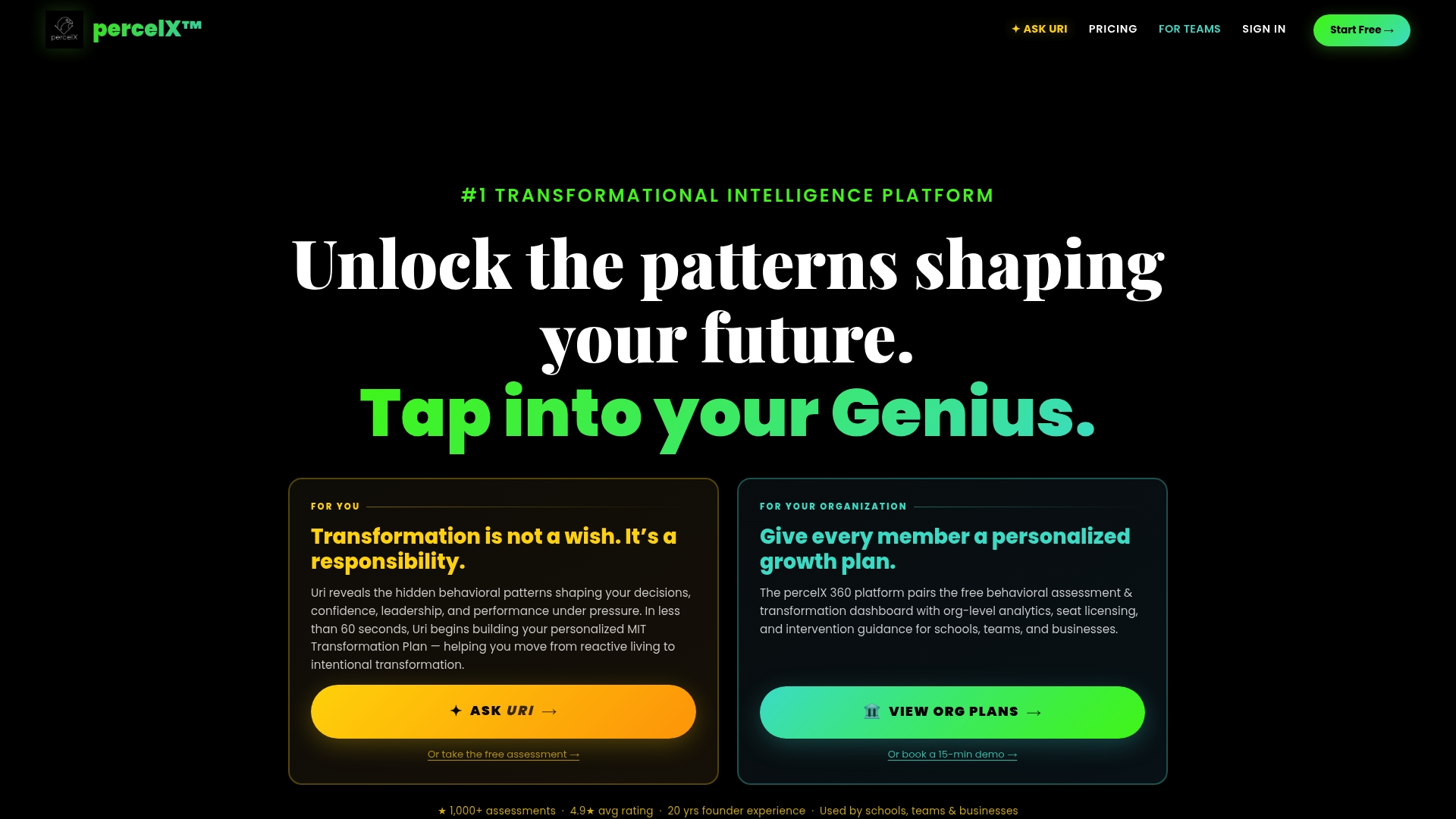
Percelx gives HR leaders and organizational teams the behavioral intelligence they need to move from guesswork to precision. The platform's 360° assessment approach reveals the hidden behavioral patterns that shape decision-making, leadership effectiveness, and team performance. With a satisfaction rating of 4.9 stars, Percelx delivers customized transformation plans that connect directly to the metrics you are already tracking. Whether you are building a behavioral intelligence foundation for your organization or looking for team-level tools through Percelx for Teams, the platform gives you the data to make transformation measurable and sustainable.
FAQ
What are the main benefits of workforce transformation programs?
Workforce transformation programs increase employee productivity, strengthen engagement, improve retention, and drive superior financial performance. Organizations with comprehensive programs are 1.8 times more likely to report top-tier financial results.
How does leadership alignment affect workforce transformation outcomes?
Leadership alignment raises transformation success rates by 27% by improving behavior modeling across teams. When leaders clearly demonstrate the behaviors the program requires, employees adopt changes faster and more consistently.
How do you measure the impact of workforce programs over time?
Track metrics like revenue per employee, cost of turnover, retention rates by cohort, and the workforce stability index. Presenting these in business terms connects HR program outcomes directly to executive priorities and secures ongoing support.
Why do most workforce transformation programs fail?
Roughly 70% of workforce transformation efforts fail because organizations treat them as time-limited projects rather than continuous operational shifts. Sustained success requires iterative feedback loops, ongoing leadership involvement, and metrics reviewed on a regular cadence.
How does workforce transformation improve employee engagement?
A human-centric approach to change management can improve the odds of lasting transformation results by up to 90%. Employees who are involved in shaping the change, recognized for growth, and supported by aligned leadership show significantly higher engagement and lower turnover.