

A talent transformation strategy is a deliberate, organization-wide approach to reshaping employee skills, behaviors, and mindsets to meet evolving business demands. Unlike a one-off training program, it spans the entire employee lifecycle and aligns workforce capability directly to business goals. For business leaders and HR professionals asking what is talent transformation strategy, the short answer is this: it is the structured system that turns your current workforce into the workforce your organization needs next. Research from Coursera confirms this includes coaching, mentoring, upskilling, reskilling, and on-the-job experiences working together as a capability system, not a course catalog.
What is a talent transformation strategy, really?
A talent transformation strategy is not a training calendar with a new name. Coursera defines it as a workforce-wide approach that develops and reshapes employee skills through upskilling, reskilling, and supportive learning experiences aligned with business needs. The distinction matters because most organizations already have learning programs. What they lack is a strategy that connects those programs to real business outcomes.
The standard industry term for this discipline is workforce transformation, and it sits at the intersection of talent management strategy, organizational design, and culture change. You are not just teaching people new tools. You are changing how your organization thinks, decides, and performs.
Three characteristics separate a true transformation strategy from a training initiative:
- Alignment to business strategy. Every capability you build must trace back to a specific business goal, whether that is entering a new market, adopting AI, or improving customer retention.
- Lifecycle scope. According to Insights Success, effective transformation runs across hiring, onboarding, performance development, leadership development, and ongoing capability building. It is continuous, not episodic.
- Behavioral change as the outcome. Skills knowledge without behavior change produces no results. The goal is performance, not completion rates.
What are the core components of an effective strategy?
The table below contrasts a talent transformation strategy with a conventional training program. The differences are structural, not cosmetic.
| Component | One-Off Training | Talent Transformation Strategy |
|---|---|---|
| Scope | Single skill or topic | Full workforce capability system |
| Duration | Days or weeks | Continuous, multi-year |
| Alignment | Departmental request | Business strategy and future skills |
| Measurement | Completion and satisfaction | Performance outcomes and skill-to-role mapping |
| Technology | LMS course delivery | AI-enabled skills mapping and workforce analytics |
| Culture | Optional add-on | Core design requirement |
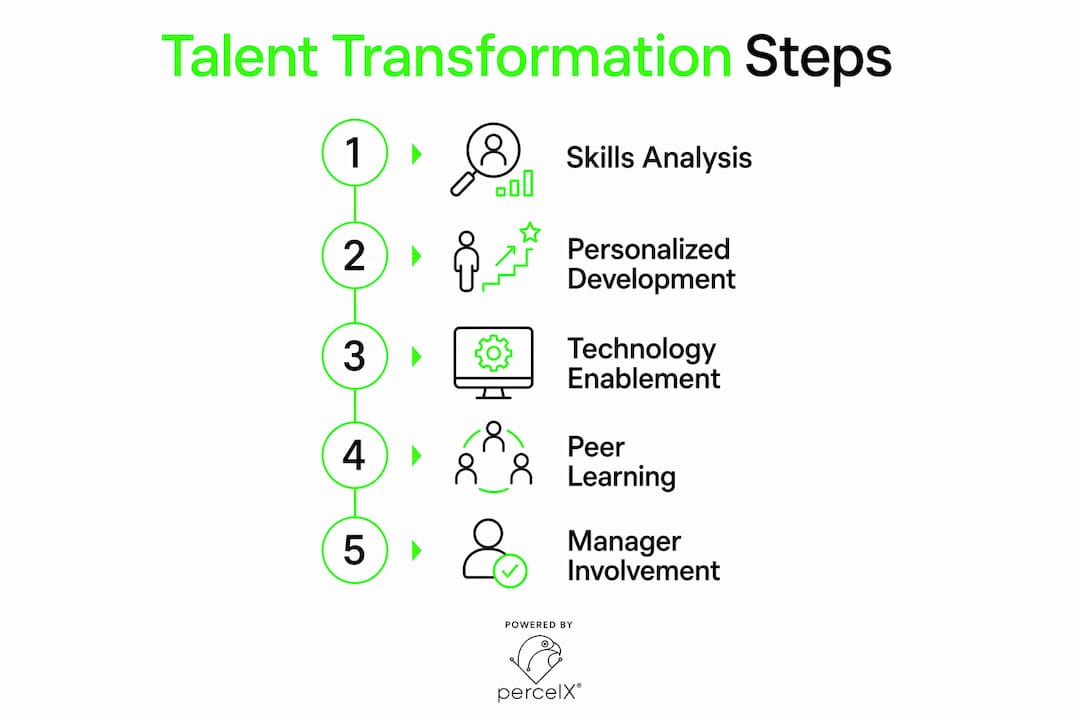
The five components that every workforce capability strategy must include are skills gap analysis, personalized development plans, technology enablement, leadership involvement, and a continuous learning culture.
Technology enablement deserves special attention in 2026. Accenture reports that shifting from job-based to future-skills thinking with AI-enabled workforce capability matching is now critical. Caterpillar invested $100 million in upskilling for digital, AI, and advanced technical skills. That investment reflects a strategic bet, not a training budget line item.
Pro Tip: Map your current skills inventory before you design any development program. You cannot close a gap you have not measured. Tools like workforce analytics platforms and 360-degree behavioral assessments give you the baseline data you need to build from.
A strong strategy for talent development also requires peer learning culture embedded into daily work. Formal programs alone cannot sustain the pace of change most organizations face today.

How does talent transformation improve engagement and retention?
The business case for workforce transformation is not abstract. Gallup-based research cited by HBR shows that employees with access to development opportunities are 3.6 times more likely to be engaged. Engaged employees drive higher productivity, lower absenteeism, and significantly better customer outcomes.
Retention data is equally direct. KPMG research highlighted by HBR shows that attrition rates can double after organizational disruption when no talent strategy is in place. That means a merger, a technology pivot, or a restructuring without a clear employee development plan can cost you half your workforce before the transformation even takes hold.
The mechanisms behind these outcomes include:
- Transparent communication. Employees who understand where the organization is going and how their role fits are far less likely to leave.
- Individual development pathways. Generic training signals that the organization does not see the individual. Personalized plans signal investment.
- Leadership visibility. When senior leaders actively participate in transformation programs, employees take the initiative seriously.
"Transformation fails if leaders neglect talent strategy and leave employee uncertainty unmanaged, which directly increases attrition risk." — HBR
Pro Tip: Involve frontline managers in the design of employee development plans, not just the delivery. Managers who co-create the strategy become advocates. Managers who receive it as a mandate become obstacles.
How to implement a talent transformation strategy
Implementation follows a clear sequence. Skipping steps does not save time. It creates the gaps that cause programs to fail eighteen months in.
- Conduct a skills gap analysis. Identify the capabilities your business needs in two to three years. Compare that to your current workforce profile. The delta is your transformation agenda.
- Define target future skills. Be specific. "Digital skills" is not a target. "AI prompt engineering for customer service teams" is a target. Specificity drives program design and measurement.
- Build personalized development plans. Talent lifecycle management research confirms that one-size-fits-all approaches fail. Each employee needs a pathway that reflects their current capabilities, career goals, and behavioral patterns.
- Integrate technology. Accenture's research confirms that modern talent strategies require orchestration of humans and technology, including foundational AI literacy and agility embedded in operating models. Workforce analytics platforms give you real-time visibility into skill alignment and team performance.
- Secure leadership alignment. Cross-functional buy-in is not optional. HR cannot own transformation alone. Business unit leaders must co-sponsor the initiative and model the behaviors they expect from their teams.
- Measure outcomes, not activity. Deloitte's research is clear: measuring transformation must go beyond training volume to focus on skill-to-job mapping, critical skill identification, and embedding skills in decision-making. Track performance outcomes, internal mobility rates, and retention of high-potential employees.
For a practical framework on assessing growth progress, the Percelx blog offers evidence-based guidance on building assessment systems that actually reflect capability change.
Pro Tip: Run a 90-day pilot with one business unit before scaling. Pilots surface adoption barriers early, generate internal case studies, and build the credibility you need to secure broader organizational commitment.
What pitfalls undermine talent transformation efforts?
Most transformation programs do not fail because of poor content. They fail because of poor design and execution assumptions.
Deloitte identifies the core problem: transformation programs fail when treated as isolated learning and development initiatives rather than integrated workforce capability systems with continuous feedback and role mapping. A completed course that does not connect to a real assignment or career move produces no lasting value.
The four most common pitfalls are:
- Treating transformation as a training project. If your program lives only inside the learning management system, it will not change behavior at work.
- Ignoring behavior change. Deloitte's research confirms that skills-based initiatives often fail due to adoption, trust, and behavior-change challenges rather than technology or framework gaps. Behavior change is the critical success factor, and it requires psychological safety, coaching, and time.
- Measuring the wrong things. Tracking hours of training completed tells you nothing about capability growth. Measure skill-to-role alignment, performance improvement, and internal mobility instead.
- Skipping stakeholder alignment. CIPD guidance is direct: there is no single best talent management approach. Effective strategies are context-driven and evidence-based. That means your strategy must be co-designed with the people who will live inside it, not handed down from a central HR function.
Organizations that skip the alignment phase typically see surface-level compliance and zero behavioral adoption. The program looks active on paper and produces no measurable change in performance.
Key takeaways
A talent transformation strategy succeeds only when it connects workforce capability development to real business outcomes, sustained leadership commitment, and behavioral change at every level.
| Point | Details |
|---|---|
| Definition is foundational | Talent transformation is a workforce-wide capability system, not a training program. |
| Engagement multiplier | Employees with development access are 3.6x more likely to be engaged, per Gallup-based research. |
| Attrition risk is real | Attrition can double post-disruption without a clear talent strategy in place. |
| Behavior change drives results | Technology and frameworks matter less than adoption, trust, and sustained behavior change. |
| Measure outcomes, not activity | Track skill-to-role alignment and internal mobility, not course completion rates. |
What i have learned about talent transformation after working with hundreds of teams
Most organizations approach talent transformation with the right intentions and the wrong mental model. They build a curriculum, launch it with executive fanfare, and then wonder why nothing changes six months later. The problem is not the content. The problem is that they treated a behavioral challenge as an information problem.
The organizations that get this right share one trait: they start with behavioral patterns, not job descriptions. They ask what hidden assumptions, reactive habits, and decision-making blind spots are currently limiting performance. Then they build the transformation program around closing those gaps. That is a fundamentally different starting point than "what skills do we need to teach?"
I have also seen the damage that cookie-cutter approaches cause. CIPD's guidance is correct that no single best approach exists. A strategy that worked brilliantly at a 500-person technology firm will not transfer cleanly to a 5,000-person manufacturing company. Context is not a footnote. It is the design constraint.
The organizations winning on workforce capability right now are the ones that invested in identifying leadership potential early and built transformation programs around those individuals first. Leadership behavior cascades. When your top 200 leaders model the new capabilities, the rest of the organization follows faster than any training program can drive.
My honest observation: the future belongs to organizations that treat talent transformation as a continuous operating system, not a change initiative with a start and end date. The moment you declare it complete, you have already fallen behind.
— Percell
How Percelx accelerates your talent transformation goals
Your workforce transformation strategy is only as strong as the behavioral intelligence behind it. Percelx gives business leaders and HR professionals the 360-degree assessment data they need to move from reactive programs to intentional, personalized growth plans.
The Percelx behavioral intelligence platform delivers customized transformation plans instantly by revealing the hidden behavioral patterns that shape decision-making, leadership, and team performance. For enterprise teams, percelX 360 Enterprise provides the infrastructure to run organization-wide assessments, track capability progress, and connect behavioral insights directly to performance outcomes. With a 4.9-star satisfaction rating, Percelx is built for organizations that want measurable results, not just completed assessments. Start with your team's behavioral foundation and build transformation that actually sticks.
FAQ
What is a talent transformation strategy in simple terms?
A talent transformation strategy is a structured, organization-wide plan to develop employee skills, behaviors, and capabilities aligned to future business needs. It goes beyond training to include coaching, mentoring, culture change, and continuous learning across the full employee lifecycle.
How is talent transformation different from talent management?
Talent management covers the full process of attracting, developing, and retaining employees. Talent transformation is a specific, time-bound initiative within that system focused on reshaping capabilities to meet a significant shift in business direction or market demands.
Why do talent transformation programs fail?
Most programs fail because they treat transformation as a training delivery problem rather than a behavioral change challenge. Deloitte research identifies adoption, trust, and behavior change as the primary failure points, not technology or framework gaps.
How do you measure the success of a talent transformation strategy?
Measure skill-to-role alignment, internal mobility rates, retention of high-potential employees, and performance outcomes. Tracking training completion rates alone tells you nothing about whether capability or behavior has actually changed.
How long does a talent transformation strategy take to implement?
A meaningful transformation program typically runs two to three years for full organizational impact, though a focused pilot with one business unit can show measurable results within 90 days. The timeline depends on organizational size, the scope of capability gaps, and leadership commitment.