

Personal growth in relationships is defined as the ongoing process of evolving as an individual in ways that directly improve your emotional health, communication, and connection with others. The role of personal growth in relationships goes far beyond self-help habits. It shapes how you regulate emotions, how you show up for your partner, and how resilient your bond becomes over time. Research confirms that self-care and personal development build a healthier foundation for all relationships by removing unresolved pain from relational dynamics. When you grow, your relationships grow with you.
How does personal growth affect relationship satisfaction?
Self-expansion is the psychological term for what happens when you grow through your relationship. It describes the process of incorporating new perspectives, skills, and experiences into your sense of self through connection with another person. Psychologists use this concept to explain why relationships that promote individual growth feel more alive and satisfying over time.
Novel and self-expanding activities with a partner directly correlate with increased relationship satisfaction, sexual desire, and commitment. That means the couple who tries rock climbing together, takes a language class, or travels somewhere unfamiliar is not just having fun. They are actively protecting their bond from stagnation.
Self-expansion activities you and your partner can try together include:
- Learning a new skill side by side, such as cooking, painting, or coding
- Traveling to places neither of you has visited before
- Volunteering for a cause that challenges your usual routines
- Attending workshops or seminars on topics outside your comfort zone
- Setting a shared physical challenge, like training for a 5K
The key is genuine novelty. Repeating the same "date night" routine does not trigger self-expansion. The activity needs to feel slightly challenging or unfamiliar to produce the psychological benefits that renew desire and commitment.
Pro Tip: You do not need to share every growth activity with your partner. Solo growth, like reading, therapy, or fitness, feeds the same self-expansion cycle and brings renewed energy back into the relationship.
Why maintaining your identity strengthens your relationship
Differentiation of self is a concept from family systems theory, developed by psychiatrist Murray Bowen. It describes your ability to stay emotionally regulated and maintain a clear sense of who you are, even under relational pressure. A person with high differentiation can be deeply connected to a partner without losing their own values, opinions, or emotional stability.

Higher differentiation benefits both partners' psychological health and fosters stable, healthier relationships. This is not about emotional distance. It is about having enough self-awareness to respond thoughtfully rather than react automatically.
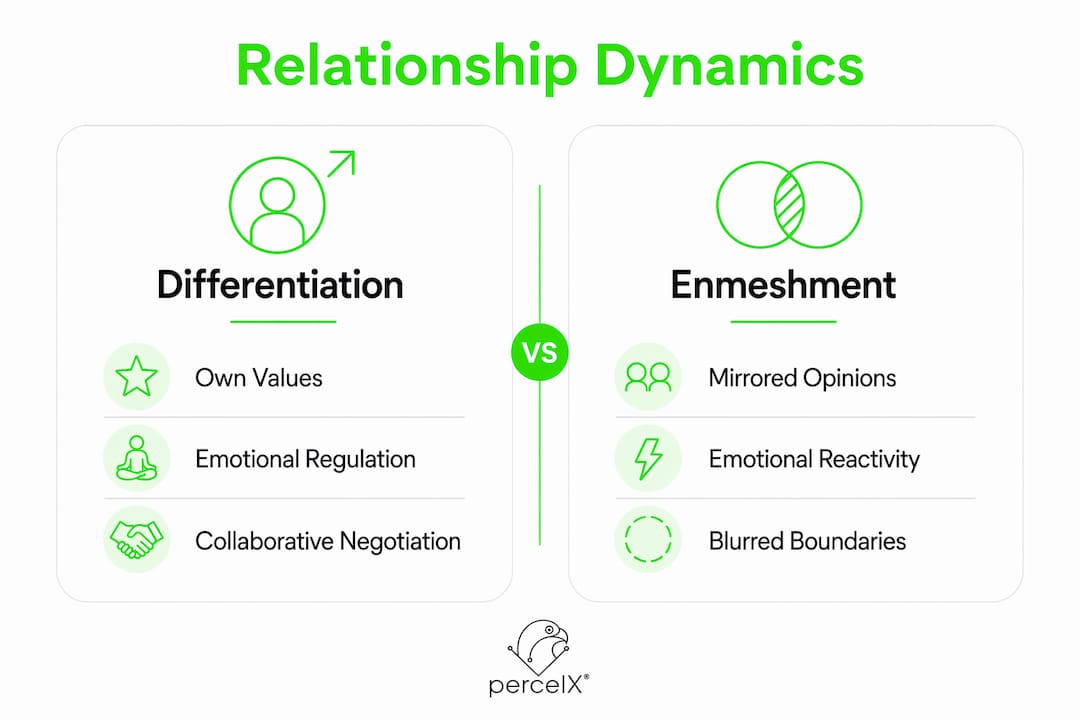
The contrast with enmeshment is worth understanding clearly. Enmeshment happens when two people become so fused that one partner's mood dictates the other's. It feels like closeness, but it actually limits both people's growth. Differentiation creates space for each person to develop without threatening the relationship's foundation.
| Differentiation | Enmeshment |
|---|---|
| Each partner holds their own values and opinions | Partners mirror each other's moods and beliefs |
| Conflict is managed with emotional regulation | Conflict triggers reactive, escalating responses |
| Individual growth is encouraged and celebrated | One partner's growth feels threatening to the other |
| Emotional support is given without losing self | Emotional boundaries are blurred or absent |
Self-awareness turns emotional reactivity into collaborative negotiation, which is crucial for intimacy during individual growth phases. When you understand your own triggers, you stop projecting them onto your partner. That shift alone can change the entire tone of a relationship.
Pro Tip: A mental performance coaching approach can help you identify the behavioral patterns that drive your emotional reactions, giving you a concrete starting point for building differentiation.
What happens when personal growth disrupts your relationship?
Growth changes you. It shifts your priorities, your schedule, your social circle, and sometimes your values. When those changes happen without open communication, your partner can feel left behind, confused, or even threatened. This is one of the most common and least discussed challenges in long-term relationships.
Personal growth changes routines and priorities, often causing tension if the relationship does not adapt alongside it. The PACER process is one framework therapists use to help couples navigate this. PACER stands for Pause, Acknowledge, Connect, Explore, and Respond. It gives both partners a structured way to address growth-induced friction before it becomes relational distance.
Here is how to apply intentional communication when growth creates tension:
- Name the change out loud. Tell your partner what has shifted for you, even if you cannot fully explain why yet. Silence creates assumptions.
- Acknowledge the impact. Recognize that your growth affects your partner's daily life and emotional experience. Validation matters more than explanation.
- Ask what they need. Do not assume your partner wants you to slow down. They may simply need more information or reassurance.
- Negotiate shared routines. Identify which rituals or habits still work for both of you and protect them intentionally.
- Revisit regularly. Growth is not a one-time event. Schedule brief check-ins to assess how both of you are adjusting.
Growth can trigger temporary relational "growing pains" by altering established priorities. Consciously naming ruptures and doing repair work sustains the connection. The couples who navigate growth best are not the ones who avoid friction. They are the ones who repair it faster.
Individuals growing gain clarity and confidence and may not need to explain each change, but they do need to recognize that the relational environment must adjust too. That recognition is what separates growth that strengthens a relationship from growth that quietly erodes it.
How does healthy interdependence support both partners' growth?
Interdependence is the balance point between losing yourself in a relationship and keeping so much distance that real intimacy never forms. It is not independence, where each person operates as a separate unit. It is not enmeshment, where boundaries dissolve. Interdependence means two fully formed individuals choosing to build something together while remaining whole on their own.
Healthy interdependence involves three sovereign entities: your individual self, your partner's self, and the relationship as its own organism. Each of these three requires attention and care. Neglecting any one of them creates imbalance.
The practical difference between these three relational models looks like this:
| Model | Individual identity | Emotional availability | Growth potential |
|---|---|---|---|
| Independence | Strong | Low | Individual only |
| Enmeshment | Weak | High but reactive | Stunted for both |
| Interdependence | Strong | High and regulated | Mutual and sustained |
Building healthy interdependence requires deliberate habits:
- Maintain personal interests, friendships, and goals outside the relationship
- Communicate needs directly rather than expecting your partner to sense them
- Celebrate each other's individual wins without making them competitive
- Create shared goals that neither person could achieve alone
- Revisit your relationship's "vision" together at least once a year
True interdependence is an ongoing practice where partners maintain stable individual selves and an emotionally available relationship, avoiding enmeshment and promoting mutual growth. The word "practice" matters here. Interdependence is not a state you reach. It is a daily choice both partners make.
An intentional career growth plan offers a useful parallel. Just as professional growth requires deliberate planning and regular reassessment, relational growth demands the same intentionality.
Key Takeaways
Personal growth strengthens relationships when it is paired with self-awareness, open communication, and a commitment to maintaining both individual identity and shared connection.
| Point | Details |
|---|---|
| Self-expansion renews bonds | Novel shared activities increase satisfaction, desire, and commitment in long-term relationships. |
| Differentiation protects both partners | Maintaining your identity and emotional regulation benefits your psychological health and your partner's. |
| Growth creates tension without communication | Use structured frameworks like PACER to name changes and repair relational ruptures before they widen. |
| Interdependence beats both extremes | Healthy interdependence outperforms both emotional enmeshment and rigid independence for mutual growth. |
| Self-awareness reduces reactivity | Turning emotional reactions into self-insight lowers defensiveness and deepens intimacy over time. |
What I've learned about growth and relationships that most articles get wrong
Most advice on personal development in relationships focuses on what you gain. Better communication. More confidence. Deeper intimacy. That framing is accurate, but it skips the part that actually trips people up: growth is disruptive before it is rewarding.
In my experience working with individuals navigating relational change, the biggest misconception is that focusing on yourself is somehow selfish or a threat to your partner. The opposite is true. Personal responsibility for mental health enables partners to provide effective, nonjudgmental support. When you do the internal work, you stop outsourcing your emotional regulation to the people you love.
The second misconception is that growth should feel smooth. It rarely does. Relationships naturally refilter during growth phases. Some connections deepen. Others loosen. That is not failure. That is alignment. The relationships that survive and strengthen through your growth are the ones worth investing in.
What I tell people consistently: clarity is more useful than comfort. You do not need to have every answer before you communicate a change. You need the courage to say, "Something is shifting for me, and I want us to figure out what that means together." That sentence alone has saved more relationships than any technique I have seen.
Growth is not something you do to your relationship. It is something you bring to it.
— Percell
Percelx: behavioral intelligence for deeper self-awareness
Understanding your behavioral patterns is the first step toward meaningful growth in any relationship. Percelx uses a 360° assessment approach to reveal the hidden patterns shaping your decisions, emotional responses, and interpersonal dynamics.
Whether you are working on differentiation, emotional regulation, or simply understanding why certain relational dynamics keep repeating, the Percelx platform delivers a personalized transformation plan built around your specific behavioral profile. With a 4.9-star satisfaction rating, Percelx supports individuals and couples who want measurable progress, not generic advice. The Uri behavioral intelligence module offers targeted insights into the interpersonal patterns that affect your closest relationships. Your growth deserves a clear map.
FAQ
What is the role of personal growth in relationships?
Personal growth in relationships means evolving as an individual in ways that improve emotional regulation, communication, and connection. Research shows that self-awareness and self-expansion directly increase relationship satisfaction and stability.
Does personal growth always improve a relationship?
Growth improves relationships when paired with open communication and mutual adaptation. Without intentional dialogue, individual growth can create tension by shifting priorities and routines in ways a partner does not understand.
What is differentiation of self in relationships?
Differentiation of self is your ability to maintain your identity and emotional regulation while staying deeply connected to a partner. Higher differentiation predicts better psychological health for both people in the relationship.
How do self-expansion activities help couples?
Self-expansion activities, such as learning new skills or traveling together, trigger psychological growth that renews desire, commitment, and overall satisfaction. The novelty of the activity is what produces the relational benefit.
What is healthy interdependence in a relationship?
Healthy interdependence means two individuals maintain strong personal identities while remaining emotionally available to each other. It avoids both enmeshment, where boundaries dissolve, and pure independence, where emotional connection is limited.