

A growth mindset in the workplace is the belief that intelligence, skills, and abilities can be developed through effort, learning, and feedback rather than fixed traits you are born with. Psychologist Carol Dweck's foundational research established this concept, and organizational psychology has since built a strong case for its impact on business performance. Organizations with growth mindset cultures show measurable improvements in adaptability, innovation, and employee resilience compared to traditional performance-driven cultures. Understanding what is growth mindset workplace means goes far beyond a motivational slogan. It requires structural changes to how leaders coach, how teams process failure, and how your organization defines success.
What is growth mindset in the workplace, exactly?
A growth mindset, as defined by Carol Dweck's work at Stanford, is the operating belief that your current abilities represent a starting point, not a ceiling. In a workplace context, this belief shapes how employees respond to challenges, criticism, and setbacks. A person with a fixed mindset treats a failed project as evidence of limited ability. A person with a growth mindset treats the same failure as data for the next attempt.
The distinction matters enormously for organizations. Growth mindset cultures report measurable gains in problem solving, innovation, and employee engagement. Those gains are not accidental. They follow directly from how people interpret difficulty and whether they stay engaged when progress is slow.

The importance of mindset at work shows up in hiring, performance reviews, and daily team interactions. When your culture rewards effort and learning, people take calculated risks. When it rewards only results, people protect themselves by avoiding anything uncertain.
How does a growth mindset differ neurologically from a fixed mindset?
The difference between growth and fixed mindsets is not just philosophical. It is measurable in brain activity. Individuals with a growth mindset exhibit higher neurological error positivity (Pe) amplitudes, a brain signal associated with greater attention to mistakes and stronger receptivity to corrective feedback. That means the brain is literally paying more attention to what went wrong and why.
Two brain regions are central to this process. The dorsal anterior cingulate cortex monitors for errors and conflicts during tasks. Striatal connectivity governs how the brain processes reward signals, including the reward of learning something new. Growth mindset strengthens both systems over time. Brain wiring adapts to make growth mindset the default operating mode when it is sustained through consistent practice and environment.
For team leaders, this has a direct implication. Employees who receive regular, specific feedback in a psychologically safe environment are not just learning faster. They are physically rewiring their neural pathways to process challenge as opportunity rather than threat. That rewiring takes time and repetition. A single training session does not produce it.
Pro Tip: Pair corrective feedback with a specific next step. "Here is what went wrong, and here is what to try differently" activates the Pe response more effectively than general praise or criticism alone.
The neurological case for growth mindset also explains why mindset determines performance in high-pressure environments. When the brain is wired to treat errors as information, performance under pressure improves because the threat response is lower and the learning response is higher.
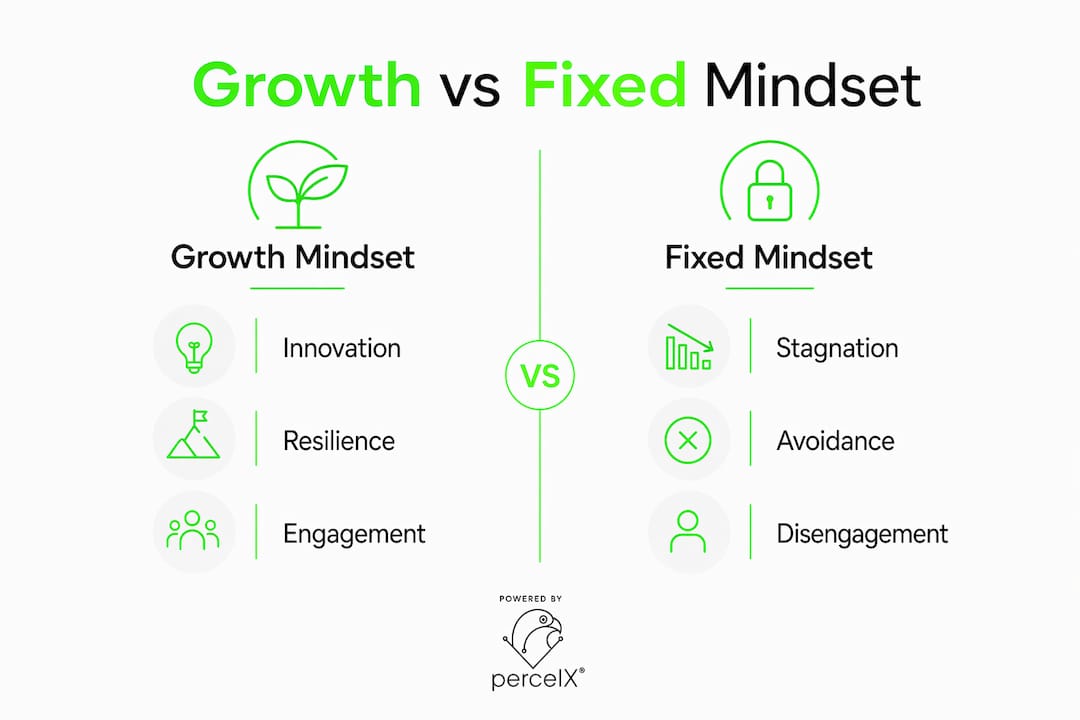
What distinguishes a growth mindset culture from a fixed mindset culture?
Culture is the sum of what gets rewarded, what gets ignored, and what gets punished. Growth mindset cultures and fixed mindset cultures differ on all three dimensions.
In a fixed mindset culture, you will typically see:
- Talent is celebrated as innate. Phrases like "she is a natural" or "he is just not a numbers person" are common.
- Failure is treated as a character flaw rather than a process outcome.
- Employees hide mistakes to protect their reputation.
- Performance reviews focus on ratings rather than development conversations.
- High performers are protected from stretch assignments to avoid risk.
In a growth mindset culture, the behavioral patterns look different:
- Effort and process are recognized alongside results.
- Mistakes are discussed openly, especially by leaders.
- Feedback cycles are frequent, specific, and forward-looking.
- Employees volunteer for unfamiliar challenges because failure carries no social penalty.
- Learning goals sit alongside performance goals in every review.
Leaders sharing mistakes transparently functions as social validation that drives mindset certainty across teams. This is a critical point. Employees do not adopt a growth mindset because a poster says to. They adopt it when they see their manager admit a misjudgment and describe what they learned from it.
Employees naturally gravitate toward organizations whose mindset culture matches their own. This means your culture actively selects for the mindset you model. If leadership models fixed mindset behaviors, growth-oriented employees leave. The culture self-reinforces in whichever direction leadership sets.
What practical steps can organizations take to build a growth mindset workplace?
Building a growth mindset culture requires structural changes, not just training sessions. Simply telling employees to adopt a growth mindset backfires unless it is fully embodied and socially validated across the culture. Here is what actually works.
-
Shift performance reviews from talent ratings to effort and process feedback. Replace "meets expectations" scores with development conversations. Ask what the employee tried, what they learned, and what they will do differently. This reframes the entire evaluation relationship.
-
Assign stretch projects with uncertain outcomes. Stretch assignments with uncertain outcomes are critical to applying a growth mindset beyond training sessions, enabling real cognitive shifts. Assign people to projects where success is not guaranteed. Support them through the discomfort rather than rescuing them from it.
-
Activate individual strengths alongside growth areas. Strengths use mediates the relationship between growth mindset and innovative behaviors. Knowing what you are already good at gives you a stable foundation from which to take risks in areas where you are not yet skilled.
-
Create psychological safety through leader behavior. Leaders who share their own errors openly, without defensiveness, signal that the environment is safe for honest learning. This is not a one-time gesture. It requires consistent modeling across every team interaction.
-
Build feedback into the workflow, not just the calendar. Annual reviews do not build growth mindset. Weekly check-ins, project retrospectives, and peer feedback loops do. Frequency and specificity matter more than formality.
-
Avoid superficial encouragement without structural support. Telling someone "great effort" while still penalizing failure in performance ratings sends a contradictory message. The structure must match the message.
Pro Tip: Use professional growth assessments to identify where each team member's behavioral patterns currently sit. Baseline data makes growth visible and keeps development conversations grounded in evidence rather than impressions.
Growth mindset training for employees works best when it is embedded in real work, not delivered as a standalone workshop. The goal is to change the daily behavioral patterns that shape how people respond to difficulty, not to add another item to the training calendar.
What are the measurable benefits of a growth mindset in business?
The benefits of growth mindset in business are concrete and well-documented across organizational psychology research. The table below summarizes the primary outcomes.
| Benefit area | What the research shows |
|---|---|
| Innovation | Growth mindset cultures report higher rates of creative problem solving and willingness to test new approaches. |
| Employee resilience | Entrepreneurs with a growth mindset show lower negative affect and better coping with setbacks. |
| Engagement | Employees in growth cultures stay engaged longer because effort is recognized, not just outcomes. |
| Adaptability | Organizations with growth mindset cultures show stronger adaptability when market conditions shift. |
| Strengths activation | Coupling growth mindset with strengths use produces the highest gains in innovative behavior. |
The resilience finding deserves particular attention. When employees expect that effort leads to improvement, setbacks do not trigger the same discouragement they would in a fixed mindset environment. The employee who fails at a new skill in a growth culture tries again. The employee who fails in a fixed culture often stops trying entirely.
Growth mindset encourages seeing challenges as opportunities and improves long-term business success. That framing shift has a compounding effect. Teams that treat obstacles as problems to solve rather than signs of inadequacy build momentum over time. The gap between growth mindset organizations and fixed mindset organizations widens with each year of sustained cultural difference.
Supporting growth mindset culture also reduces the cost of talent attrition. When people feel they are developing, they stay. When they feel stuck, they leave. The connection between mindset culture and retention is direct.
Key takeaways
A growth mindset workplace requires structural support, leadership modeling, and strengths activation working together, not just positive messaging.
| Point | Details |
|---|---|
| Core definition | Growth mindset means abilities develop through effort and feedback, not fixed talent. |
| Neurological basis | Higher Pe amplitudes show the brain pays more attention to errors in growth mindset individuals. |
| Culture signals | Leaders sharing mistakes openly is the single most powerful driver of team mindset adoption. |
| Practical priority | Stretch assignments and effort-based feedback embed growth mindset more effectively than training alone. |
| Strengths pairing | Coupling growth mindset with strengths activation produces the strongest gains in innovation and engagement. |
What I have learned about growth mindset that most articles get wrong
The most common mistake organizations make is treating growth mindset as a communication problem. They write it into their values statement, run a half-day workshop, and wonder why nothing changes. Growth mindset is not a message. It is a behavioral pattern that either gets reinforced or undermined by every structural decision your organization makes.
Growth mindset requires high standards combined with the support to meet them. It is not about uncritical positivity or celebrating effort regardless of outcome. The discomfort of pushing beyond your current capability is not a side effect of growth mindset. It is the mechanism. If your team never feels stretched, they are not developing.
The second thing most articles miss is the role of social validation. Research from Emory Business confirms that mindset certainty in employees depends heavily on whether leadership models the same mindset they are asking for. You cannot ask your team to be vulnerable about failure while protecting yourself from the same exposure. The credibility gap kills the culture shift before it starts.
What actually works is a combination of high expectations, genuine support, transparent leadership, and talent development strategies that treat people as capable of more than their current performance suggests. That combination is harder to build than a workshop. It is also the only version that lasts.
— Percell
How Percelx supports growth mindset development in your organization
Building a growth mindset culture requires more than good intentions. It requires knowing where your team's behavioral patterns currently stand and what is driving them.
Percelx uses a 360° behavioral intelligence assessment to reveal the hidden patterns shaping how your team makes decisions, responds to feedback, and handles pressure. With a 4.9-star satisfaction rating, the Percelx platform delivers personalized transformation plans that connect individual behavioral data to team-wide performance outcomes. Whether you are working with a single leader or an entire organization, Percelx gives you the baseline clarity needed to build a culture where growth is measurable, not assumed. The enterprise team tools are built specifically for leaders who need real data behind their development programs.
FAQ
What is a growth mindset in the workplace?
A growth mindset in the workplace is the belief that intelligence and abilities can be developed through effort, learning, and feedback. It shapes how employees respond to challenges, criticism, and setbacks.
How does a growth mindset differ from a fixed mindset at work?
A fixed mindset treats ability as static and failure as a personal flaw. A growth mindset treats both as changeable through effort, which leads to higher engagement and stronger resilience over time.
What are the main benefits of growth mindset in business?
Organizations with growth mindset cultures report stronger innovation, better employee resilience, higher engagement, and greater adaptability when conditions change.
How can leaders foster a growth mindset in their teams?
Leaders build growth mindset cultures by modeling transparent error-sharing, shifting to effort-based feedback, assigning stretch projects, and pairing growth goals with individual strengths activation.
Does growth mindset training for employees actually work?
Training works when it is embedded in real work and backed by structural changes to feedback and evaluation systems. Standalone workshops without cultural reinforcement produce little lasting change.