

Team transformation strategies are defined as structured approaches that shift how teams operate, collaborate, and perform across specific organizational levels. The three core categories are team-level agile adoption, department-level alignment, and enterprise-wide restructuring. Each category uses distinct frameworks, rollout patterns, and leadership behaviors. Understanding the types of team transformation strategies available lets you match the right method to your team's actual context, rather than applying a one-size-fits-all model that stalls before it scales.
1. what are team-level agile adoption strategies?
Team-level agile adoption is the most focused type of transformation, targeting a single team before any broader rollout. Agile transformation roadmaps at this level typically move through four phases: awareness, doing, measuring, and scaling. Starting small lets you test what works without disrupting the entire organization.
The most common frameworks at this level are Scrum, Kanban, and iterative delivery cycles. Scrum structures work into fixed sprints with defined roles. Kanban visualizes workflow and limits work in progress. Both create shared accountability and surface bottlenecks that were previously invisible to leadership.

Pilot team formation is the critical first step. You select a willing, cross-functional group, give them the tools and coaching they need, and measure outcomes before expanding. This approach reduces risk and builds an internal proof of concept that earns buy-in from skeptical stakeholders.
Leadership mindset shifts matter as much as process changes at this stage. Managers must move from directing to enabling. That shift is harder than it sounds, and it requires deliberate practice, not just a policy memo.
- Define sprint goals and review cycles from day one
- Track velocity, cycle time, and team satisfaction weekly
- Assign a dedicated agile coach or internal champion
- Document lessons learned before scaling to other teams
Pro Tip: Set up a simple dashboard tracking two or three agile metrics from the first sprint. Teams that measure early adapt faster and generate the data you need to justify broader rollout.
2. how do department-level strategies align multiple teams?
Department-level transformation addresses the coordination challenges that emerge when several teams must work toward a shared outcome. A single agile team can self-organize. Five teams working on the same product stream cannot do that without deliberate alignment mechanisms.
The core challenge is value stream synchronization. Each team may operate well independently, but handoffs between teams create delays, rework, and misaligned priorities. Department-level strategies introduce shared planning cadences, cross-team retrospectives, and unified goal frameworks to close those gaps.
Scaling pilot success into department culture requires more than copying what worked for the pilot team. You need a cross-functional leadership coalition that actively models the new behaviors. Without visible commitment from department heads, teams revert to old patterns within weeks.
Communication is the most underestimated factor at this level. Teams need to know not just what they are doing, but why it connects to the department's direction. Goal clarity artifacts like OKRs (Objectives and Key Results) or shared backlogs make that connection visible and persistent.
- Establish a cross-team planning rhythm, such as quarterly planning sessions
- Create shared definition-of-done standards across all teams
- Assign integration owners who manage dependencies between teams
- Run joint retrospectives monthly to surface systemic blockers
- Use OKRs to align team-level work with department outcomes
3. what characterizes enterprise-wide transformation?
Enterprise-wide transformation restructures how an entire organization operates, not just how individual teams or departments function. This is the highest-stakes category of change, and it requires the most deliberate framework selection. Change management models at this scale complement each other rather than compete, and selecting the right combination depends on your primary adoption blockers.
John Kotter's 8-step model is the most widely applied framework for organizational-scale strategic change. It moves from creating urgency and building a guiding coalition through to anchoring new behaviors in culture. The model works best when the primary blocker is leadership alignment, not individual skill gaps.
ADKAR, developed by Prosci, targets individual adoption. It addresses Awareness, Desire, Knowledge, Ability, and Reinforcement in sequence. When people understand the change but still resist it, ADKAR diagnoses exactly where the breakdown is occurring. The Bridges Transition Model adds a third dimension by addressing the psychological side of change, specifically the emotional process of letting go of old roles before embracing new ones.
Rollout patterns at the enterprise level fall into two broad categories: pilot and expand, or big bang. Pilot and expand reduces risk by proving value in a contained environment first. Big bang applies change across the organization simultaneously, which works only when leadership alignment is near-total and the change is time-sensitive.
- Assess leadership alignment before choosing a framework
- Build a guiding coalition that spans business units
- Create a shared vision statement that teams can repeat in one sentence
- Identify short-term wins and communicate them loudly within 90 days
- Use ADKAR to diagnose individual adoption blockers at each phase
- Apply Bridges when emotional resistance is slowing adoption despite adequate knowledge
- Anchor changes in performance reviews, hiring criteria, and onboarding
Pro Tip: Before selecting a framework, ask one question: where is adoption actually stalling? If it is leadership alignment, use Kotter. If it is individual knowledge or motivation, use ADKAR. If it is emotional resistance to letting go, use Bridges. Framework selection is diagnostic, not preferential.
4. which rollout patterns fit different organizational contexts?
Transformation rollout patterns include bottom-up, top-down, pilot-and-expand, big bang, and emergent approaches. No single pattern is universally superior. Context factors like leadership commitment, grassroots energy, and organizational risk tolerance determine which pattern fits.
Bottom-up transformations start with teams and build momentum organically. They work well when frontline teams are motivated and leadership is open to following their lead. The risk is that without executive sponsorship, momentum stalls when the change requires budget, policy shifts, or cross-department coordination.
Top-down transformations start with executive mandate and cascade downward. They move faster and carry organizational authority. The risk is low ownership at the team level, which produces compliance rather than genuine adoption.
The most effective approach in most organizations is a hybrid. Blending top-down commitment with bottom-up implementation gives leaders clarity on direction while giving teams ownership over execution. Pilot-and-expand patterns fit this hybrid model well because they reduce risk while maintaining momentum.
| Pattern | Best Context | Primary Risk |
|---|---|---|
| Bottom-up | High grassroots energy, open leadership | Stalls without executive sponsorship |
| Top-down | Urgent change, strong executive alignment | Low team ownership, surface compliance |
| Pilot and expand | Moderate risk tolerance, proof-of-concept needed | Slow scaling if pilots are not well-documented |
| Big bang | Time-critical change, near-total leadership alignment | High failure cost if adoption is incomplete |
| Emergent | Experimental culture, high psychological safety | Unpredictable pace and outcomes |
Success factors that apply across all patterns include the following:
- Visible leadership engagement at every phase, not just launch
- A clear and repeatable purpose statement for the transformation
- Investment in learning and skill development, not just process change
- Regular feedback loops between teams and decision-makers
- Celebration of short-term wins to sustain energy over multi-month timelines
5. how does psychological safety drive team dynamics improvement?
Psychological safety is the single most important factor in high-performing teams. Google's Project Aristotle identified it as the top predictor of team effectiveness, above skill level, experience, or team composition. Teams where members feel safe to speak up, disagree, and admit mistakes outperform those where they do not.
Psychological safety is not a culture slogan. It is a learnable interpersonal environment created through specific, repeatable behaviors by leaders and team members. The relational enablers include open communication, trust in leadership, peer trust, and inclusive participation norms.
Regular interpersonal moments build safety more effectively than isolated training workshops. A leader who asks for input in every meeting, acknowledges mistakes publicly, and follows through on commitments creates more psychological safety than a half-day offsite ever will.
Sustained behavioral changes, not one-off events, are what build trust and accountability over time. This means transformation planning must include recurring touchpoints, not just a launch event and a follow-up survey six months later.
Practical strategies for building psychological safety during transformation include the following:
- Create inclusive team agreements that define how the team handles disagreement
- Use structured turn-taking in meetings to ensure equitable participation
- Practice active listening by summarizing what you heard before responding
- Model vulnerability by sharing your own uncertainties about the transformation
- Recognize contributions publicly and correct course privately
Pro Tip: Embed one psychological safety behavior into every recurring team ritual. Start your weekly standup by asking what is not working. That single habit, repeated consistently, signals that honesty is welcome and rewarded. For a deeper look at building trust in teams, a 90-day framework can accelerate the process.
Key takeaways
Effective team transformation requires matching your strategy type to your organizational scale, then selecting frameworks and rollout patterns based on where adoption is actually breaking down.
| Point | Details |
|---|---|
| Match strategy to scale | Use team-level agile for single teams, department alignment for multiple teams, and enterprise models for full restructuring. |
| Diagnose before selecting frameworks | Kotter fits leadership alignment gaps; ADKAR targets individual adoption; Bridges addresses emotional resistance. |
| Hybrid rollouts outperform pure patterns | Combining top-down mandate with bottom-up implementation increases both speed and team ownership. |
| Psychological safety is a behavior, not a value | Build it through small, frequent leader actions in recurring team rituals, not isolated workshops. |
| Pilot before scaling | Documenting pilot outcomes creates the evidence base that earns organizational buy-in for broader rollout. |
What i have learned about transformation that most guides skip
Most transformation guides treat framework selection as the hard part. In my experience, it is not. The hard part is getting leaders to change their own behavior while simultaneously asking their teams to change theirs.
I have seen organizations apply Kotter's 8-step model with textbook precision and still fail at step six because the guiding coalition stopped showing up. The framework was right. The sustained leadership engagement was not there. That gap is where most transformations quietly die.
The teams that actually transform share one pattern: their leaders treat the process as a personal development challenge, not just an organizational project. They ask for feedback. They adjust. They model the behaviors they are asking their teams to adopt.
Rollout pattern selection matters, but it matters less than most people think. A well-executed bottom-up transformation with genuine leadership support will outperform a poorly executed top-down mandate every time. Context shapes the pattern, but commitment determines the outcome.
My honest recommendation: start with a 90-day pilot, measure behavioral change alongside process metrics, and build your scaling case from real data. Rigid plans do not survive contact with real teams. Adaptive, learning-oriented approaches do.
— Percell
How Percelx supports your transformation from the inside out
Choosing the right strategy type is only the beginning. Executing it requires visibility into the behavioral patterns that shape how your team actually operates, not just how it is supposed to operate.
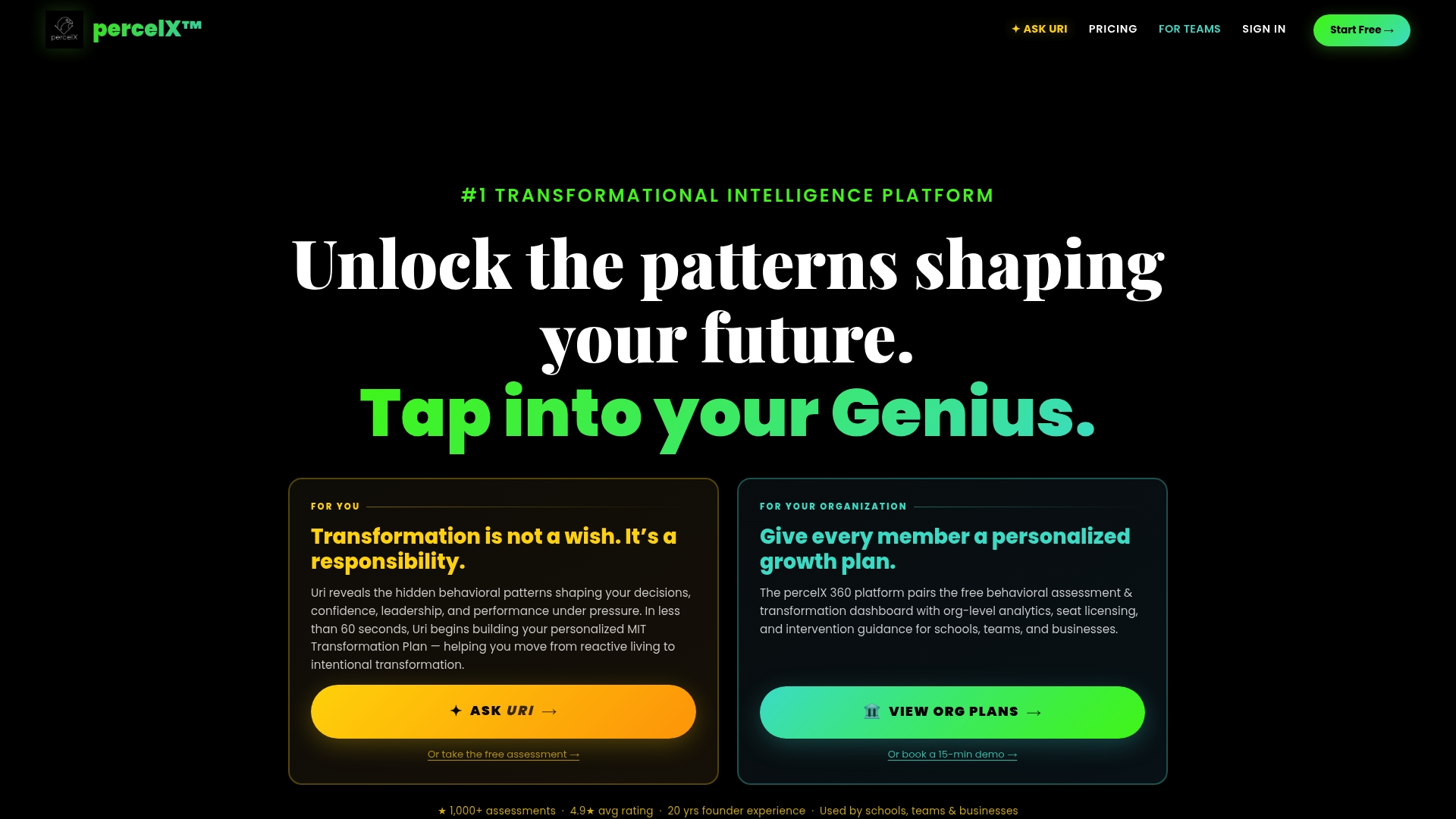
Percelx gives you that visibility. The Percelx 360 Enterprise platform uses a 360° behavioral intelligence assessment to surface the hidden patterns affecting decision-making, leadership, and team performance. Whether you are running a pilot team rollout or anchoring enterprise-wide change, Percelx delivers personalized transformation plans that turn assessment data into measurable behavioral shifts. With a 4.9-star satisfaction rating, it is built for teams that want results, not just reports. Explore the full Percelx platform to see how behavioral intelligence accelerates every stage of your transformation.
FAQ
What are the main types of team transformation strategies?
The three main types are team-level agile adoption, department-level alignment, and enterprise-wide transformation. Each operates at a different organizational scale and uses distinct frameworks and rollout patterns.
When should you use kotter vs. ADKAR vs. bridges?
Use Kotter when the primary blocker is leadership alignment, ADKAR when individuals lack knowledge or motivation to adopt change, and Bridges when emotional resistance to letting go of old roles is stalling progress.
What is the safest rollout pattern for most organizations?
The pilot-and-expand pattern carries the lowest risk for most organizations. It tests the approach in a contained environment, generates proof-of-concept data, and builds the organizational case for scaling.
How do you build psychological safety during a transformation?
Psychological safety builds through small, frequent leader behaviors like active listening, inclusive participation, and public acknowledgment of mistakes. Isolated workshops do not create lasting safety; consistent daily habits do.
How long does a team transformation typically take?
Effective team transformation is a multi-month initiative requiring frequent touchpoints and sustained leadership behavior changes. A 90-day pilot phase followed by a structured scaling plan is a practical starting framework for most teams.