

Behavioral gaps in leadership are the single most underestimated driver of organizational failure. When leaders know what good leadership looks like but consistently act otherwise, the result is not just personal ineffectiveness. Teams disengage, trust erodes, and change initiatives stall before they gain traction. The knowing-doing gap consistently produces decreased performance and engagement across organizations of every size. Here is what that looks like in practice:
- Leaders say they value open feedback but shut down dissent in meetings
- Managers champion collaboration but hoard information under pressure
- Executives announce culture change while rewarding the same behaviors as before
- Team leads preach accountability but avoid difficult conversations themselves
These are not personality flaws. They are behavioral gaps, and closing them is one of the highest-leverage moves any leader or HR professional can make.
What are behavioral gaps and leadership gaps?
A behavioral gap is the disconnect between what a leader intends to do and what they actually do, especially under pressure. Leadership gaps are broader: they include competency deficits, skill shortfalls, and behavioral inconsistencies that collectively reduce a leader's effectiveness. The two concepts overlap constantly, but the distinction matters for diagnosis.
Common behavioral gaps in leadership roles include:
- Stating that psychological safety is a priority while visibly dismissing ideas in team meetings
- Committing to transparent communication but withholding context during organizational change
- Advocating for employee development while consistently canceling one-on-one coaching sessions
- Claiming to trust the team while micromanaging every deliverable
- Promising to model work-life balance while sending emails at midnight and expecting replies
Leadership gaps, by contrast, often show up as missing capabilities: an inability to adapt communication style across different team members, weak digital fluency in a technology-driven environment, or a failure to anticipate market shifts and pivot strategy. Both types of gaps share one root: a misalignment between intention and behavior that teams notice long before leaders do. Understanding how to identify leadership gaps across departments is the first step toward closing them.
What causes behavioral gaps in leadership?
The causes are rarely simple, and they almost never come down to a leader not caring enough. Four root causes appear repeatedly across organizations.

The knowing-doing gap. Leaders often have the training, the frameworks, and the stated commitment. What they lack is the execution infrastructure to translate that knowledge into consistent daily behavior. As researchers Pfeffer and Sutton identified, organizations persistently fail to turn knowledge into action, not because of weak motivation, but because of systemic barriers between deciding and doing.
Cultural reinforcement patterns. Organizational culture is shaped by what gets rewarded and what gets tolerated under pressure, not by the values posted on the wall. When a leader who speaks bluntly in meetings gets promoted while a more collaborative peer gets passed over, the behavioral message is clear. Culture teaches people which behaviors actually pay off.
Psychological and identity-based resistance. Changing behavior requires leaders to act in ways that may feel inconsistent with how they see themselves. A leader who has built an identity around being decisive may resist admitting uncertainty, even when transparency would serve the team better. This identity protection triggers resistance that looks like stubbornness but is actually self-preservation.
Structural failures:
- Incentive systems that reward output but ignore how results are achieved
- Performance reviews that measure what leaders deliver, not how they lead
- No feedback mechanisms that surface behavioral blind spots in real time
- Leadership modeling that is inconsistent across levels of the organization
How do behavioral gaps affect leadership perception and team outcomes?
The impact of behavioral gaps on leadership is most visible in the perception gap between how leaders see themselves and how their teams experience them. Leaders routinely rate their own effectiveness higher than their direct reports do. That gap is not just a data point. It is the lived experience of every team member who stops raising concerns, stops volunteering ideas, and starts updating their resume.
"Overcoming challenges requires a strong sense of psychological safety and disciplined learning practices. This is where you come in. As a leader, it's your job to unlock the potential of your team and create the best possible chance for breakthrough performance." — Amy Edmondson, HBS Professor, Dynamic Teaming
Organizational consequences of unaddressed behavioral gaps include:
- Reduced psychological safety, causing team members to self-censor and withhold critical information
- Declining employee engagement as the gap between stated values and observed behavior widens
- Decision-making bottlenecks when teams stop trusting leaders to act on their input
- Higher voluntary turnover, particularly among high performers who have options
- Failed change initiatives because the leader's behavior signals that the old rules still apply
- A weakened culture where informal norms override formal values
Consider a mid-sized technology company where the VP of Engineering publicly champions a "fail fast, learn fast" culture. In practice, every post-mortem meeting focuses on assigning blame rather than extracting lessons. Within two quarters, engineers stop reporting near-misses, documentation of failures disappears, and the team's ability to learn from mistakes collapses. The VP's behavioral gap did not just affect morale. It directly degraded the team's decision-making capacity and innovation output.
Fostering strong connections between leaders and their teams is one of the most direct ways to close this perception gap and rebuild engagement.

Why is closing behavioral gaps so difficult?
Most leaders want to change. The barriers are not about desire. They are structural, psychological, and cultural, and they are more persistent than most leadership development programs acknowledge.
The most common barriers include:
- Identity threat: When new behaviors conflict with a leader's self-concept, the brain treats change as a loss, not a gain. This triggers defensive resistance that is often misread as simple refusal.
- Inconsistent reinforcement: If the organization rewards old behaviors even while announcing new expectations, leaders receive contradictory signals. The old behavior wins because it has a proven track record.
- Lack of accountability: Without clear behavioral expectations and visible consequences, change stays aspirational.
- Diagnosing symptoms instead of gaps: Organizations often address the visible symptom (a disengaged team, a failed project) without tracing it back to the specific behavioral pattern driving it.
- Insufficient modeling: When senior leaders do not visibly demonstrate the new behaviors, middle managers have no credible reference point.
Without redesigned incentives, culture change efforts result in superficial behavior. Leaders perform the new language while maintaining the old patterns, producing what behavioral scientists call "culture theatre."
Behavioral costs impede culture change when organizations underestimate the perceived losses that come with behavioral shifts. A leader asked to be more vulnerable in team settings is not just learning a skill. They are being asked to risk their reputation, their authority, and their sense of competence, often with no structural support and no guarantee that the risk will be rewarded.
Behavioral change also fails when the psychological cost of new behaviors goes unaddressed, leading to cynicism and disengagement that looks like resistance but is actually unprocessed loss.
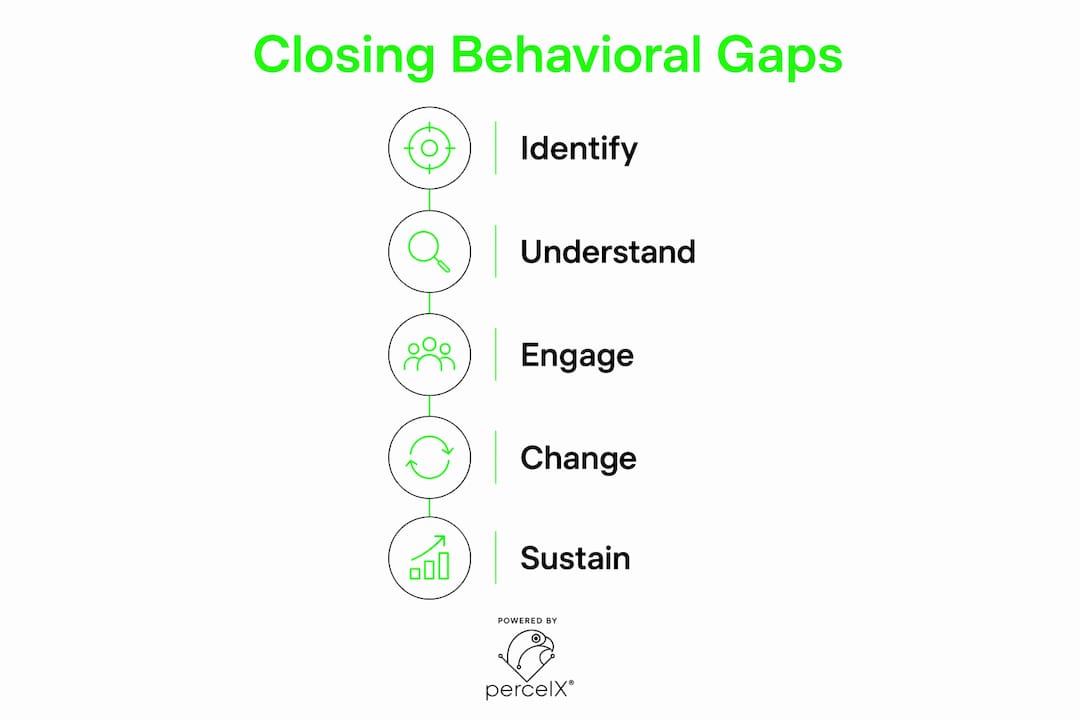
How to address and close behavioral gaps in leadership
Closing behavioral gaps requires more than a training workshop or a new set of leadership principles. It requires a system. Here is a sequence that works.
-
Assess the actual gap, not the assumed one. Use 360° assessments to surface the difference between self-perception and team experience. Percelx's 360° assessment approach delivers customized transformation plans by revealing the hidden behavioral patterns that leaders cannot see in themselves. Generic surveys miss this. Personalized behavioral intelligence does not.
-
Align incentives with the behaviors you want. If your performance review system rewards results but ignores how those results were achieved, you are paying for the behavioral gap to persist. Redesign recognition and evaluation to make the target behaviors visible and rewarded.
-
Set specific behavioral expectations, not values. "Be collaborative" is not a behavioral expectation. "Share project updates with the full team before making decisions that affect them" is. Specificity creates accountability.
-
Build psychological safety deliberately. Leaders must actively invite dissent, not just keep an open door. Psychological safety enables interpersonal risk-taking and improved team outcomes, but it requires consistent behavioral signals from the leader, not a single announcement.
-
Use if-then planning for high-pressure moments. Behavioral gaps widen most under stress. If-then planning ("If I feel defensive in a feedback conversation, then I will pause and ask a clarifying question before responding") gives leaders a pre-committed response that bypasses reactive patterns.
-
Establish peer accountability structures. Bridging the knowing-doing gap requires sustained discipline, including reflection, planning, and accountability over time. Peer coaching cohorts and structured check-ins create the social reinforcement that individual willpower cannot sustain alone.
-
Model the behavior visibly and repeatedly. Leaders who want their teams to give candid feedback must give it themselves, receive it gracefully, and act on it publicly. One visible act of modeling does more than ten training sessions.
-
Measure behavioral change, not just outcomes. Track leading indicators: frequency of one-on-ones, rate of feedback conversations, team psychological safety scores. Measuring transformation progress in real time keeps behavioral change from drifting back to old patterns.
-
Sustain the cycle. Effective leadership transformation includes repeated cycles of intention-setting, practical planning, monitoring, and adaptive correction. A single intervention does not close a behavioral gap. A sustained system does.
Pro Tip: When launching a behavioral change initiative, identify the one or two behaviors that, if changed, would have the greatest downstream effect on team trust and performance. Trying to change everything at once produces the same result as changing nothing.
What behavioral science tells us about closing leadership gaps
The behavioral science behind leadership gaps is more precise than most leadership development frameworks acknowledge, and it points to a harder truth: motivation alone does not produce behavior change.
"Psychological safety is where you come in as a leader. It's your job to unlock the potential of your team and create the best possible chance for breakthrough performance." — Amy Edmondson, HBS
Psychological safety is one of the most critical behavioral gaps in leadership, and it is also one of the most misunderstood. Leaders often believe that having an open-door policy constitutes psychological safety. It does not. Psychological safety requires active, visible, repeated signals that dissent is welcome and that speaking up will not result in punishment. Amy Edmondson's research at Harvard Business School makes this distinction with precision: leaders must actively encourage dissent, not just permit it.
The knowing-doing gap operates as a structural problem, not a motivational one. Execution challenges in leadership stem from systemic barriers between intention and action, including friction, unclear next steps, and the absence of feedback loops. This is why if-then planning and peer accountability work: they reduce the gap between deciding and doing by pre-committing behavior and creating external checkpoints.
Identity protection is the least-discussed barrier in leadership development, and possibly the most powerful. Sustainable behavior change requires helping leaders reconcile new behaviors with their existing professional identity. A leader who has built their reputation on being the smartest person in the room will not suddenly become a curious, question-asking facilitator without support in reframing what good leadership means for them personally. Without that reframing, the new behavior feels like self-erasure, and the brain resists accordingly.
Culture operates as an operating system shaped by habits, reinforcement, and informal social norms, not by formal statements or values documents. Most organizations focus on communicating culture but miss that behavior is shaped by what is rewarded and visible in daily work. Changing the culture means changing the behavioral operating system, one reinforced habit at a time. Business coaching strategies that drive real growth consistently anchor this principle: structural support and accountability matter more than motivation.
Ready to close the gaps holding your leadership back?

Percelx was built for exactly this challenge. The Percelx behavioral intelligence platform reveals the hidden patterns shaping your leadership decisions and team dynamics, then delivers a personalized transformation plan instantly. No generic frameworks. No guesswork. Just a clear picture of where your behavioral gaps are and a precise path to closing them.
With a 4.9-star satisfaction rating and a 360° assessment approach that goes beyond surface-level feedback, Percelx transforms reactive leadership into intentional growth. Whether you are an HR leader building a development program or a manager ready to take ownership of your own transformation, Percelx gives you the behavioral intelligence to move forward with confidence.
Start your assessment and unlock the patterns shaping your leadership today.
Key Takeaways
Behavioral gaps in leadership consistently erode team trust, reduce engagement, and cause change initiatives to fail when leaders' actions do not match their stated intentions.
| Point | Details |
|---|---|
| Behavioral gaps are behavioral, not motivational | The knowing-doing gap is a systemic execution problem, not a failure of desire or awareness. |
| Culture is shaped by reinforcement, not values | What gets rewarded and tolerated under pressure defines actual culture more than any stated value. |
| Psychological safety requires active signals | Leaders must explicitly invite dissent; an open-door policy alone does not create safety. |
| Identity protection drives resistance | Sustainable change requires helping leaders reconcile new behaviors with their professional self-concept. |
| Sustained systems outperform single interventions | Repeated cycles of assessment, planning, accountability, and correction close gaps that training alone cannot. |