

A leadership gap is defined as the space between the leadership capabilities your organization currently has and what it actually needs to execute its strategy. The ability to identify leadership gaps across departments is not a diagnostic luxury. It is a core management discipline that directly determines whether your teams execute, adapt, and grow. Organizations that wait for visible failures to surface these gaps pay a steep price in turnover, stalled initiatives, and lost momentum. The good news is that leadership gaps follow recognizable patterns, and a structured approach puts you in control of finding them before they cost you.
How to identify leadership gaps across departments: the baseline map
Before you can measure a gap, you need a clear picture of what leadership currently looks like. Start by listing every formal leadership role across each department, from senior directors down to team leads. For each role, document the stated responsibilities, the decisions that person owns, and the outcomes they are accountable for.
The next step is alignment. Map each role against your organization's current strategic priorities. Ask one direct question for each position: does this role, as it is currently functioning, actively advance the strategy? You will quickly find roles that exist on paper but have drifted from their original purpose. This drift is one of the most common sources of leadership shortfall analysis work, because the gap is structural, not personal.
- List all leadership roles by department and level
- Document formal decision rights and accountability for each role
- Identify which strategic objectives each role is expected to drive
- Note where roles overlap, conflict, or leave strategic priorities uncovered
- Flag any emerging functional areas (data, AI, cross-team initiatives) with no clear leadership owner
Pro Tip: Unclear accountability in emerging fields like AI and data is one of the most frequently overlooked leadership vacuum sources. If no one owns it, no one leads it.
Common pitfalls in role mapping include treating org charts as accurate representations of actual authority, and ignoring informal leadership that fills gaps the formal structure misses. Both distort your baseline.
What signals reveal a leadership gap in your department?
Leadership gaps emerge most visibly during rapid growth, organizational change, or market disruption. But the early signals appear long before those conditions become a crisis.
The most reliable indicator is execution inconsistency. When a team understands the strategy but consistently fails to translate it into clear priorities and follow-through, the problem is almost never the strategy itself. Inconsistent execution despite clear strategic intent signals a leadership alignment problem at the department level. That is the gap speaking.
- Execution inconsistency. Teams understand the direction but cannot maintain momentum toward it. Deadlines slip without clear accountability.
- Activity overload with low impact. An overload of initiatives with limited measurable outcomes signals weak prioritization and poor leadership arbitration. Busyness replaces progress.
- Middle manager distress. Middle managers are the first to experience and signal leadership gaps through turnover, issue escalation, and declining confidence. Their engagement data is a leading indicator.
- Stalled change initiatives. Projects that launch with energy but lose momentum repeatedly point to a sponsorship gap at the leadership level.
- Decision avoidance. When decisions consistently escalate upward or stall in committee, the department lacks a leader with the authority and willingness to own outcomes.
Data sources that reveal these patterns include employee engagement surveys, performance review trends, 360-degree feedback cycles, project completion rates, and voluntary turnover data segmented by department. Qualitative signals from exit interviews and skip-level conversations add texture that metrics alone cannot capture.
How do you assess leadership effectiveness step by step?
A structured leadership gap analysis uses role mapping, strategic alignment reviews, and 360-degree feedback assessments to produce a clear picture of where leadership capability falls short. Here is how to run that process with rigor.

Set your assessment criteria first
Define what effective leadership looks like in your organization before you collect a single data point. Criteria should connect directly to organizational goals: decision speed, team development, cross-functional collaboration, and accountability for results. Without defined criteria, feedback becomes opinion rather than evidence.
Run 360-degree feedback and self-assessments
A 360-degree self-assessment collects structured input from a leader's direct reports, peers, and supervisors alongside the leader's own self-rating. The gap between self-perception and how others experience a leader is often where the most significant behavioral patterns hide. Percelx uses this exact methodology to surface those hidden patterns and deliver a customized development plan based on the results.
Pro Tip: Self-assessments are most useful when leaders rate themselves before seeing peer feedback. Reversing the order biases self-ratings toward the group average and reduces diagnostic value.
Analyze the gap between expected and actual behavior
Compare assessment results against your defined criteria. Look for patterns across departments, not just individual outliers. If three separate departments show low scores on accountability, the gap is systemic. If one department shows a cluster of low scores on strategic communication, the gap is localized. The distinction matters because the remediation is different.
| Assessment method | Best for | Limitation |
|---|---|---|
| 360-degree feedback | Behavioral patterns, blind spots | Requires psychological safety to be honest |
| Performance review analysis | Outcome trends over time | Lags behind real-time leadership behavior |
| Leadership audit | Role clarity and structural gaps | Snapshot only; misses behavioral nuance |
| Employee engagement survey | Team-level impact of leadership | Aggregated data can mask individual gaps |
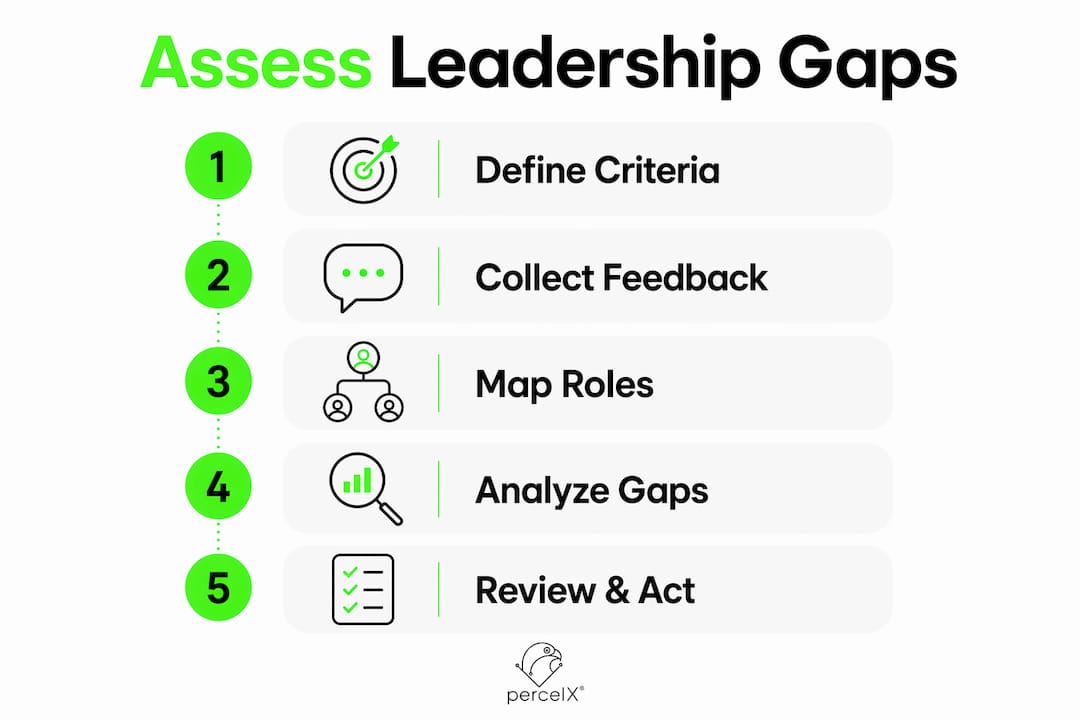
Regular leadership capability reviews every 6–12 months are recommended, especially during periods of scaling or strategic change. Leadership needs evolve, and a one-time assessment quickly becomes outdated.
Common leadership gaps and how they show up in departments
Leadership titles alone do not guarantee leadership impact. Organizations can have every role formally filled and still suffer from a lack of ownership, direction, and accountability at the senior level. These are the most common gaps you will find when you evaluate departmental leadership closely.
- Accountability gap. No one owns outcomes. Decisions get made collectively but no individual is responsible when results fall short. Teams learn quickly that accountability is optional.
- Communication gap. Leaders understand the strategy but cannot translate it into language their teams act on. Priorities shift without explanation. Teams operate on assumptions.
- Talent development gap. Leaders focus on delivery but invest no time in growing the people below them. The department becomes dependent on a small number of high performers with no succession depth.
- Strategic alignment gap. Department leaders optimize for their own metrics without connecting their work to organizational priorities. Siloed execution replaces coordinated progress.
- Change leadership gap. Stalled change initiatives and repeated failure to maintain momentum during transformations point directly to a gap in effective leadership sponsorship.
Subtle dysfunction patterns are harder to spot but equally damaging. Watch for leaders who are universally liked but never make a hard call, teams that are technically productive but never take initiative, and departments where all good ideas originate from the same two people. These patterns signal that leadership is present in title but absent in practice.
The organizations that identify leadership potential most effectively treat these behavioral signals as data, not personality observations. That shift from subjective impression to structured evidence is what separates reactive organizations from those that build leadership capacity ahead of need.
Key Takeaways
Identifying and addressing leadership gaps requires a structured process that moves from role mapping to behavioral assessment to targeted remediation.
| Point | Details |
|---|---|
| Define gaps before measuring them | Map every leadership role against strategic objectives before collecting any assessment data. |
| Use execution data as your first signal | Inconsistent strategy execution and activity overload are the earliest and most reliable indicators of a leadership gap. |
| Run 360-degree feedback with clear criteria | Set behavioral criteria first, then collect multi-source feedback to separate opinion from evidence. |
| Segment gaps by type and scope | Distinguish systemic gaps (multiple departments) from localized ones to choose the right remediation approach. |
| Review leadership capability regularly | Assess leadership alignment every 6–12 months, especially during growth phases or strategic pivots. |
Why I think most organizations find leadership gaps too late
Most organizations treat leadership gap analysis as a response to a crisis. A key leader exits, a change initiative collapses, or engagement scores drop sharply, and then the diagnostic work begins. That sequence is backwards.
Leadership gaps often emerge subtly as failures in execution alignment and excessive activity lacking impact, rather than abrupt failures. By the time the failure is visible, the gap has been present for months, sometimes years. The cost of that delay is not just one bad quarter. It is the compounded loss of talent, momentum, and organizational trust.
What I have seen work consistently is treating leadership assessment as a rhythm, not an event. Organizations that run professional growth assessments on a defined cadence catch gaps while they are still correctable. They also normalize the conversation around leadership development, which reduces the defensiveness that makes gap analysis so difficult in the first place.
One underused strategy is bringing in interim leaders during transitions. Interim leaders offer rapid decision-making and objective perspectives that restore leadership function during gaps. They also surface structural problems that internal leaders, who are too close to the situation, consistently miss. That external vantage point is not a sign of organizational weakness. It is a sign of organizational maturity.
Leadership gaps are signals of organizational evolution, not organizational failure. The departments that grow fastest are the ones where leaders actively seek out their own gaps before someone else finds them.
— Percell
Percelx: built for leadership gap analysis

Percelx is a behavioral intelligence platform designed to surface the hidden patterns that drive leadership behavior, decision-making, and team performance. Its 360° assessment approach goes beyond standard performance reviews by capturing multi-source behavioral data and delivering a personalized development plan based on what the data actually shows. For HR professionals and organizational leaders who need to move from observation to evidence, Percelx provides the structure and the depth that generic survey tools cannot match. The platform carries a 4.9-star satisfaction rating and supports both individual leaders and full organizational assessments. Visit Percelx to see how behavioral intelligence translates into measurable leadership growth.
FAQ
What is a leadership gap in an organization?
A leadership gap exists when an organization's strategy or pace of change outgrows its current leadership capabilities, even when all roles are formally filled. The gap shows up as execution failures, not empty org chart boxes.
How often should you assess leadership gaps across departments?
Leadership gap assessments every 6–12 months are recommended, with additional reviews triggered by scaling phases, strategic pivots, or significant leadership changes.
What is the best tool for identifying leadership gaps?
360-degree feedback assessments, combined with strategic alignment reviews and performance trend analysis, provide the most complete picture of where leadership capability falls short.
How do you identify a leadership gap in middle management?
Middle manager turnover, repeated issue escalation to senior leaders, and declining team engagement scores are the clearest early signals of a leadership gap at that level.
What is the difference between a leadership gap and a skills gap?
A skills gap is a deficit in technical or functional knowledge. A leadership gap is a deficit in the behavioral patterns, decision-making, and accountability that drive team performance and strategic execution.