

Professional transformation planning is defined as a structured process of designing and executing a strategic roadmap to achieve sustainable personal or career growth by systematically assessing current capabilities, setting clear goals, and managing change effectively. This process differs fundamentally from routine project planning because it centers on change management, organizational readiness, and continuous measurement aligned with evolving objectives. The industry term for the broader discipline is change management, and understanding transformation planning means recognizing that it goes far beyond task lists or training schedules. Organizations using a formal transformation roadmap reach milestones 47% faster than ad-hoc approaches. That gap exists because structured planning forces alignment before execution begins.
What is professional transformation planning and why it matters
Professional transformation planning is the strategic framework that guides you in systematically planning and implementing personal or career change to achieve meaningful, measurable growth. Unlike a standard project plan, it treats human behavior, readiness, and benefit realization as the primary variables. A project plan tracks tasks. A transformation plan tracks whether real change is actually happening.
Transformation projects differ from standard projects because of their complexity, human factors, and long-term benefit focus. That distinction matters because it changes how you measure success. Finishing a training program on schedule is not success. Demonstrating new competencies on the job is.
The career transformation process also requires sequencing. You cannot build advanced capabilities on a weak foundation. A professional development strategy that skips the assessment phase and jumps straight to execution is the single most common reason transformations stall. 70% of transformation delays are linked to skipping or underinvesting in the assessment phase. Skipping diagnostics does not save time. It creates rework that costs far more time later.

What are the key phases of a transformation plan?
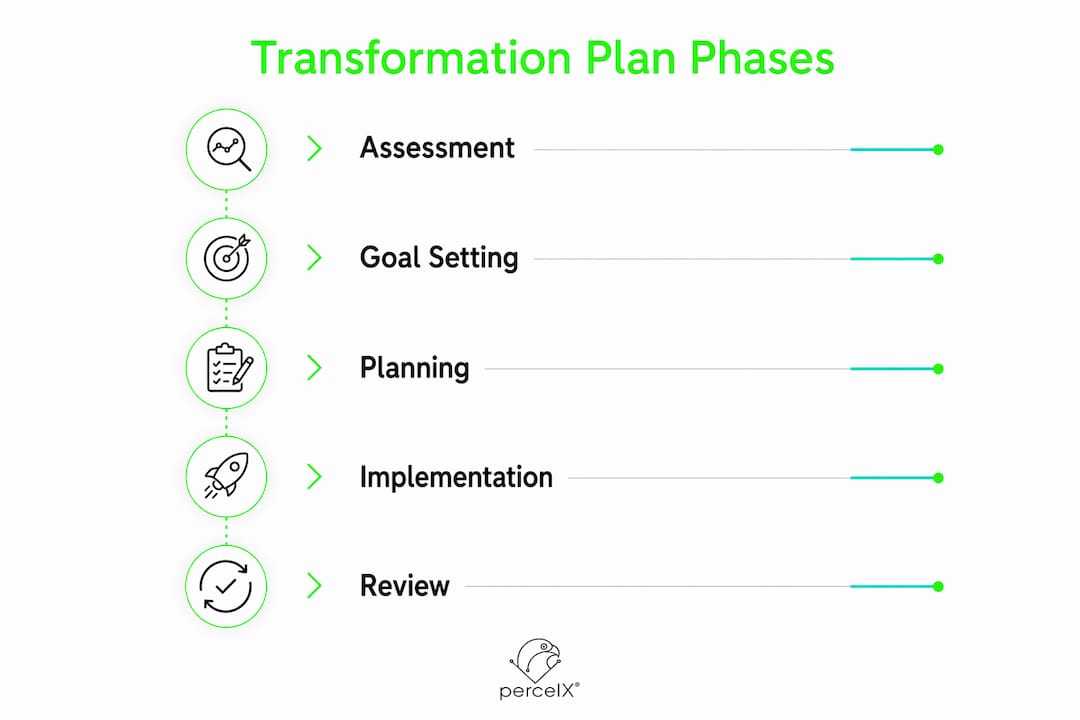
A well-structured transformation plan moves through five phases. Each phase builds on the one before it, and skipping any phase creates compounding problems downstream.
- Assess. Map your current capabilities, behavioral patterns, and skill gaps against your target state. Use a competency framework to make the gap visible and specific.
- Vision. Define what success looks like in concrete, measurable terms. Tie your vision to outcomes you can observe, not activities you can count.
- Prioritize. Rank your initiatives by business or career value and by complexity. High-value, lower-complexity changes go first to build momentum.
- Execute. Deliver change in iterative waves rather than one large release. Executing transformation in iterative waves allows learning and adjustment, reducing risk compared to one-time delivery.
- Measure. Track benefit realization, not just task completion. Ask whether the change is producing the intended outcome, and adjust if it is not.
The sequencing of these phases is not optional. Choosing a delivery model like Agile or Waterfall before completing the assessment phase turns a planned program into a high-risk venture. The model should serve the plan, not the other way around.
Pro Tip: Start with a 30-day assessment sprint before committing to any delivery timeline. The data you collect will reshape your priorities and prevent costly mid-program pivots.
How do you set measurable goals and track transformation progress?
Measurable goals are the accountability mechanism of any career transformation process. Without them, you are measuring activity instead of growth. Best practice is to focus on 2–4 SMART goals per quarter with monthly check-ins to confirm progress. That cadence keeps goals visible without creating review fatigue.
SMART goals in a transformation context are Specific, Measurable, Achievable, Relevant, and Time-bound. A goal like "improve leadership presence" is not SMART. A goal like "lead two cross-functional meetings per month and receive structured feedback from peers by the end of Q3" is. The difference is that the second version produces evidence you can evaluate.
Competency frameworks aligning skill proficiency ratings with business objectives are the gold standard for tracking progress. They shift your measurement from participation metrics, such as hours in training, to validated competency growth. That shift is what separates professionals who complete programs from professionals who actually change.
Tracking methods that work:
- Competency self-assessments completed before and after each phase
- 360-degree feedback collected at quarterly intervals to capture behavioral shifts
- Milestone reviews tied to specific capability targets, not calendar dates
- Benefit realization logs that document observable changes in performance output
Pro Tip: Apply the 70-20-10 learning framework to your development mix. Seventy percent of growth comes from on-the-job experience, 20% from coaching and peer feedback, and 10% from formal training. Weighting your plan toward experience and feedback produces faster, more durable change than classroom time alone.
What are the most common pitfalls in transformation planning?
The most damaging mistakes in transformation planning share a common root. They all involve treating a transformation like a standard project. A strategic transformation plan must manage interdependencies and benefit realization rather than simply tracking task completion dates. When you ignore that distinction, you get plans that look complete on paper but produce no real change.
Skipping detailed diagnostics and stakeholder alignment early causes considerable downstream rework and often outright failure. The pressure to "get started" is real, but starting without a clear picture of your current state is the fastest path to a stalled program.
| Common pitfall | Recommended practice |
|---|---|
| Skipping the assessment phase | Complete a full diagnostic before setting timelines |
| Choosing delivery model before sequencing | Assess readiness first, then select Agile or Waterfall |
| Tracking tasks instead of outcomes | Shift to benefit realization metrics and competency ratings |
| Treating governance as bureaucracy | Use governance to clarify decision authority and speed course correction |
| Managing dependencies informally | Use a dynamic roadmap tool that surfaces interdependencies in real time |
Governance structures providing decision-making clarity accelerate transformations and reduce risk. Governance is not about oversight for its own sake. It is about making sure the right people can make fast, well-informed decisions when the plan needs to adjust.
Pro Tip: Treat your transformation roadmap as a living document. Review it monthly, not annually. The plans that succeed are the ones that adapt to new information rather than defending original assumptions.
How does transformation planning apply to individual career development?
Individual development plans, commonly called IDPs, are the personal application of transformation planning principles. An IDP translates the five-phase framework into a career-specific roadmap that connects your current skills to your target professional identity. The professional identity transformation process is not just about adding skills. It is about shifting how you show up, make decisions, and lead.
Effective individual development plans integrate SMART goals, mixed learning modalities, and frequent progress reviews to create measurable transformation. The 70-20-10 framework applies directly here. You build the most durable career change through real work challenges, not through courses alone.
Career development tactics that produce results:
- Set 2–4 SMART goals per quarter and review them monthly with a mentor or coach
- Seek out stretch assignments that put you in situations slightly beyond your current capability
- Request structured feedback from peers and managers after high-stakes projects
- Use a competency framework to rate your own proficiency and identify the next gap to close
- Document behavioral shifts, not just completed tasks, in your progress log
A talent transformation strategy built on these tactics produces professionals who grow with intention rather than by accident. The difference between professionals who plateau and those who keep advancing is almost always the presence or absence of a structured plan.
Key takeaways
Professional transformation planning produces faster, more durable growth when it is grounded in assessment, sequenced by value, and measured by benefit realization rather than task completion.
| Point | Details |
|---|---|
| Assessment comes first | Skipping diagnostics causes 70% of transformation delays, according to McKinsey analysis. |
| SMART goals drive accountability | Set 2–4 goals per quarter and review monthly to maintain momentum and visibility. |
| Measure outcomes, not activity | Track competency growth and benefit realization, not hours spent in training. |
| Governance accelerates change | Clear decision-making authority reduces risk and speeds course correction. |
| IDPs apply the same framework | Individual development plans use the same five phases as organizational transformation programs. |
What I have learned from watching transformation plans succeed and fail
The most common mistake I see is not a planning error. It is a framing error. Professionals treat their transformation plan like a project with a finish line. They complete the program, check the box, and move on. Then, six months later, nothing has actually changed in how they perform or lead.
Real transformation is not a project. It is a shift in behavioral patterns that has to be reinforced, measured, and adjusted over time. The plans that produce lasting change are the ones that treat benefit realization as the primary metric from day one. Not "did I finish the training?" but "am I performing differently because of it?"
The other pattern I have seen consistently is that professionals underestimate the assessment phase. They know roughly where they want to go, so they skip the diagnostic and start building. That shortcut almost always produces a plan built on assumptions rather than evidence. A transformation strategy must be evidence-based, closing actual skill gaps rather than running programs driven by availability rather than need.
The professionals who grow fastest are the ones who stay curious about their own behavioral patterns. They treat feedback as data, not judgment. They adjust their plans when the evidence points in a new direction. That mindset is what separates people who complete transformation programs from people who are actually transformed by them.
— Percell
How Percelx supports your transformation planning
Percelx is built for professionals who want their transformation plan grounded in real behavioral data, not guesswork or generic assessments.
The Percelx platform uses a 360° behavioral intelligence assessment to surface the hidden patterns shaping your decisions, leadership style, and performance. It delivers a customized transformation plan instantly, so you move from diagnosis to direction without delay. Percelx holds a 4.9-star satisfaction rating and supports individuals, teams, and organizations across professional development, athletics, and personal growth. If you are ready to build a plan grounded in evidence and aligned with measurable outcomes, explore Percelx for teams or start with your own behavioral assessment today.
FAQ
What is professional transformation planning?
Professional transformation planning is a structured process of assessing current capabilities, setting measurable goals, and executing change in sequenced phases to achieve sustainable career or personal growth. It differs from standard project planning by prioritizing benefit realization and behavioral change over task completion.
How long does a professional transformation plan take?
The timeline varies by scope, but most effective plans operate in quarterly cycles with monthly reviews. A full career transformation typically spans 12–24 months of structured, iterative development.
What is the most important phase in transformation planning?
The assessment phase is the most critical. McKinsey analysis shows that 70% of transformation delays are linked to skipping or underinvesting in this phase.
How do SMART goals fit into a transformation plan?
SMART goals provide the measurable targets that make progress visible. Best practice calls for 2–4 SMART goals per quarter with monthly check-ins to track whether real behavioral change is occurring.
What is the difference between change management and transformation planning?
Change management is the broader discipline of managing how people adopt new ways of working. Transformation planning is the structured roadmap process within that discipline, focused specifically on sequencing capabilities and realizing measurable benefits over time.