

ROI metrics for employee transformation programs are defined as the quantifiable measures that connect workforce development investments to business outcomes, from productivity gains to retention improvements. The standard ROI formula, ((Net Benefits – Total Program Costs) / Total Program Costs) × 100, gives HR leaders a financial language that CFOs accept. Yet 70% of transformation programs fail to achieve their intended value, largely because organizations measure the wrong things at the wrong time. The metrics you choose, and when you apply them, determine whether your program is seen as a cost center or a growth driver.
1. What are the best ROI metrics for employee transformation programs?
The most reliable ROI metrics span both financial and behavioral dimensions. Tracking only one side gives you an incomplete picture and weakens your case with leadership.
Financial metrics to track:
- Productivity improvement: Measure output per employee before and after the program. Productivity gains typically appear within 60–90 days of program launch.
- Retention rate change: Calculate the cost of turnover avoided. Leadership development training can yield ROI around 633% when reduced turnover is factored in.
- Training cost vs. benefit: Compare total program spend against measurable gains. Onboarding programs average 353% ROI driven primarily by reduced turnover, while sales training can exceed 1,000% ROI.
- Compliance cost avoidance: Regulatory fines avoided can range from $50,000 to $5 million per incident. This makes compliance training financially significant even when direct productivity gains are minimal.
Behavioral and cultural metrics to track:
- Behavior change indicators: Use 360° assessments to measure shifts in decision-making patterns, communication quality, and leadership presence before and after the program.
- Culture shift measurements: Track engagement scores, psychological safety ratings, and peer feedback trends across quarters.
- Capacity freed: Quantify hours reclaimed when employees stop reactive behaviors and work with greater intention. This metric translates directly into financial proxies for CFO reporting.
Pro Tip: Pair every qualitative metric with a financial proxy. "Improved manager communication" becomes "X hours of conflict resolution time saved per month," which becomes a dollar figure your CFO can act on.
2. How and when to measure ROI for reliable results

Measurement timing is where most programs fail. You cannot calculate ROI without a baseline, and you cannot build a baseline after the program has already started.
Follow this sequence for reliable results:
- Establish a 30-day baseline before launch. Collect performance data, engagement scores, and behavioral assessments. This pre-launch window is your control point.
- Run a 90-day review. Check early productivity signals and initial behavior shifts. This is your first real data checkpoint.
- Conduct a 180-day review. Assess whether behavior changes are holding. Look for retention trends and manager effectiveness scores.
- Complete a 365-day review. Measure long-term cultural shifts and full financial ROI. Broad transformation outcomes typically take 12–18 months to fully materialize.
The type of outcome also determines your measurement window. Specific task improvements, like faster report completion or reduced error rates, show up within weeks. Cultural shifts, like psychological safety or cross-team collaboration, require at least a year of consistent tracking.
Pro Tip: Use controlled comparisons where possible. Run the program with one team while a comparable team continues without it. The before-and-after contrast gives you defensible data, not just anecdotal evidence.
A tiered measurement approach saves resources without sacrificing rigor. Apply Levels 1–2 measurement for compliance and low-cost programs. Reserve full ROI analysis for the 5–10% of initiatives that are high-cost and strategically critical.
3. Common challenges and misconceptions in ROI measurement
The biggest misconception is that every training program needs a full ROI calculation. Applying Level 5 ROI analysis to a one-hour compliance module wastes analyst time and produces misleading numbers.
The most common pitfalls HR leaders face:
- Skipping baseline measurement. 72% of organizations launch workforce tools without capturing baseline performance data. Without a starting point, you cannot prove change occurred.
- Over-relying on surveys. Satisfaction scores measure how people felt about training, not whether behavior changed. Surveys are useful for Levels 1–2 but insufficient for financial ROI claims.
- Underestimating hidden costs. Productivity dips during transition average 10–15% for 4–8 weeks. Ongoing skills maintenance adds a 30–40% annual refresh cost that most program budgets ignore.
- Weak data governance. Inconsistent data collection across departments makes before-and-after comparisons unreliable. Standardize your data fields before the program launches.
- Poor feedback loops. Programs without structured feedback mechanisms cannot course-correct mid-execution. This is a primary reason transformation initiatives stall.
"Transformation efforts often fail due to weak governance and lack of feedback loops. Successful leaders establish ongoing execution systems that align strategy, decisions, and behavior well beyond short-term KPIs." — BCG
Misdiagnosis at the start is equally costly. Structured, evidence-based diagnostics before program design prevent expensive mid-program corrections. Skipping this step is the equivalent of prescribing treatment before running tests.
4. How to translate behavioral change into financial ROI
Workforce transformation ROI differs fundamentally from technology ROI. Technology ROI measures automation efficiency. Workforce transformation ROI captures human capability improvements, including reclaimed capacity, better judgment, and stronger leadership, all of which require financial proxy translation before a CFO will act on them.
The table below shows how behavioral improvements map to financial proxies:
| Behavioral Improvement | Financial Proxy |
|---|---|
| Faster decision-making by managers | Hours saved × average manager hourly rate |
| Reduced conflict between teams | Conflict resolution hours avoided per quarter |
| Improved employee retention | Replacement cost avoided (typically 50–200% of annual salary) |
| Higher engagement scores | Productivity gain estimated from engagement-to-output research |
| Stronger leadership presence | Reduced escalations × cost per escalation event |
The most credible proxies are built from your own internal data. Use your HR system's cost-per-hire figures, your finance team's loaded labor rates, and your operations data on error rates or cycle times. Generic industry benchmarks work as a starting point, but internal numbers win the CFO conversation.
Pro Tip: Frame behavioral ROI as "capacity freed" rather than "soft improvement." A manager who spends two fewer hours per week on conflict resolution frees 104 hours per year. At a $75 per hour loaded rate, that is $7,800 per manager per year in reclaimed productive time.
You can find real examples of this approach applied across different industries and program types, which helps when building your internal business case.
5. Choosing ROI metrics based on program type
Not every transformation program deserves the same measurement intensity. Matching your metrics to your program type saves time and produces more credible results.
Leadership development programs:
- Track behavior change via 360° assessments at 90 and 180 days.
- Measure retention of high-potential employees before and after.
- Calculate productivity gains in the leader's direct team as a downstream indicator.
- Leadership development ROI ranges from 200–600%+ when measured correctly.
Compliance training:
- Focus on risk avoidance metrics rather than productivity gains.
- Track incident rates, audit findings, and regulatory violations before and after.
- Apply Level 1–2 measurement only. Full ROI analysis is not warranted here.
AI-enabled workforce tools:
- Require formal before-and-after comparisons in real work systems.
- Measure time-to-task completion, error rates, and decision quality.
- Capture adoption rates and behavioral integration, not just tool usage statistics.
Culture change initiatives:
- Use engagement surveys, psychological safety scores, and voluntary turnover rates.
- Expect a 12–18 month measurement window before drawing conclusions.
- Align culture metrics with specific business outcomes like customer satisfaction or cross-functional project success rates.
Checklist for selecting your ROI metrics:
- Does this program affect a measurable business outcome?
- Do you have baseline data to compare against?
- Is the program cost high enough to justify full ROI analysis?
- Can you isolate the program's effect from other organizational changes?
- Do you have a financial proxy ready for each behavioral metric?
The benefits of workforce transformation are real, but they only become defensible when you match your measurement approach to the program's scope and strategic weight.
Key takeaways
The most effective ROI metrics for employee transformation programs combine financial proxies with behavioral indicators, measured at structured intervals starting 30 days before program launch.
| Point | Details |
|---|---|
| Use the standard ROI formula | Apply ((Net Benefits – Total Costs) / Total Costs) × 100 to every high-cost program. |
| Establish a pre-launch baseline | Collect performance and behavioral data 30 days before launch to enable valid comparisons. |
| Match measurement depth to program type | Reserve full ROI analysis for the top 5–10% of strategic, high-cost initiatives. |
| Translate behavior into financial proxies | Convert capacity freed and retention gains into dollar figures CFOs will accept. |
| Track at 90, 180, and 365 days | Cultural shifts take 12–18 months to fully appear; short reviews miss the real story. |
Why most ROI frameworks miss the point
Working with HR leaders across industries, I have seen the same pattern repeat. Organizations invest in transformation programs, collect satisfaction surveys at the end, and call it measured. Then they wonder why the CFO cuts the budget next cycle.
The real problem is not a lack of data. It is a lack of connection between people outcomes and business outcomes. A human-centric approach to transformation improves lasting performance by up to 90% and correlates with 15% higher total shareholder return. That is a number worth putting in front of any executive team. But you only get there if you build the measurement system before the program launches, not after.
What I have found actually works is treating ROI measurement as a behavioral science problem, not a finance problem. The question is not "what did we spend?" The question is "what patterns changed, and what did those changes produce?" When you frame it that way, the financial proxies follow naturally. Behavioral alignment with organizational strategy is the foundation. Everything else, the metrics, the reviews, the CFO reports, builds on top of that foundation.
The organizations that get this right do not just measure transformation. They build ongoing execution systems that keep behavior and strategy aligned long after the program ends.
— Percell
Percelx: built for measuring what actually changes
HR leaders who want to move beyond satisfaction surveys need a system that connects behavioral data to business outcomes automatically. Percelx is built for exactly that.
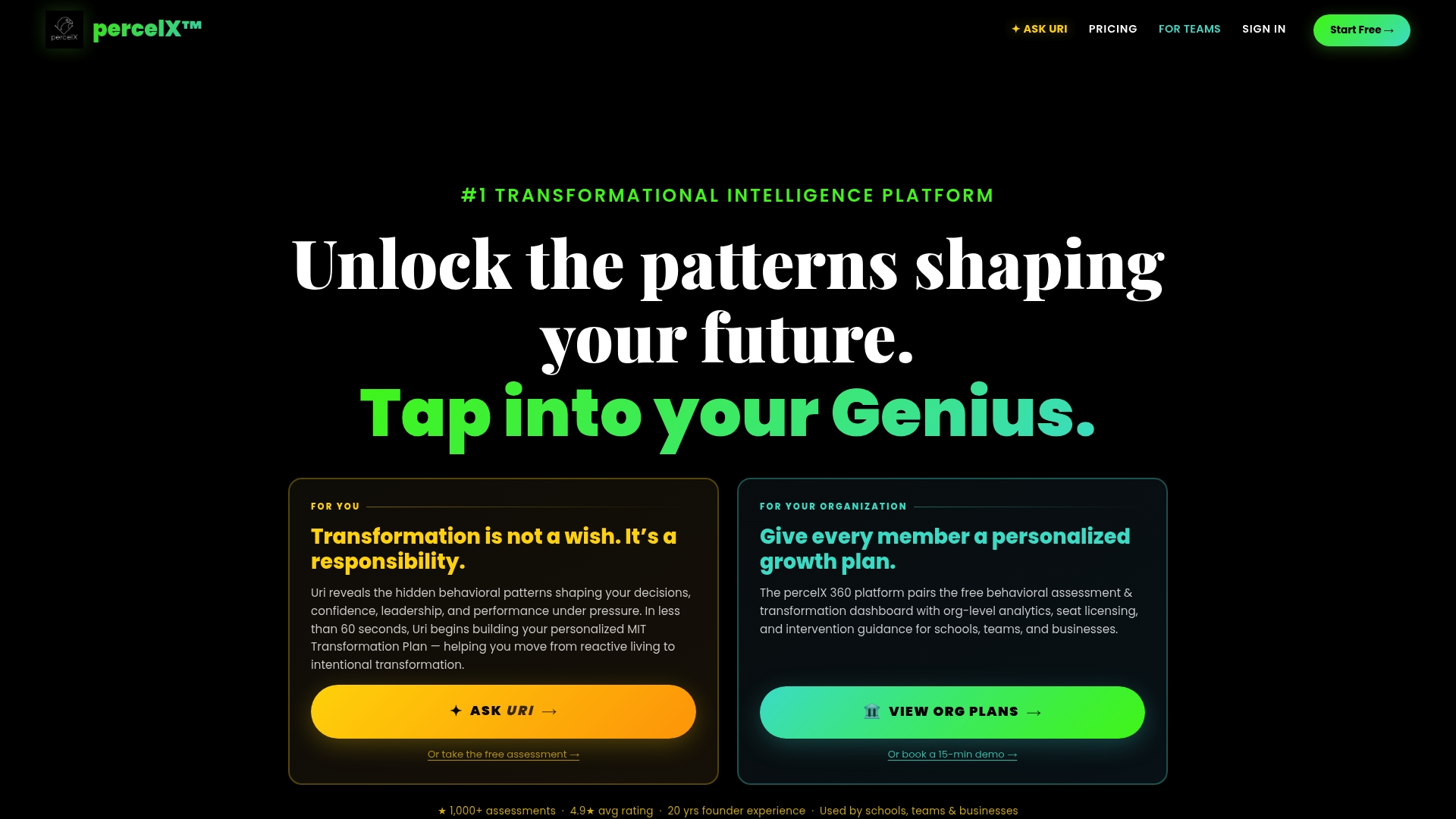
The Percelx Behavioral Intelligence Platform uses a 360° assessment approach to surface the hidden behavioral patterns that affect leadership, decision-making, and team performance. It delivers customized transformation plans and tracks behavioral shifts over time, giving you the before-and-after data your ROI analysis requires. For teams that need custom integrations with existing HR systems, the Percelx Developer Platform provides behavioral intelligence APIs that connect directly to your data environment. Percelx holds a 4.9-star satisfaction rating, and the measurement infrastructure is built in from day one.
FAQ
What is the standard ROI formula for training programs?
The standard formula is ((Net Benefits – Total Program Costs) / Total Program Costs) × 100. A result above 0% means the program returned more than it cost.
How long does it take to see ROI from employee transformation programs?
Productivity gains typically appear within 60–90 days. Broader cultural and behavioral shifts take 12–18 months to fully measure.
Do all training programs need a full ROI analysis?
No. A tiered approach is more effective. Apply full ROI analysis only to the 5–10% of programs that are high-cost and strategically critical. Use simpler metrics for compliance and operational training.
What are the most common reasons transformation ROI measurements fail?
The top reasons are skipping baseline measurement, over-relying on satisfaction surveys, underestimating hidden costs like productivity dips during transition, and weak data governance across departments.
How do you convert behavioral improvements into financial ROI?
Use financial proxies such as capacity freed, replacement cost avoided, and productivity gains calculated from internal labor rates and HR cost data. These translate qualitative outcomes into CFO-acceptable numbers.