

Why high performers plateau professionally
High performers plateau professionally when the behaviors that built their early success stop matching what the next level actually demands. This is not a talent problem. It is a behavioral alignment problem, and it catches some of the most capable people completely off guard.
Early career success runs on individual output: technical skill, reliable execution, and measurable results. Those qualities earn trust, promotions, and recognition. But at senior levels, evaluation criteria shift from individual execution to strategic judgment, cross-functional influence, and the ability to lead through others. The professional who mastered one game is now playing a different one without realizing the rules changed.
Several core patterns drive this stagnation:
- Selective discipline: After early wins, foundational habits slip quietly. Preparation, feedback seeking, and structured coaching start to feel optional rather than essential.
- Complexity confusion: High performers often chase new tools or systems, mistaking added complexity for progress, when consistent execution of proven fundamentals is what actually moves the needle.
- The competency trap: Being indispensable in a current role can block promotion entirely. Organizations resist moving their most reliable people because doing so feels risky.
- Habit inertia: The neural pathways that made someone exceptional at one level actively resist the behavioral shifts required at the next.
Understanding these causes is the first step toward doing something about them.
Table of Contents
- How shifting evaluation and feedback dynamics hold top performers back
- What a career plateau actually costs you psychologically and organizationally
- Practical strategies to break through a career plateau and regain momentum
- How Percelx's 360° behavioral assessment diagnoses and breaks plateaus
- When skill stagnation quietly becomes the ceiling
- How workplace politics and culture shape your career trajectory
- Why limited networking and mentorship accelerate career stagnation
- Why setting new challenges after early success is non-optional for growth
- Percelx gives you the behavioral clarity to move forward
- Key Takeaways
How shifting evaluation and feedback dynamics hold top performers back
The criteria organizations use to assess talent change dramatically as careers advance, and most high performers are never told this directly. Early on, strong results speak for themselves. At senior levels, organizations evaluate through a wider lens: judgment under ambiguity, stakeholder influence, communication under pressure, and the capacity to align people across functions.
Feedback also becomes less honest as seniority increases. Candor diminishes at higher levels, which means high performers receive fewer clear signals about what is actually holding them back. They keep delivering strong results and assume that is enough. Nobody tells them otherwise.
The organizational side of this dynamic is equally problematic:
- Companies often keep high performers locked in roles where they excel, fearing disruption to operations.
- Unclear promotion criteria leave talented professionals guessing what advancement actually requires.
- Without honest developmental conversations, both sides assume the other understands the gap.
This creates a frustrating loop: the professional keeps performing at a high level, the organization keeps benefiting from that performance, and the career trajectory quietly flatlines.
What a career plateau actually costs you psychologically and organizationally
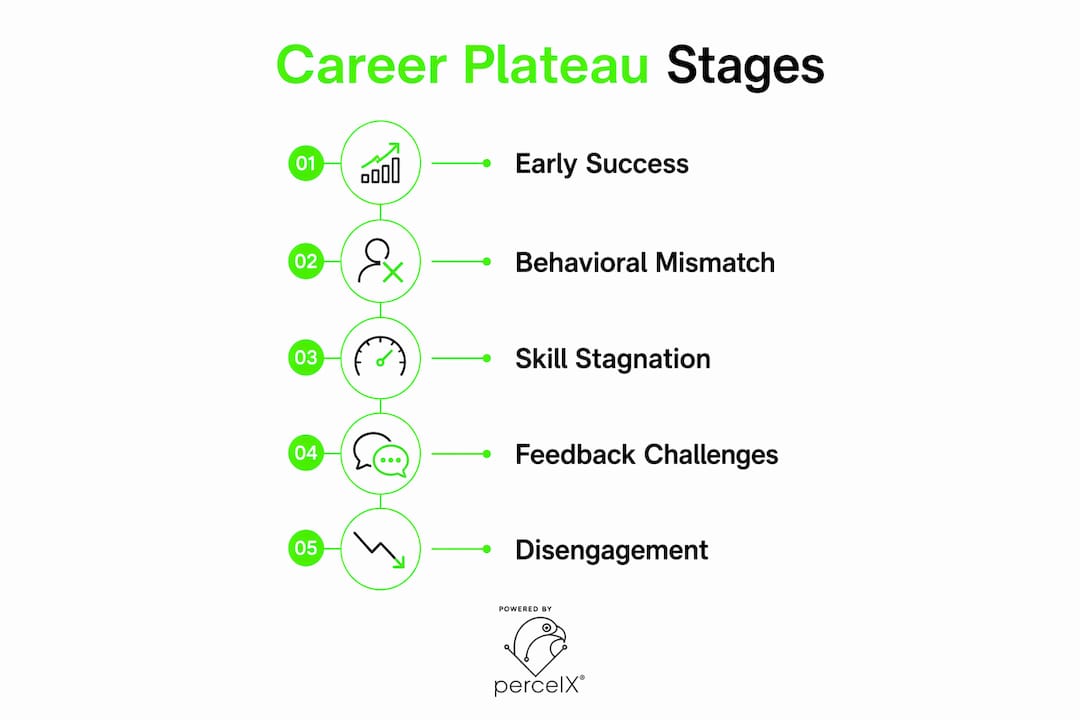
Plateauing does not feel neutral. For high achievers, it tends to feel personal, even when the causes are largely structural. Frustration builds. Motivation drops. And without intervention, burnout follows.
One of the more insidious effects is what Psychology Today describes as the competency tax: the more reliable you are, the more work gets assigned to you, but the strategic visibility and influence that lead to advancement go to someone else. You are fixing problems while a colleague is presenting solutions to leadership. Your responsibilities expand; your influence does not.
There is also an identity dimension. When a professional's sense of self is tied to upward momentum, a stalled trajectory can trigger something close to an identity plateau: restlessness, self-doubt, and a quiet sense that effort no longer translates to outcomes. Research on workplace stress links sustained high performance without corresponding growth opportunities to increased burnout risk.
For organizations, the cost is just as real. Talent gets underutilized. High performers disengage or leave. And the leadership pipeline thins out precisely when it should be filling up. Addressing a plateau is not just good for the individual. It protects the organization's ability to develop the leaders it will need.
Practical strategies to break through a career plateau and regain momentum
Breaking through a plateau requires deliberate behavioral change, not just more effort. The professionals who continue advancing are not necessarily the most talented. They are the most intentional about evolving their habits and expanding their influence.
Pro Tip: Ask yourself honestly: "Where have I started relaxing the fundamentals because things are going well?" That single question often reveals the exact source of a plateau faster than any assessment.
Here is what actually works:
- Reinforce fundamentals consistently. Coaching, preparation, and structured feedback are not tools for struggling performers. They are performance maintenance systems for people who are already winning.
- Expand your influence deliberately. Shift from execution to strategic communication. Participate in cross-functional initiatives. Make your thinking visible to decision-makers, not just your output.
- Seek coaching during success phases. Blind spots grow when feedback feels unnecessary. A leadership coach keeps discipline sharp and surfaces patterns you cannot see from inside your own performance.
- Pursue visible, stretching opportunities. Volunteer for high-stakes presentations, cross-functional projects, or initiatives that put you in front of senior leadership. Visibility is not self-promotion. It is how others learn to trust your judgment.
- Build deliberate daily habits that compound over time. Small, focused behavioral investments practiced consistently produce outsized results. Less than twenty minutes a day of focused development, sustained over a year, can put you ahead of the vast majority of peers in a specific skill.
An intentional career growth plan gives these efforts structure and direction, turning scattered effort into compounding momentum.
How Percelx's 360° behavioral assessment diagnoses and breaks plateaus
Most professionals cannot see the behavioral patterns limiting their growth. That is not a character flaw. It is how blind spots work. Percelx's 360° behavioral assessment is built specifically to surface what performance reviews and self-reflection miss.
The platform uncovers hidden behavioral patterns that shape decision-making, leadership presence, and team influence, then delivers a customized plan for addressing them. Rather than generic coaching advice, the output is precise and tied to the specific gaps holding a professional back.
| Assessment Dimension | What It Reveals | Growth Outcome |
|---|---|---|
| Decision-making patterns | Reactive vs. intentional choices under pressure | Stronger judgment at senior levels |
| Leadership presence | Visibility and influence gaps | Expanded cross-functional impact |
| Feedback receptivity | Blind spots around coaching and input | Faster behavioral correction |
| Habit consistency | Where foundational discipline has slipped | Restored execution fundamentals |
| Strategic communication | How well impact is made visible to leadership | Increased promotion readiness |
Tracking behavioral progress quantitatively is what separates lasting change from a temporary motivation spike. Percelx builds that tracking into the process, so momentum does not fade after the initial assessment. For organizations, the enterprise platform applies the same behavioral intelligence across teams, giving HR leaders and managers a clear picture of where their highest-potential people are stalling and why.
When skill stagnation quietly becomes the ceiling
Skill stagnation is one of the most overlooked reasons top performers stop advancing. It does not announce itself. It accumulates slowly as the gap widens between what a professional can do and what the next level requires.

Early career growth is often fast because every new challenge builds a genuinely new capability. At a certain point, the work becomes familiar enough that it stops stretching the person doing it. Repetition replaces learning. Confidence, which is an asset in most contexts, can quietly suppress the urgency to develop new skills.
The professionals who keep advancing treat learning as a leadership skill in its own right. They actively seek roles, projects, and feedback that expose their current limits. They do not wait for a formal development program to tell them what to work on next.
How workplace politics and culture shape your career trajectory
Culture and politics are not soft factors. They are structural forces that determine whose contributions get recognized and whose get absorbed into the background. High performers who focus exclusively on output often underestimate how much these dynamics influence advancement decisions.
In most organizations, promotion decisions happen in rooms where the candidate is not present. The people in those rooms rely on impressions, relationships, and secondhand accounts of your judgment and influence. If you have not built those relationships deliberately, your track record may not speak as loudly as you assume.
Navigating organizational culture does not mean becoming political in a cynical sense. It means understanding how decisions get made, who influences them, and how to build cross-level relationships that give others direct exposure to your thinking. Professionals who treat this as optional tend to find that their careers plateau despite strong performance metrics.
Why limited networking and mentorship accelerate career stagnation
Isolation is a plateau accelerant. High performers who rely solely on their own judgment and their immediate team's feedback cut themselves off from the perspectives that would help them grow fastest.

Mentors who have navigated the same transitions you are facing can compress years of trial and error into a single honest conversation. Sponsors, distinct from mentors, actively advocate for you in the rooms where advancement decisions are made. Without both, even exceptional performers can find themselves invisible to the people who control the next opportunity.
Networking at senior levels is less about volume and more about depth. A handful of genuine relationships with people who understand your capabilities and can speak to them credibly carries more weight than a large but shallow professional network. Business coaching strategies that prioritize relationship-building alongside skill development tend to produce faster career progression than skill-only approaches.
Why setting new challenges after early success is non-optional for growth
Initial success creates a comfort zone that feels like momentum but is actually inertia. The projects that once stretched you become routine. The goals that once required your full effort now get handled on autopilot. And without realizing it, you stop growing.
The professionals who sustain long careers of advancement share one consistent behavior: they say yes to things that make them uncomfortable before they feel ready. They take on roles that expose gaps. They set goals that require new capabilities, not just more of the existing ones. This is not recklessness. It is deliberate discomfort as a growth mechanism.
Goal setting at this level works best when it is tied to specific behavioral development, not just performance targets. "Increase revenue by 15%" is an outcome. "Build the habit of translating my team's work into visible strategic narratives for senior leadership" is a behavioral goal that changes how you show up and how others perceive your readiness. A professional transformation plan that connects behavioral goals to career milestones gives that development real direction.
Percelx gives you the behavioral clarity to move forward
Career stagnation in high achievers is rarely about effort. It is about alignment: between your current behavioral patterns and what the next level of your career actually demands. Percelx is built for exactly this gap.
Where traditional coaching gives you frameworks, Percelx gives you a precise behavioral map of what is holding you back and a customized plan to address it. The 360° assessment surfaces the blind spots that performance reviews miss, and the platform tracks your progress so that behavioral change compounds over time rather than fading after the first week of motivation. Percelx carries a 4.9-star satisfaction rating, and the platform serves both individuals navigating their own plateau and organizations that want to stop losing high-potential leaders to stagnation.
Your next move is concrete: take the Percelx 360° assessment at percelx.org and get a personalized behavioral profile that shows you exactly where your growth is stalling and what to do about it.
Key Takeaways
High performers plateau professionally because the behaviors that drive early success do not automatically scale to the influence, judgment, and cross-functional leadership that senior roles demand.
| Point | Details |
|---|---|
| Behavioral misalignment drives plateaus | Early success habits become limiting at senior levels, where influence and judgment matter as much as execution. |
| Feedback gaps hide the real problem | Candor diminishes at higher levels, leaving high performers without clear signals about what advancement actually requires. |
| The competency tax is real | Reliability earns more work but less strategic visibility, blocking the career progression it should accelerate. |
| Deliberate daily habits compound | Less than twenty minutes a day of focused behavioral development, sustained consistently, separates advancing leaders from those who stall. |
| Percelx surfaces hidden blind spots | The 360° behavioral assessment delivers a personalized plan that targets the exact patterns limiting your next level of growth. |