

Workplace relationships stall careers more often than skill gaps do. The culprits are rarely obvious: emotional sabotage from a partner or colleague, misaligned shared agency with your support network, and reactive interpersonal patterns that quietly erode your confidence and visibility. These forces operate beneath the surface, shaping your decisions, limiting your leadership presence, and keeping you stuck in the same role long after you've outgrown it. Recognizing them is the first move toward changing them.
The most common signs that relationships are hindering your career advancement include:
- A partner or colleague who mocks opportunities or points out obstacles rather than encouraging you to pursue them
- Passive-aggressive behaviors that undermine your confidence after individual wins
- A social network that reinforces limiting norms instead of expanding your perspective
- Communication breakdowns with supervisors that restrict your autonomy
- Workplace gossip and politics that isolate you from decision-makers
- Overinvestment in relational dynamics at the expense of visible, career-building work
How emotional sabotage and shared agency shape your career momentum
Emotional sabotage does not always look like hostility. Relationship expert Susan Winter describes unintentional sabotage as deeply confusing: your partner loves you, yet their "good is good enough" mentality weakens your resolve and erodes your goal-setting over time. Research from Carnegie Mellon University found that unsupportive partners actively hinder career moves by avoiding discussions about opportunities, discouraging ambition, and downplaying the value of a promotion or new role. The same dynamic plays out with colleagues who reinforce insularity rather than growth.
Shared agency is the concept that careers are social projects accomplished through joint effort with mentors, partners, and peers. When that joint effort is missing or misaligned, opportunities go unrealized. Successful professionals treat relationships as prisms for interpreting opportunity, not just pipelines for information. When your network lacks that interpretive quality, you miss signals that others in better-aligned relationships catch early.
The behavioral consequences of misaligned shared agency include:
- Reduced willingness to pursue stretch opportunities without external encouragement
- Narrowed perspective on what advancement looks like or feels possible
- Dependency on a closed relational system that discourages exploration beyond the immediate work context
- Gradual erosion of self-efficacy, the belief that you can succeed in a specific situation
Key insight: Research on career development across the lifespan shows that non-shared agency — when joint effort with close social partners is never actualized — is a primary mechanism through which careers stall, regardless of individual talent or effort.
How workplace relationships influence your decision-making and leadership
The impact of workplace relationships on career trajectories runs deeper than most professionals realize. Colleagues occupy lateral positions in your relational network, shaping your career through everyday interactions and shared norms rather than formal authority. They can provide belonging and continuity, especially in mobile careers, but they can also constrain your agency by narrowing your perspective and reinforcing limiting professional identities.
Supervisory relationships carry even more weight. Because of the power asymmetry involved, a single disrespectful supervisory interaction can abruptly end career opportunities. Violations of trust, misuse of authority, and failure to provide constructive guidance leave professionals feeling like gatekeepers are blocking them rather than developing them. That experience erodes decision confidence in ways that compound over time.
High performers often stall not because they lack skill, but because they prioritize delivery over strategic visibility. At senior levels, advocacy and networking carry more weight than work quality alone. When relational dynamics keep you in execution mode and out of visible leadership conversations, advancement stalls. Research on sponsorship relationships confirms that less than a quarter of such relationships involve the mutual trust, candid feedback, and active advocacy that actually accelerate promotion.
Reactive interpersonal behaviors that block leadership growth include:
- Over-explaining in meetings instead of stating positions with confidence
- Avoiding visibility because self-promotion feels uncomfortable
- Social loafing within positive relational systems that shift focus from task performance to relational dynamics
- Perceived organizational politics arising from negative interpretations of colleague relationships, leading to stress and isolation
- Shrinking in negotiations due to unprocessed rejection or accumulated self-doubt
Pro Tip: If your network consists mostly of peers rather than decision-makers, you are building belonging without building access. Identify two people above your current level who understand your work and can advocate for you in rooms you are not in.
How Percelx turns relationship challenges into career growth
Most professionals who stall do so because hidden behavioral patterns, not missing skills, are running their decisions. Percelx addresses this directly through its 360° behavioral assessment approach, which identifies reactive patterns, communication gaps, and relational blind spots that traditional coaching misses. The platform delivers a customized transformation plan instantly, converting reactive behavior into intentional growth rather than leaving professionals to diagnose themselves through trial and error.
Percelx carries a 4.9-star satisfaction rating, reflecting the precision of its personalized assessments across professional development, leadership, and personal relationships. The platform's behavioral intelligence framework helps professionals shift from task executor to relationship architect, the identity shift that research consistently identifies as the real unlock at senior career levels.
The steps Percelx uses to convert relational stalls into career momentum include:
- Identify the pattern: The 360° assessment surfaces specific reactive behaviors, whether passive-aggression, over-resilience, or visibility avoidance, that are limiting advancement
- Map the gap: Percelx analyzes foundational behavioral gaps between your current relational patterns and the leadership presence your role requires
- Build the plan: A personalized transformation plan is generated instantly, with targeted interventions for communication, boundary-setting, and strategic visibility
- Track the shift: Ongoing support and measurable benchmarks keep momentum alive through the inevitable rough patches of any serious career transition
For professionals working within consulting environments, where relational capital and client trust directly affect career trajectory, tools like TKD Consulting demonstrate how structured professional frameworks complement behavioral transformation work.
Practical strategies to repair workplace relationships and unblock your growth
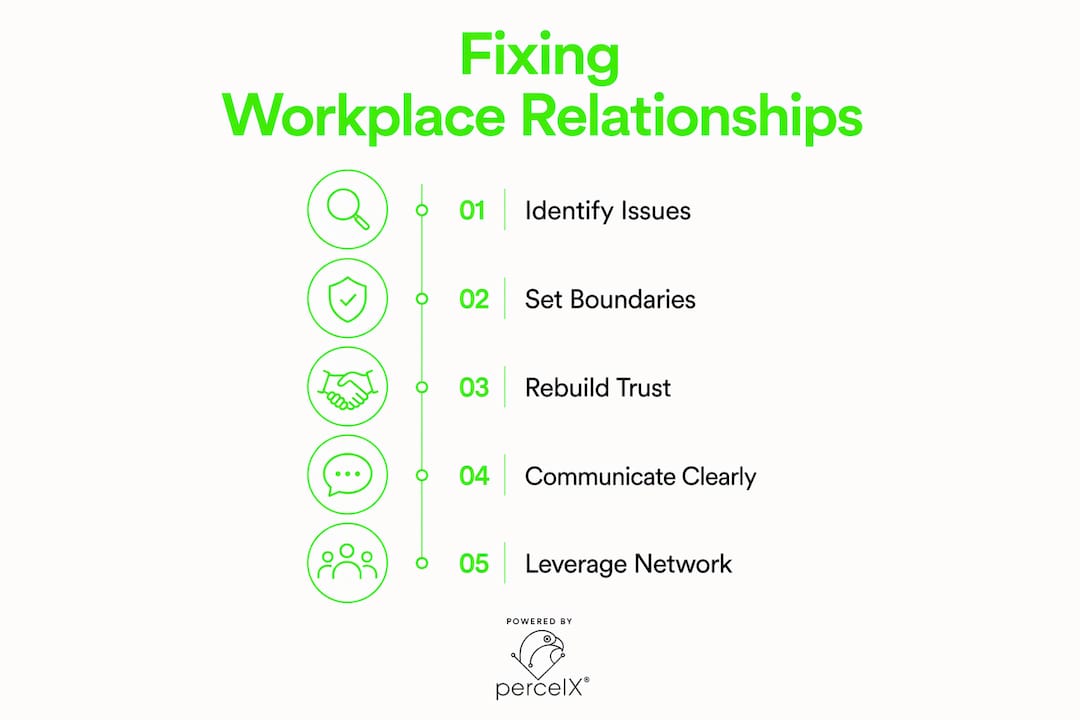
Setting healthy professional boundaries is the foundation of career growth that relationships support rather than stall. Boundaries are not about distance; they are about clarity. When colleagues know what you will and will not absorb, the passive-aggressive dynamics and workload imbalances that quietly drain your career energy lose their grip.

Rebuilding trust after relational damage requires consistency over time, not a single conversation. Follow through on small commitments, ask better questions than you give answers, and make the people around you feel genuinely understood. Research in social psychology shows that trust forms through perceived competence, consistency, and genuine interest in others, not through impressive performances.
Communication breakdowns often stem from reactive behavioral patterns that have never been examined. When you interrupt those cycles, you create space for the kind of candid, direct exchange that actually moves careers forward. Name the dynamic when it appears, address it in the moment rather than letting it accumulate, and replace defensive responses with curiosity.
Leveraging social capital authentically means building relationships with decision-makers before you need them, not when you are already in crisis. Visibility is a strategy, not vanity. Communicate your achievements, take visible roles on projects, and get into conversations about your future path with people who have the authority to influence it.
Pro Tip: Block time each week specifically for growth work: connecting, planning, and learning. Without protected time, even a clear career plan stalls because delivery always crowds it out.
Key Takeaways
Workplace relationships stall careers primarily through emotional sabotage, misaligned shared agency, and reactive behavioral patterns that erode visibility, trust, and leadership confidence.
| Point | Details |
|---|---|
| Emotional sabotage is often unintentional | Partners and colleagues with low ambition weaken your resolve and discourage pursuit of challenging opportunities. |
| Shared agency drives career progress | Careers are social projects; when joint effort with your network is missing, opportunities go unrealized regardless of individual talent. |
| Supervisory dynamics carry outsized risk | A single disrespectful supervisory interaction can abruptly end career opportunities due to power asymmetry. |
| Delivery without visibility stalls advancement | Less than a quarter of sponsorship relationships involve the active advocacy that actually accelerates senior promotion. |
| Behavioral assessment accelerates the shift | Percelx's 360° assessment identifies reactive patterns and delivers a personalized transformation plan to convert relational stalls into growth. |