

Workforce transformation planning is defined as the long-term, structured process of realigning an organization's workforce capabilities, roles, and culture to support evolving business goals. This is not routine headcount planning or a one-time restructuring exercise. It is a forward-looking discipline that integrates skills mapping, technology enablement, cultural alignment, and process redesign into a single, coherent strategy. The World Economic Forum and Bain & Company both treat this as a core leadership priority, not an HR side project. Business leaders and HR professionals who understand what workforce transformation planning truly requires are far better positioned to build organizations that last.
What is workforce transformation planning and what does it include?
Workforce transformation planning is a structured approach to closing the gap between the workforce you have today and the workforce your organization needs in the future. It goes well beyond updating an org chart or running a training program. According to research, workforce transformation includes redesigning roles, skills, organizational structure, talent strategy, and how work gets done at every level. That scope means transformation touches every function, from finance to operations to people management.
True transformation changes organizational capacity by altering how decisions are made and how work is allocated at managerial levels. This is the distinction that separates transformation from reorganization. A reorganization moves boxes on a chart. Transformation changes the behaviors, skills, and systems that determine what those boxes can actually deliver.

The planning process typically operates on a six-year forward-looking vision with a three-year midpoint milestone for actionable talent planning. That structure gives leaders a directional hypothesis to work from while still allowing for course corrections as markets shift. The six-year horizon is long enough to build real capability. The three-year midpoint keeps execution grounded in near-term reality.
Operational vs. strategic workforce planning
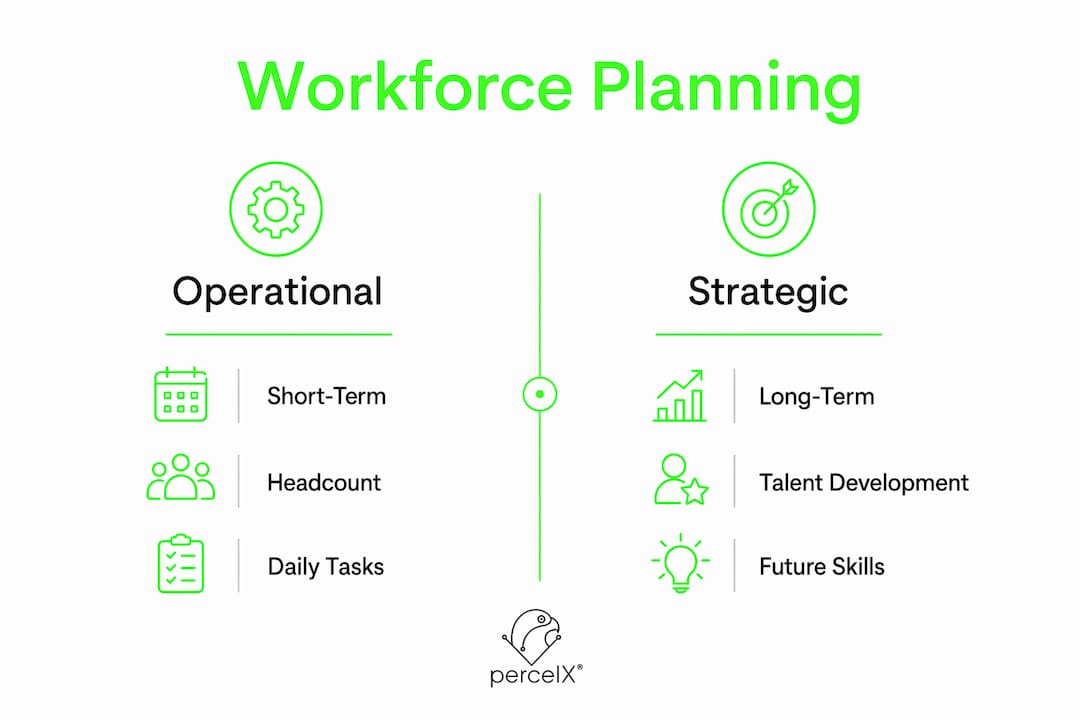
Most organizations already practice operational workforce planning. They track headcount, manage attrition, and fill open roles. Strategic workforce planning, the engine inside transformation planning, operates on a different level entirely. The table below shows the core differences.
| Dimension | Operational workforce planning | Strategic workforce planning |
|---|---|---|
| Time horizon | 0–12 months | 3–6 years |
| Primary focus | Headcount and backfill | Capability and capacity gaps |
| Decision type | Reactive hiring | Buy, build, borrow, or automate |
| Ownership | HR operations | Senior leadership and HR strategy |
| Output | Staffing plans | Talent action plans tied to business goals |
Strategic workforce planning provides the North Star vision needed to guide long-term workforce development decisions. Without it, organizations default to reactive talent management and miss the window to align with technological and business shifts.
Why do workforce transformation initiatives often fail?
Workforce transformation initiatives fail at about a 70% rate because organizations treat them as one-time projects rather than operating model shifts. That statistic is not a warning about ambition. It is a warning about structure. When transformation is scoped as a project, it gets a budget, a deadline, and a project manager. When the deadline passes, the work stops, and the organization reverts.
The most common failure causes follow a recognizable pattern:
- Treating transformation as a project. A project ends. A workforce transformation must become the new way the organization operates.
- Focusing on org charts instead of capacity. Redrawing reporting lines does not change what people can do or how they make decisions.
- Lacking leadership alignment. When senior leaders disagree on the direction, middle managers receive conflicting signals and stall.
- Skipping skills gap analysis. Without a clear picture of current capabilities, talent action plans are built on assumptions.
- Ignoring culture. Behavioral patterns at the team level determine whether new processes actually get used.
The corrective path is equally clear. Organizations that align vision, skills, technology, process, and culture treat transformation as a continuous discipline rather than a finite initiative. That shift in framing changes everything from governance to budgeting to how success gets measured.
Pro Tip: Build a transformation governance board that meets quarterly, not just at project milestones. Continuous review catches drift before it becomes failure.
Embedding behavioral science principles in change management accelerates adoption and sustains workforce changes over time. This means designing new behaviors into daily workflows, not just announcing them in town halls.
How does strategic workforce planning support transformation?
Strategic workforce planning is the operational mechanism inside broader workforce transformation planning. It translates business priorities into four specific talent actions: buy, build, borrow, or automate. These four levers give leaders a concrete decision framework for every capability gap they identify.
The steps for building a strategic workforce plan follow a logical sequence:
- Define the business strategy. Identify where the organization needs to be in three to six years and what capabilities that destination requires.
- Assess the current workforce. Map existing skills, roles, and behavioral patterns against the future state requirements.
- Conduct a gap analysis. Quantify the difference between current capacity and future need by role, skill, and function.
- Build talent action plans. Assign each gap a lever: hire externally (buy), develop internally (build), use contractors or partners (borrow), or redesign the role around automation (automate).
- Set midpoint milestones. Use the three-year mark to evaluate progress and recalibrate the plan based on actual business conditions.
- Integrate AI and technology design. Determine which roles will be augmented by AI and redesign job architectures accordingly.
Future-built companies are 5 times more likely to engage in strategic workforce planning with AI at the core of workforce design. That finding from BCG signals a clear competitive divide. Organizations that plan around AI capabilities from the start build fundamentally different talent pipelines than those that retrofit AI onto existing structures.
Organizations investing in workforce development are 1.8 times more likely to report superior financial results. The financial case for planning for workforce development is not theoretical. It shows up in earnings.
What practical steps help leaders implement workforce transformation?
Execution is where most workforce change management efforts break down. The plan looks sound on paper, but the day-to-day behaviors of managers and employees do not change. The gap between planning and execution closes when leaders treat implementation as a behavioral challenge, not just a process challenge.
The most effective implementation practices share several characteristics:
- Governance with teeth. Assign a senior sponsor who owns transformation outcomes, not just a project manager who tracks tasks.
- Measurable KPIs from day one. Define what success looks like in behavioral terms, not just headcount or training completion rates. Tracking transformation with data gives leaders the feedback loops they need to course-correct.
- Continuous learning embedded in work. Successful upskilling integrates learning into daily work, is behaviorally designed, and includes tracking metrics. Learning that happens only in scheduled workshops rarely transfers to job performance.
- Inclusion as a design principle. Workforce transformation that excludes frontline employees from the design process produces plans that frontline employees resist.
- Technology as an amplifier. The goal of integrating humans and AI is to amplify human capabilities, not replace people. Leaders who communicate this clearly reduce resistance and accelerate adoption.
Adaptive planning checkpoints every 90 days keep the transformation responsive to real conditions. Markets change. Business priorities shift. A plan that cannot adapt is a plan that will eventually be abandoned.
Pro Tip: Assign each upskilling initiative a behavioral outcome, not just a completion metric. "Managers apply coaching techniques in weekly one-on-ones" is measurable. "Managers complete leadership training" is not.
The benefits of workforce transformation programs compound over time when implementation is treated as an ongoing practice rather than a launch event. The organizations that sustain momentum are the ones that build transformation into their operating rhythm.
Key Takeaways
Workforce transformation planning succeeds when it operates as a continuous operating model, not a project, built on skills assessment, leadership alignment, and behavioral change embedded into daily work.
| Point | Details |
|---|---|
| Define transformation broadly | Workforce transformation covers roles, skills, structure, talent strategy, and how work gets done. |
| Plan on a six-year horizon | Use a six-year vision with a three-year midpoint milestone to balance ambition with execution. |
| Apply four talent levers | Buy, build, borrow, or automate to close every capability gap identified in the gap analysis. |
| Treat failure causes as design inputs | The 70% failure rate traces to project thinking, weak leadership alignment, and skipped culture work. |
| Embed learning in daily work | Upskilling that integrates into workflows and tracks behavioral outcomes outperforms scheduled training. |
The uncomfortable truth about workforce transformation I've learned
Most organizations approach workforce transformation planning as a confidence problem. They believe they need more data, a better framework, or a larger budget before they can start. After working with leaders across industries, I've found the real obstacle is almost always behavioral, not analytical.
Leaders know what needs to change. They delay because transformation requires them to confront how their own management behaviors are part of the problem. A skills gap analysis that reveals a leadership capability deficit is not a data problem. It is a personal accountability moment.
The organizations that make real progress are the ones where senior leaders submit to the same assessment process they ask of their teams. They map their own behavioral patterns, identify where their decision-making creates bottlenecks, and build personal development plans alongside the organizational ones. That kind of alignment between individual and organizational transformation is rare. When it exists, the results are unmistakable.
Short-term fixes feel productive. Reorganizations generate activity. Training programs generate completion certificates. Neither changes the underlying behavioral patterns that determine how work actually gets done. The only path to sustainable workforce change runs through honest assessment, clear accountability, and the patience to build capability over years, not quarters.
— Percell
How Percelx supports workforce transformation planning
Percelx is built for the behavioral layer of workforce transformation that most planning frameworks leave unaddressed. The Percelx Behavioral Intelligence Platform uses a 360° assessment approach to reveal the hidden behavioral patterns that shape leadership decisions, team dynamics, and individual performance. Those patterns are the foundation of any credible workforce transformation plan. Percelx delivers customized transformation plans instantly, giving HR leaders and business leaders the specific, personalized data they need to move from gap analysis to targeted action. With a 4.9-star satisfaction rating, Percelx turns behavioral insight into measurable performance outcomes across professional development, leadership, and team alignment.
FAQ
What is workforce transformation planning?
Workforce transformation planning is the long-term process of aligning an organization's workforce capabilities, roles, and culture to its future business goals. It integrates skills mapping, technology enablement, and cultural alignment into a single strategy.
How is workforce transformation different from workforce planning?
Workforce planning manages near-term headcount and hiring. Workforce transformation planning operates on a three-to-six-year horizon and redesigns roles, skills, processes, and organizational capacity to support a future business model.
Why do most workforce transformation efforts fail?
Research shows a 70% failure rate, primarily because organizations treat transformation as a one-time project rather than a continuous operating model shift. Weak leadership alignment and skipping culture work are the two most common contributing factors.
What are the four talent action levers in strategic workforce planning?
The four levers are buy (external hiring), build (internal development), borrow (contractors or partners), and automate (redesigning roles around technology). Each lever addresses a specific type of capability gap identified in the planning process.
How do you measure workforce transformation success?
Effective measurement tracks behavioral outcomes, not just training completion rates. KPIs should include changes in decision-making patterns, skill application on the job, and business performance metrics tied directly to the transformation goals.