

Leadership style is the manner in which a leader directs, motivates, and influences their team, and it fundamentally shapes team dynamics and performance outcomes. What is leadership style impact on teams? The answer is measurable: leaders explain at least 70% of the variance in employee engagement scores. That single figure tells you your approach to leading is not a soft skill. It is the primary driver of how your team communicates, makes decisions, stays motivated, and produces results. The five most studied styles are transformational, transactional, autocratic, democratic, and servant leadership. Each produces a distinct pattern of team behavior, and understanding those patterns is the foundation of intentional leadership.
What is leadership style impact on teams: communication and decision-making
The way you lead directly controls how information flows inside your team. Transformational leaders create open communication channels by connecting individual goals to a shared vision. Team members speak up, challenge ideas, and contribute to decisions because they feel their input matters. Transactional leaders, by contrast, structure communication around task completion and reward systems. Dialogue tends to stay task-focused, which works well for clear deliverables but can limit creative exchange.
Autocratic leadership centralizes decision-making in one person. Speed increases because there is no consensus process, but team morale often drops when members feel excluded from choices that affect their work. Democratic and participative leadership styles do the opposite. They distribute voice across the team, producing more inclusive dialogue and stronger buy-in. The tradeoff is time. Participative decisions take longer, which matters in fast-moving environments.
Here is how each style shapes communication and decision-making in practice:
- Transformational: Open, vision-driven dialogue; team members co-create solutions
- Transactional: Structured, task-focused exchanges; rewards tied to performance milestones
- Autocratic: Top-down directives; fast execution but limited team input
- Democratic: Collaborative discussion; high buy-in but slower resolution
- Servant: Leader facilitates team voice; decisions emerge from team needs
Pro Tip: If your team faces a high-stakes deadline, temporarily shift toward a more directive style for clarity, then return to a participative approach once the pressure eases. Labeling the shift openly prevents confusion.
Leadership effectiveness depends on contextual fit, meaning no single communication style works across every scenario. The leaders who produce the best team outcomes are those who read the situation and adjust their approach accordingly.
How leadership styles affect team motivation, cohesion, and creativity
Leadership style is the single strongest organizational predictor of team creativity and cohesion. A meta-analysis of 232 studies covering 98,769 participants found that strategic, shared, transformational, empowering, and inclusive leadership styles all significantly increase team creativity. Abusive leadership harms it. That is not a marginal finding. It represents the clearest evidence available that your behavioral patterns as a leader either build or erode your team's capacity to generate new ideas.

Servant and inclusive leadership styles produce particularly strong effects on trust and loyalty. When team members believe their leader genuinely prioritizes their growth, they reciprocate with discretionary effort. That effort shows up in cohesion: teams stick together through setbacks, cover for each other, and maintain momentum under pressure. You can see real examples of this dynamic in measurable employee transformation case studies where leaders shifted their behavioral patterns and saw direct gains in team output.
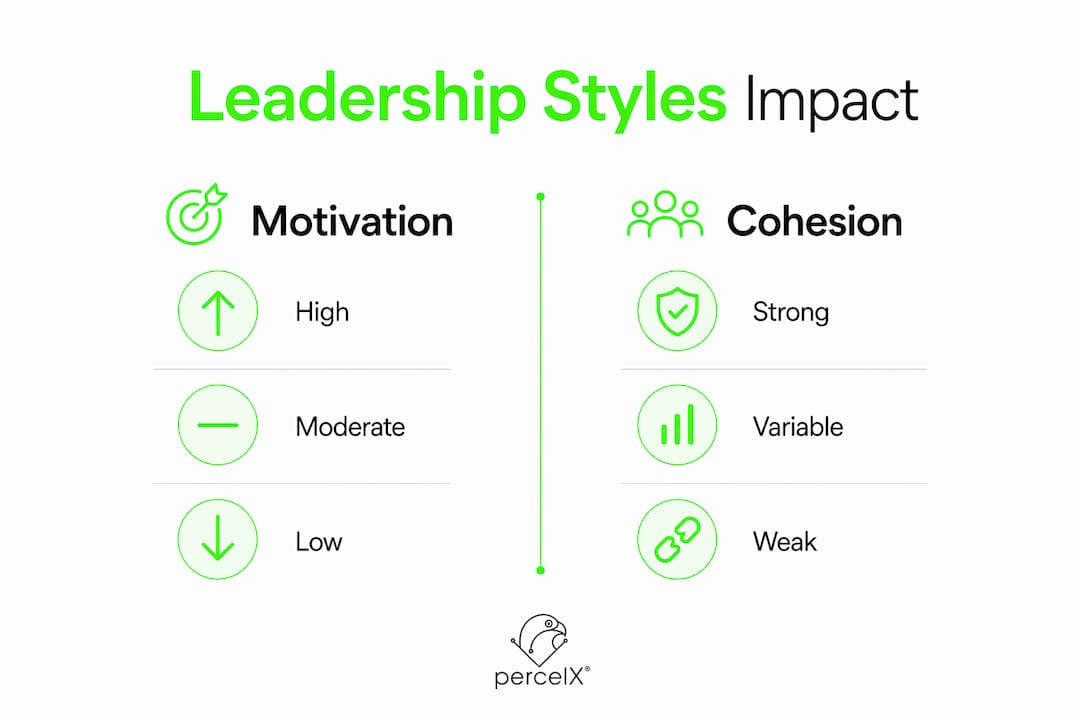
Transactional leadership plays a different but equally important role. It excels at individual task performance through clear reward structures. Where transformational leadership builds the emotional foundation of a team, transactional leadership keeps the operational engine running.
| Leadership style | Effect on motivation | Effect on cohesion | Effect on creativity |
|---|---|---|---|
| Transformational | High intrinsic motivation | Strong team unity | Significantly positive |
| Transactional | Task-based, reward-driven | Moderate | Neutral to low |
| Autocratic | Can suppress motivation | Often fragmented | Negative |
| Democratic | High ownership | Strong | Positive |
| Servant | Deep loyalty | Very strong | Positive |
| Abusive | Severely negative | Destructive | Significantly negative |
Transformational leadership drives cohesion and innovation, but transactional leadership remains essential for task-focused performance stability. The strongest teams operate under leaders who blend both.
Pro Tip: Audit your last five team interactions. Count how many were vision-focused versus task-focused. If the ratio skews heavily toward tasks, your team may be losing the motivational fuel that drives creative output.
Does emotional intelligence change how leadership styles affect teams?
Emotional intelligence is the variable that separates average leaders from exceptional ones. Emotional intelligence enhances transformational leadership, producing better trust, motivation, and psychological safety in teams. The effect sizes in this research are moderate to high, meaning the difference is practically significant, not just statistically interesting.
A leader with high emotional intelligence reads the emotional state of the room before choosing how to communicate. They recognize when a team member is disengaged and address it directly rather than letting it fester. They calibrate their style in real time. This is what separates situational leadership theory from rigid style adherence. Situational leadership teaches you to assess each team member's competence and commitment per task, then match your approach to that specific combination.
Key factors that shape how leadership style lands with your team:
- Team maturity: Veteran teams with high competence need empowering, hands-off leadership. New teams need more structure and direction.
- Task complexity: Novel, ambiguous tasks benefit from transformational and democratic approaches. Routine tasks respond well to transactional clarity.
- Psychological safety: Teams with low trust need servant or inclusive leadership before they can absorb transformational vision.
- Organizational culture: A culture that punishes failure will undermine even the best transformational leader.
Empowering leadership builds trust and enables team autonomy, which improves performance over time. This reciprocal dynamic means your leadership style does not just affect your team. Your team's response shapes how you lead next. Leadership is a two-way behavioral system, not a one-directional broadcast.
Understanding how organizations identify leadership potential increasingly involves assessing emotional intelligence alongside technical competence. That shift reflects what the research confirms: style without self-awareness produces inconsistent results.
Practical strategies for matching your leadership style to your team
Improving your leadership impact starts with an honest assessment of where your team is right now. Follow these steps to align your style with your team's actual needs.
-
Map your team's current state. Identify each team member's competence level and motivation for their primary tasks. High competence and high motivation calls for delegation. Low competence and high motivation calls for coaching. This mapping prevents the most common leadership mistake: applying one style to everyone.
-
Develop your emotional intelligence deliberately. Emotional intelligence training combined with transformational leadership development maximizes team effectiveness and long-term commitment. Start with self-regulation: before your next difficult conversation, pause for ten seconds and name the emotion you are feeling. That pause changes the quality of what follows.
-
Blend transformational and transactional elements. Use transformational communication to set vision and meaning. Use transactional structures to track milestones and recognize achievement. Neither style alone produces peak performance. The combination does.
-
Build shared leadership into your team design. Teams gain performance benefits when allowed to select leaders based on required motivational or coordination focus. Rotate project leadership based on expertise. Let the person with the deepest knowledge lead that phase. This builds trust and develops leadership capacity across your team.
-
Reassess regularly. Teams change. A team that needed directive leadership six months ago may now need empowerment. Schedule a quarterly check-in specifically to evaluate whether your current style still fits your team's maturity and the demands of the work.
-
Seek behavioral feedback. Ask your team directly how your communication style affects their ability to do their best work. Most leaders never ask this question. The ones who do get information that no performance review captures.
Key Takeaways
The most direct answer to what is leadership style impact on teams is this: your style shapes engagement, creativity, cohesion, and performance more than any other single organizational factor.
| Point | Details |
|---|---|
| Engagement variance | Leaders explain at least 70% of the variance in employee engagement scores. |
| Creativity and style | Transformational, inclusive, and empowering styles significantly increase team creativity; abusive leadership destroys it. |
| Emotional intelligence | Developing emotional intelligence alongside leadership skills produces stronger trust and psychological safety. |
| No universal style | Contextual fit matters more than style category; adapt your approach to team maturity and task demands. |
| Blend styles | Combining transformational vision with transactional structure produces the most consistent team performance. |
What I've learned about leadership style that most articles won't tell you
The research on leadership styles is clear, but the practice is messier than any framework suggests. After working with leaders across industries, the pattern I see most often is not bad leadership. It is rigid leadership. A leader who is genuinely transformational in calm periods often reverts to autocratic behavior under pressure. That reversion is where teams lose trust, and trust is extraordinarily slow to rebuild.
The reciprocal nature of leadership is the insight that changes everything. Your team is not a passive recipient of your style. They are actively shaping your behavior through their responses, their silence, their energy. When you recognize that dynamic, you stop asking "What is my leadership style?" and start asking "What is this team pulling out of me right now, and is that serving us?"
Emotional intelligence is not a personality trait you either have or lack. It is a skill set you build through deliberate practice. The leaders I have seen produce the most consistent team results are not the most charismatic or the most technically brilliant. They are the ones who stay curious about their own behavioral patterns and honest about the gap between their intentions and their impact. That self-awareness, combined with the willingness to adapt, is what team-level transformation actually looks like in practice.
My strongest recommendation: stop treating leadership style as a fixed identity. Treat it as a set of tools. The best leaders carry all of them and choose based on what the moment requires.
— Percell
How Percelx helps leaders measure and shift their impact on teams
Understanding your leadership style is one thing. Seeing exactly how your behavioral patterns affect your team's performance is another.
Percelx is a Behavioral Intelligence and Performance Transformation Platform built for leaders who want that second layer of clarity. Its 360° assessment approach surfaces the hidden behavioral patterns driving your decision-making, communication, and leadership impact. You get a customized transformation plan instantly, not a generic report. For team leaders and managers, the Percelx for Teams solution translates behavioral data into specific, measurable steps for improving team dynamics. With a 4.9-star satisfaction rating, Percelx delivers the kind of personalized insight that turns self-awareness into real performance gains. Visit percelx.org to see how it works for your team.
FAQ
What is leadership style impact on teams?
Leadership style impact on teams refers to how a leader's approach to directing and motivating people shapes team communication, motivation, cohesion, and performance. Leaders explain at least 70% of the variance in employee engagement, making leadership style the most significant organizational driver of team outcomes.
Which leadership style is best for team performance?
No single style is universally best. Research shows that contextual fit matters more than style category, and blending transformational vision with transactional structure consistently produces the strongest results across performance criteria.
How does emotional intelligence affect leadership impact on teams?
Emotional intelligence strengthens transformational leadership by improving trust, motivation, and psychological safety. Leaders who develop emotional intelligence alongside their leadership skills produce better team effectiveness and long-term commitment.
Does autocratic leadership always harm team performance?
Autocratic leadership reduces morale and creativity in most contexts, but it can improve speed and clarity during crises or when teams need immediate direction. The harm comes from applying it rigidly across all situations rather than as a temporary, context-specific tool.
How can leaders adapt their style to different teams?
Situational leadership teaches assessing each team member's competence and commitment per task, then matching your approach to that combination. Veteran, high-competence teams benefit from empowering, hands-off leadership, while newer teams need more structure and direct guidance.