

Feedback is the fastest path to professional growth you are probably underusing. When delivered with specificity and credibility, feedback gives you a precise map of the gap between where your performance stands and where it needs to go. Meta-analysis research confirms that feedback produces a measurable, medium-to-high positive effect on performance, with many recipients outperforming peers who received no feedback at all. The key word is specific. Generic praise or vague criticism does almost nothing. What moves the needle is targeted, behavior-focused information delivered by a credible source, close in time to the observed behavior.
The role of feedback in professional growth comes down to four core functions:
- Clarifying expectations: Feedback tells you exactly what "good" looks like in your role.
- Identifying skill gaps: It surfaces the behavioral patterns holding you back before they become career-limiting habits.
- Sustaining motivation: Clear feedback on progress reinforces effort and builds self-efficacy.
- Driving self-regulation: It teaches you to monitor your own performance between formal reviews.
For feedback to work, three conditions must be present. The source must be credible, someone whose judgment you respect and who has directly observed your behavior. The timing must be close to the event, not six months later in an annual review. And the content must be specific enough to act on.
How feedback drives your career development
The benefits of consistent, well-structured feedback compound over time. Each piece of quality input adds to a clearer picture of your behavioral patterns, your strengths, and the gaps that are quietly limiting your trajectory.
Here is what the research shows feedback actually does for your career:
- Builds self-awareness: You cannot fix what you cannot see. Feedback from credible observers surfaces blind spots that self-assessment alone will miss.
- Sharpens goal alignment: Effective feedback supports growth goal setting by helping you connect daily behaviors to longer-term career objectives.
- Increases engagement: When you understand the success criteria for your role, you invest more deliberately in meeting them. Feedback clarifies those criteria in real time.
- Builds a growth mindset: Professionals who receive regular developmental feedback learn to treat performance gaps as problems to solve, not verdicts on their ability.
- Accelerates skill acquisition: Feedback delivered during or immediately after a task, rather than weeks later, supports continuous skill refinement far more effectively than infrequent formal assessments.
- Strengthens resilience: Feedback that is framed around effort and process, rather than fixed traits, builds your sense of control over outcomes.
Research callout: Positive feedback consistently outperforms negative feedback in improving performance. Excess negative feedback triggers defensiveness, which shuts down the receptivity you need to actually grow.
The professionals who advance fastest are not the ones who avoid feedback. They are the ones who actively seek it, process it without ego, and build it into their development plans.
What types of feedback actually move performance?

Not all feedback is equal, and using the wrong type at the wrong moment can stall progress rather than accelerate it. Understanding the landscape of feedback types lets you request the right kind and interpret what you receive more accurately.
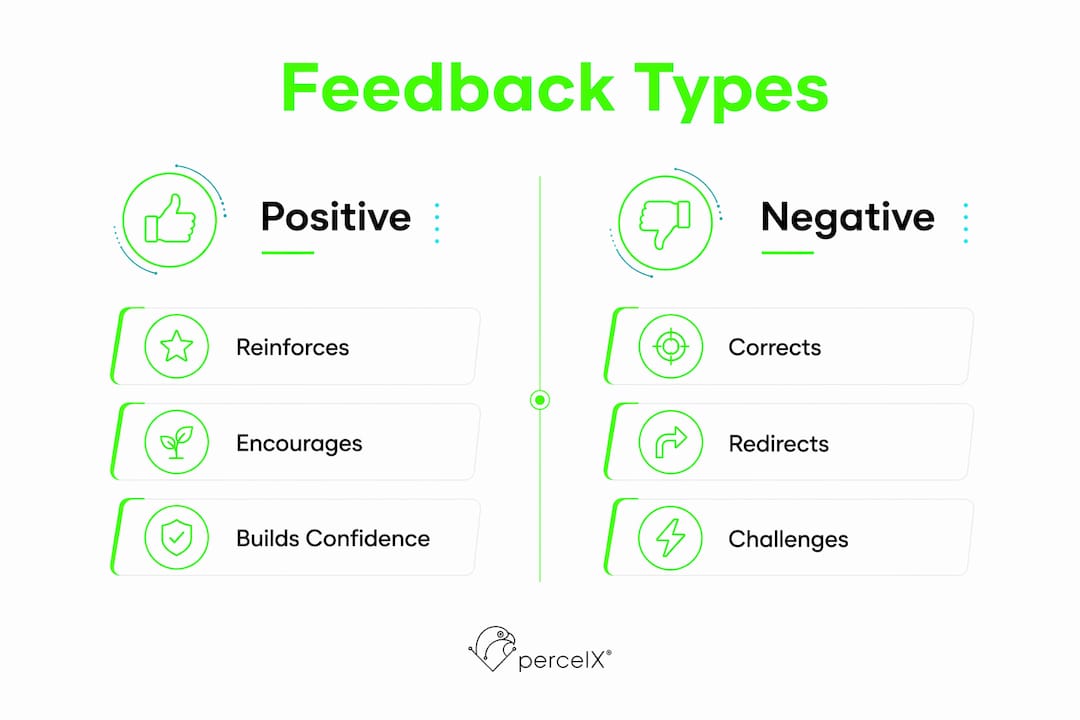
Positive vs. negative feedback
Positive feedback reinforces behaviors worth repeating. It is not empty praise. It is specific confirmation that a particular action produced a good outcome, which tells your brain to encode that behavior. Negative feedback, when delivered with care, corrects course. The problem is that over one-third of feedback instances can worsen performance when recipients feel judged rather than supported. The ratio and the relationship both matter.
Formative vs. summative feedback
- Formative feedback is developmental and ongoing. It arrives during the process, while you still have time to adjust. This is the type that drives real growth.
- Summative feedback evaluates a completed performance against a standard. It is useful for understanding outcomes but less useful for changing behavior in the moment.
Distinguishing formative from summative feedback is one of the most underrated skills in professional development. When you treat a summative evaluation as if it were formative guidance, you miss the point of both.
Task, process, and self-regulation feedback
- Task-level feedback addresses whether a specific output met the standard. Best used early in learning a new skill.
- Process-level feedback focuses on the strategies and effort behind the output. More useful as you gain proficiency.
- Self-regulation feedback prompts you to monitor your own thinking and adjust independently. This is the highest-leverage type for experienced professionals, because it builds the internal compass that makes you less dependent on external input over time.
How to ask for, receive, and act on feedback professionally
Most professionals wait for feedback to come to them. That is a slow strategy. The ones who grow fastest treat feedback as something they actively engineer, not passively receive.
Asking for high-quality feedback

The quality of feedback you get depends almost entirely on how you ask for it. Vague questions produce vague answers. Specific, behavior-focused questions elicit far more useful responses than general performance inquiries. Instead of "How am I doing?" try "In that client presentation, was my framing of the risk section clear enough to support a decision?"
Receiving feedback without shutting down
Defensiveness is the single biggest barrier to using feedback well. When you feel judged rather than supported, your brain treats the input as a threat and filters it out. A few practices that help:
- Pause before responding. Let the information land before you evaluate it.
- Separate the message from the delivery. Even poorly delivered feedback can contain accurate observations.
- Ask clarifying questions rather than counter-arguments. "Can you give me a specific example?" keeps the conversation productive.
- Acknowledge what resonates, even partially. You do not have to agree with everything to extract value.
Turning feedback into a development plan
Receiving feedback is not the same as using it. After a meaningful feedback conversation, write down the two or three behavioral changes most worth prioritizing. Connect each one to a specific goal in your professional transformation planning. Then schedule a follow-up to check whether the change is visible to the person who gave you the feedback.
Common mistakes that block growth
- Collecting feedback without acting on it, which signals to others that the process is performative.
- Seeking only positive feedback from people who will not challenge you.
- Treating all feedback as equally valid regardless of the source's credibility or proximity to your work.
- Waiting for annual reviews instead of building feedback into weekly or monthly rhythms.
Pro Tip: Create a standing "feedback agenda" with two or three people whose judgment you trust. Meet with them quarterly, bring specific behavioral questions, and track your responses over time. This turns feedback from a reactive event into a structured growth system.
Feedback vs. coaching: what is the difference and why it matters
Professionals often use "feedback" and "coaching" interchangeably. They are related, but they are not the same thing, and confusing them leads to mismatched expectations on both sides of the conversation.
Feedback is an educational tool. It points to observed behaviors, specific and time-bound, with the intent to inform and improve. A manager who tells you after a meeting that your data framing was unclear is giving you feedback. Coaching is a developmental philosophy. It is a longer-term relationship built on trust, reflection, and co-created goals. A coach uses feedback as one tool among many, alongside direct observation, goal-setting, and structured reflection over time.
| Dimension | Feedback | Coaching |
|---|---|---|
| Time horizon | Immediate or near-term | Long-term, ongoing |
| Focus | Specific observed behavior | Overall development and potential |
| Relationship | Can be one-time or infrequent | Built on sustained trust and rapport |
| Goal | Correct or reinforce a behavior | Build capacity for self-directed growth |
| Mindset required | Openness to input | Growth mindset, willingness to reflect |
| Initiated by | Observer or supervisor | Coach and learner together |
The practical implication: you need both. Feedback without coaching gives you data points but no developmental arc. Coaching without quality feedback gives you a relationship but no reliable signal about actual performance. The most effective growth mindset cultures integrate both, with feedback flowing continuously and coaching providing the framework that makes that feedback meaningful.
One more distinction worth holding onto: coaching relationships require psychological safety in a way that single feedback exchanges do not. When a coach and professional build genuine trust over time, the vulnerability required for honest performance conversations feels less threatening. That safety is what allows coaching to reach the behavioral patterns that surface-level feedback never touches.
How Percelx uses 360° assessments to personalize your growth
Most feedback systems give you a snapshot. Percelx gives you a pattern. The difference is the difference between knowing you missed a target and understanding the behavioral architecture that caused it.
360° feedback collects input from multiple sources simultaneously: peers, direct reports, supervisors, and self-assessment. This multi-source approach surfaces the blind spots that single-source feedback consistently misses. A manager may see your strategic thinking clearly but have no visibility into how your communication lands with your team. A peer sees something different again. The 360-degree process integrates all of those perspectives into a coherent picture of your behavioral patterns across contexts.
Percelx takes that foundation further. Its platform analyzes the data from multi-source assessments to identify the specific behavioral gaps affecting your decision-making, leadership presence, and performance outcomes. The result is not a generic development report. It is a personalized transformation plan, delivered immediately, built around your actual patterns rather than a population average.
The benefits of this approach over generic feedback processes include:
- Specificity at the behavioral level: You see exactly which patterns are driving outcomes, not just that outcomes need to improve.
- Multi-perspective alignment: Discrepancies between how you see yourself and how others experience you become visible and addressable.
- Personalized development priorities: Your growth plan reflects your actual gaps, not a standard competency framework applied to everyone.
- Measurable progress tracking: Because the assessment is behavioral and specific, you can measure transformation progress over time with real data.
- Immediate delivery: Percelx generates your customized plan instantly, so momentum does not stall between assessment and action.
Percelx carries a 4.9-star satisfaction rating, reflecting the precision of its assessments and the quality of the development support it provides.
Pro Tip: When you receive your 360° assessment results, resist the urge to focus only on your lowest scores. The most powerful growth often comes from understanding the behavioral patterns connecting your strengths and your gaps. That connection is where your transformation plan should start.
The Percelx platform is built for professionals who are serious about turning feedback into measurable behavioral change, not just awareness.
Ready to move from reactive to intentional? Percelx's behavioral intelligence platform delivers the personalized 360° assessment your career development actually needs.
Key Takeaways
Feedback drives professional growth only when it is specific, timely, and delivered within a relationship of trust, making the quality of feedback far more important than the quantity.
| Point | Details |
|---|---|
| Feedback quality over quantity | High-information, specific feedback drives growth; generic praise or criticism produces little measurable change. |
| Timing accelerates learning | Feedback delivered close to the observed behavior supports continuous skill refinement better than infrequent formal reviews. |
| Positive feedback outperforms negative | Positive feedback improves performance more reliably; excess negative feedback triggers defensiveness and can worsen outcomes. |
| Feedback and coaching are distinct | Feedback addresses specific behaviors in the moment; coaching builds long-term capacity through sustained trust and reflection. |
| 360° assessments reveal hidden patterns | Multi-source feedback surfaces blind spots and behavioral patterns that single-source input consistently misses. |